A Beginner’s Guide to Replacing a Golf Cart Battery Pack
Prove the pack is really finished with five quick tests, then pick the one lithium pack that replaces it by voltage, tray size and the way you use the cart.
- Test before you buy. A charger that never finishes, a loose cable or one weak battery causes many “dead pack” carts. Five checks settle it.
- Voltage picks the section, not the badge. Count the batteries: six 6V is 36V, six 8V or four 12V is 48V, six 12V is 72V.
- One lithium pack replaces the set. 38.4V for a 36V cart, 51.2V for 48V, 76.8V for 72V. We sell Lithium Rhino and MODZ, not lead-acid.
- Measure the tray. Every row gives the pack’s enclosure size; the shape that fits matters as much as the capacity.
- Pick capacity for your day, and a heated pack if the cart charges below freezing. Use the charger that comes with the pack.
The cart does not go as far as it used to, or it dies on the hill home, and someone has told you the batteries are gone. Maybe they are. Here is the 30-second answer to golf cart battery replacement: run the five tests below first, because a charger, a cable or one weak battery often causes the same symptoms; if the pack fails them, count the batteries to find your voltage, measure the tray and find your use in the tables. One lithium pack at the same voltage replaces the whole lead-acid set. Every row says why it fits and whether you need anything else.
- What This Guide Helps You Do
- Is It Really the Pack? Symptoms That Do and Do Not Point to It
- Confirm the Pack Is Done: Five Tests Before You Buy
- Quick Picks: Replacement Packs for the Most Common Carts
- Golf Cart Battery Replacement: A New Lead-Acid Set or One Lithium Pack
- 36V Carts: Six 6-Volt Batteries
- 48V Carts, Short Trips: The Smaller Packs
- 48V Carts, Everyday Range: 105Ah and 120Ah Packs
- 48V Carts, Long Days and Lifted Carts: 170Ah and 175Ah Packs
- 72V Carts: Six 12-Volt Batteries
- How Many Amp-Hours: Sizing the Pack to the Job
- What Else to Check and Order to Finish the Job
- Six Mistakes That Waste a New Battery Pack
- Still Not Sure? Three Quick Checks
- Frequently Asked Questions
What This Guide Helps You Do
A battery pack is the most expensive thing on a golf cart that wears out by design, and it is also the part most often blamed for faults that live somewhere else. This guide does two jobs, in this order. First it helps you prove the pack is really done, with the tests our repair guides use. Then it shows you exactly which lithium pack to buy for your cart’s voltage, tray and daily use, with the reasoning shown on every row.
You need three facts before you start:
- Your pack voltage. Count the batteries and read one label. Six 6V batteries make 36V; six 8V or four 12V batteries make 48V; six 12V batteries make 72V. A single lithium pack says its voltage on the case: 38.4V is a 36V pack, 51.2V a 48V pack, 76.8V a 72V pack.
- Your tray size. With the old batteries out, measure the tray length and width and the height up to the seat frame or anything above it. Every row below gives the pack’s published enclosure size to compare against.
- How you use the cart. Short trips on flat ground, a full day with hills, a rear seat or a lift kit, and whether it is charged in a cold garage. That picks the capacity and whether you want built-in heating.
Run the checks in the next two sections first. When they point at the pack, jump to your voltage:
How to read the tables: Your cart gives the pack voltage, the battery count in bold and the tray space the pack needs. Your goal names the job, Buy this links the pack, Why this one gives the published energy, discharge and weight, and What else you need lists anything not in the box. Where two packs suit the same job, each gets its own row.
Is It Really the Pack? Symptoms That Do and Do Not Point to It
Batteries do wear out: flooded lead-acid plates sulfate and shed, and a single weak battery drags the whole series string down with it. But range and power depend on the charger, the cables and the connections too, and a fault in any of them feels like a tired pack from the driver’s seat.
| What the cart does | Usually the pack? | More often it is | Test it with |
|---|---|---|---|
| Range has shrunk slowly over a season or two | Often | An ageing pack, or one weak battery limiting the rest | Tests 3 and 4 |
| Short range right after a new charger or a power cut | Rarely | The charger or the Club Car OBC not finishing the charge | Charger not charging fault tree |
| Dies or slows hard on hills, fine on the flat | Sometimes | One battery collapsing under load, or a loose or corroded cable | Voltage drop test, then test 4 |
| Gauge or meter says full, cart dies early | Sometimes | Surface charge hiding a dead cell | Dead cell but says 100 percent |
| Pack is flat after a few days parked | Rarely | A parasitic draw: a meter, radio, converter or a sticky switch | Parasitic draw test |
| One terminal hot, melted or blue with corrosion | Sometimes | A loose or corroded connection cooking the post | Terminal melting causes |
| Lithium pack cuts out under load or will not take a charge in the cold | Rarely | The battery management system (BMS) protecting the cells | BMS guide |
Still guessing? Start the golf cart troubleshooter with your symptom; it narrows the cause before you pick up a meter.
Confirm the Pack Is Done: Five Tests Before You Buy
Work through these in order with a digital multimeter, and a hydrometer if the batteries are flooded. Every test either clears the pack or condemns it. Wear safety glasses and gloves, take off rings and watches, and put the cart in tow before touching any terminal.
- Prove the charge. Charge the pack fully and let the charger finish on its own. If it will not start, shuts off early or never finishes, the fault may be the charger or, on a Club Car, the onboard computer (OBC); our charger fault tree settles it before you blame the batteries.
- Read the pack at rest. After the charge, let the pack sit a few hours and read the voltage across the whole pack. A full flooded lead-acid pack rests around 38.1V on a 36V cart and 50.8V on a 48V cart; about 36.6V and 48.8V means it is only half full. The battery voltage chart turns your reading into a state of charge. A pack that will not rest near full after a complete charge is failing or is not being charged properly.
- Find the weak battery. Read each battery on its own. On flooded batteries, the hydrometer is more honest than the meter: a full cell reads 1.277 to 1.285, a healthy pack sits inside a 0.030 band, and a cell more than 0.050 below the others marks a failing battery. Our hydrometer guide shows how to take and temperature-correct the reading.
- Load test the pack. Resting voltage can look fine while a battery collapses the moment the cart pulls. Under the same load, read every battery at the same time: the one that sags first is the one limiting the pack. The published endpoints are 5.25V for a 6V battery, 7.00V for an 8V and 10.50V for a 12V at the test current, and a battery that reaches its endpoint in under half its rated runtime is poor. The voltage bounce test walks it step by step.
- Clear the cables and connections. Clean every post, tighten every lug and run a voltage drop test across each cable under load. A hot or corroded connection steals power and looks exactly like a weak pack. On a lithium pack, read the BMS display or app for a fault or a low cell before condemning it; our BMS communication guide covers packs that talk to the cart.
If the pack charged fully, the cables passed and one or more batteries still failed tests 3 or 4, the pack is the part to replace. Replace lead-acid batteries as a set: mixing old and new flooded batteries drags the new ones down toward the weakest unit. If a test pointed at the charger instead, the charger guide is where to go next.
Quick Picks: Replacement Packs for the Most Common Carts
Tests done and the pack is finished? Here are the packs for the jobs we see most often. The sections further down give the reasoning and every other option.
| Your cart and use | Replace it with | Also an option |
|---|---|---|
| 36V cart, six 6V batteries, everyday use | Lithium Rhino 38.4V 65Ah | The MODZ 38.4V 60Ah Nano, or the 105Ah Rhino for more range |
| 48V cart, neighborhood trips on flat ground | Lithium Rhino 51.2V 65Ah | The 50Ah Rhino for the smallest tray, or the MODZ 60Ah Nano |
| 48V cart, a full day of use, the most common choice | Lithium Rhino 51.2V 105Ah CUBE | The MODZ 105Ah Nano, or the MODZ 105Ah Slim for a long, narrow tray |
| 48V cart with a rear seat, a lift or long days with hills | Lithium Rhino 51.2V 170Ah Goliath | The MODZ 175Ah Blade or the 120Ah Rhino |
| 48V cart charged in a garage that drops below freezing | Lithium Rhino 51.2V 120Ah Heated | Any pack marked heated in the tables below |
| 72V cart, six 12V batteries | Lithium Rhino 76.8V 105Ah | The 170Ah Godzilla for the most range we sell |
Golf Cart Battery Replacement: A New Lead-Acid Set or One Lithium Pack
There are two ways to replace a finished pack, and we only sell one of them. Here is what each involves, so you can choose with the full picture.
A new set of lead-acid batteries
The same count and voltage as the old set, bought and fitted together. The cart, charger and wiring stay as they are. We do not sell lead-acid batteries; a local battery supplier or cart dealer is the place for a matched set.
One lithium pack in place of the whole set
A single LiFePO4 pack at the same system voltage replaces all the batteries. It weighs a fraction of the lead-acid set, needs no watering and comes with its own charger. This is what we sell, from Lithium Rhino and MODZ.
Charger, converter and display in the box
Each Rhino bundle brings a lithium-rated charger, a DC-DC converter for 12V accessories, a state-of-charge display, mounting hardware and cables. Rhino publishes energy and discharge figures for every pack.
Onboard charger and brackets in the box
Each MODZ bundle charges through a UL-certified 20A onboard charger and brings universal brackets and a display. It has no 12V converter, and an E-Z-GO RXV needs separate MODZ RXV hardware.
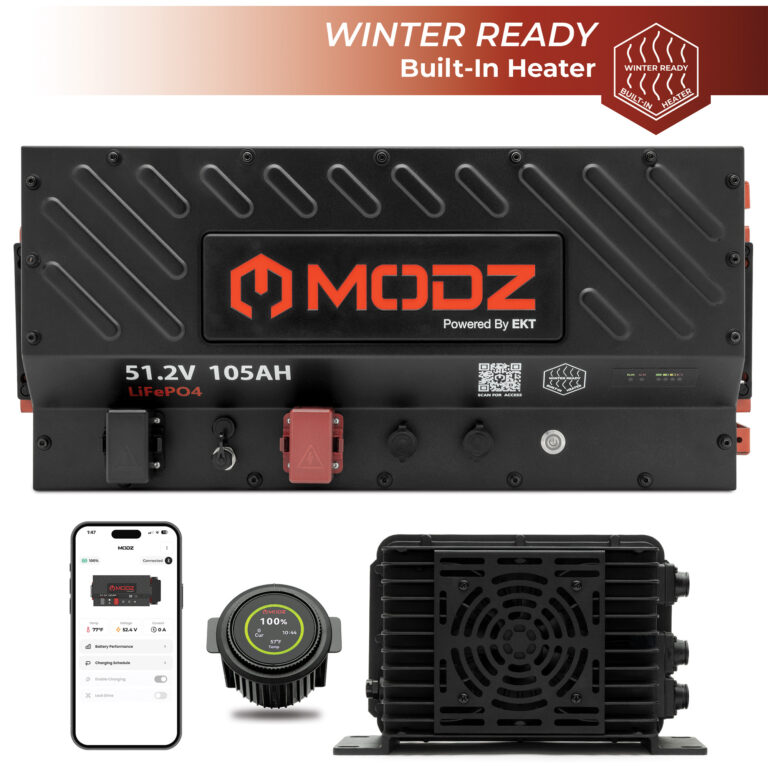
Three things decide which lithium pack fits, and every listing says so: the system voltage (38.4V for 36V carts, 51.2V for 48V, 76.8V for 72V), the tray space against the published enclosure size, and what the controller asks of the pack. The badge on the cart does not decide it. A lithium pack reads a little higher than the lead-acid set it replaces because of its cell chemistry; our guide to 48V and 51.2V batteries explains why a 51.2V pack runs a 48V cart. If you are comparing lithium brands beyond the two we sell, our lithium battery buyer’s guide covers the market.
Parts note: A typical Route 2 replacement: one MODZ 51.2V 105Ah pack with an onboard charger in place of a 48V lead-acid set. See the MODZ 105Ah Nano
36V Carts: Six 6-Volt Batteries
If your cart runs six 6V batteries, it is a 36V cart, like many older E-Z-GO TXT, Club Car DS and Yamaha G-series carts. The replacement is a 38.4V lithium pack. For everyday use the 65Ah Rhino is the compact choice and the MODZ 60Ah Nano is the alternative with an onboard charger; for longer days the 105Ah Rhino holds about 60 percent more energy.
A 38.4V pack keeps the cart at 36V; it does not convert it to 48V. If you want 48V, that is a bigger job with a new controller, solenoid and charger, covered in our 36V to 48V guide.
| Your cart | Your goal | Buy this | Why this one | What else you need |
|---|---|---|---|---|
| 36V cart, six 6V batteries, tray at least 12.5 x 10.0 x 9.0 in | Everyday range | Lithium Rhino 38.4V 65Ah | The compact 36V pack. 2,496Wh, 150A continuous and 300A peak, about 49 lb. | Nothing. The lithium charger, DC-DC converter, state-of-charge display, mounting hardware and cables are in the box. |
| 36V cart, six 6V batteries, tray at least 14.0 x 13.8 x 11.0 in | Everyday range | MODZ 38.4V 60Ah Nano | The MODZ 36V pack, charged through its onboard charger. IP66, about 69 lb. MODZ does not publish a discharge figure in the specs we hold. | Nothing for the pack itself: the onboard charger, brackets and display are in the box. A 48V to 12V converter only if you run 12V lights or accessories. An E-Z-GO RXV needs MODZ RXV mounting hardware, not in this box. |
| 36V cart, six 6V batteries, tray at least 15.4 x 13.4 x 9.3 in | Long days, hills or a rear seat | Lithium Rhino 38.4V 105Ah | The most 36V energy we sell. 4,032Wh, 200A continuous and 500A peak, about 80 lb. | Nothing. The lithium charger, DC-DC converter, state-of-charge display, mounting hardware and cables are in the box. |
We do not list a heated 36V pack or a 36V pack larger than 105Ah. If your cart charges below freezing, store it somewhere warmer or charge it once the pack has warmed up.
48V Carts, Short Trips: The Smaller Packs
If your cart runs six 8V or four 12V batteries and mostly makes short trips on flat ground, a campground, a gated neighborhood or a few holes, a small 51.2V pack does the job and fits the tightest trays. The 50Ah Rhino has the smallest case we sell. The 65Ah Rhino holds about 30 percent more energy, and the MODZ 60Ah Nano is the onboard charger alternative.
Small packs have lower discharge limits, so they suit stock carts on flat ground rather than lifted carts or upgraded controllers; the sizing section explains.
| Your cart | Your goal | Buy this | Why this one | What else you need |
|---|---|---|---|---|
| 48V cart, six 8V or four 12V batteries, tray at least 10.4 x 7.1 x 11.6 in | Short trips, smallest pack | Lithium Rhino 51.2V 50Ah | The smallest case we sell, for light use. 2,560Wh, 100A continuous and 150A peak, about 44 lb. | Nothing. The lithium charger, DC-DC converter, state-of-charge display, mounting hardware and cables are in the box. |
| 48V cart, six 8V or four 12V batteries, tray at least 14.0 x 10.0 x 9.0 in | Short trips, smallest pack | Lithium Rhino 51.2V 65Ah | About 30 percent more energy than the 50Ah pack, for everyday neighborhood use. 3,328Wh, 150A continuous and 300A peak, about 62 lb. | Nothing. The lithium charger, DC-DC converter, state-of-charge display, mounting hardware and cables are in the box. |
| 48V cart, six 8V or four 12V batteries, tray at least 14.0 x 13.8 x 11.0 in | Short trips, smallest pack | MODZ 51.2V 60Ah Nano | The MODZ alternative with a UL-certified onboard charger. IP66, about 78 lb. MODZ does not publish a discharge figure in the specs we hold. | Nothing for the pack itself: the onboard charger, brackets and display are in the box. A 48V to 12V converter only if you run 12V lights or accessories. An E-Z-GO RXV needs MODZ RXV mounting hardware, not in this box. |
Wiring a single pack in place of a series string is covered in how to connect a lithium battery.
48V Carts, Everyday Range: 105Ah and 120Ah Packs
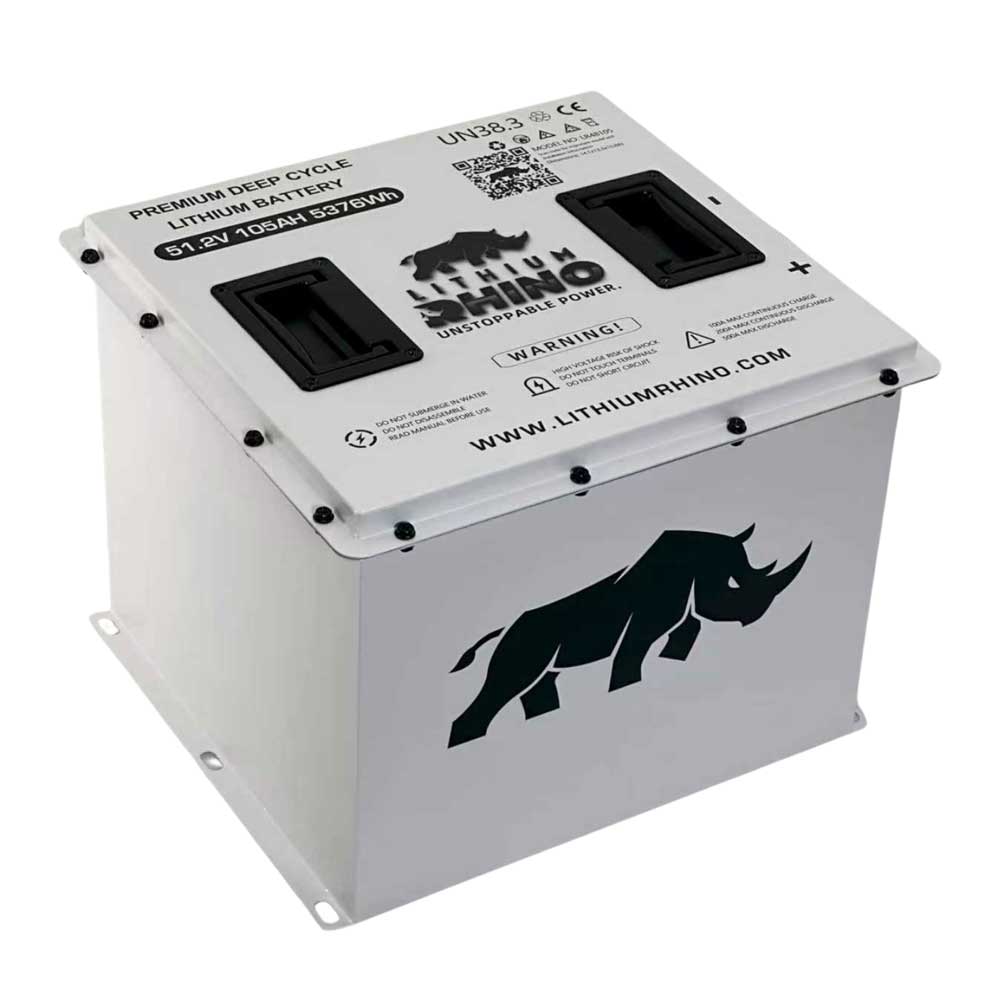
If your 48V cart does a full round, daily errands or a mix of flat and hills, a 105Ah pack is the most common choice. The Rhino CUBE is the compact square case. The MODZ 105Ah comes in two shapes, the Nano and the long, narrow Slim, and both have built-in heating. The 120Ah Rhino adds range, and its heated version is the one to pick if the cart charges in a cold garage.
Shape matters as much as capacity here: the Slim is 22.0 inches long but under 10 inches wide, while the CUBE and the Nano are close to square. Measure the tray and pick the shape that fits.
| Your cart | Your goal | Buy this | Why this one | What else you need |
|---|---|---|---|---|
| 48V cart, six 8V or four 12V batteries, tray at least 14.1 x 13.3 x 10.8 in | Everyday range | Lithium Rhino 51.2V 105Ah CUBE | The compact square case and our most common 48V pick. 5,376Wh, 250A continuous and 500A peak, about 91.3 lb. | Nothing. The lithium charger, DC-DC converter, state-of-charge display, mounting hardware and cables are in the box. |
| 48V cart, six 8V or four 12V batteries, tray at least 14.0 x 13.8 x 11.0 in | Everyday range | MODZ 51.2V 105Ah Nano | The MODZ 105Ah in its compact case. IP66, about 104 lb, built-in heating. MODZ does not publish a discharge figure in the specs we hold. | Nothing for the pack itself: the onboard charger, brackets and display are in the box. A 48V to 12V converter only if you run 12V lights or accessories. An E-Z-GO RXV needs MODZ RXV mounting hardware, not in this box. |
| 48V cart, six 8V or four 12V batteries, long, narrow tray at least 22.0 x 9.76 x 10.4 in | Everyday range | MODZ 51.2V 105Ah Slim | The same MODZ 105Ah in a long, narrow case for trays that will not take a square pack. IP66, about 110 lb, built-in heating. MODZ does not publish a discharge figure in the specs we hold. | Nothing for the pack itself: the onboard charger, brackets and display are in the box. A 48V to 12V converter only if you run 12V lights or accessories. An E-Z-GO RXV needs MODZ RXV mounting hardware, not in this box. |
| 48V cart, six 8V or four 12V batteries, tray at least 22.1 x 14.6 x 9.3 in | Long days, hills or a rear seat | Lithium Rhino 51.2V 120Ah | More range than the 105Ah packs for rear-seat loads. 6,144Wh, 200A continuous and 500A peak, about 120 lb. | Nothing. The lithium charger, DC-DC converter, state-of-charge display, mounting hardware and cables are in the box. |
| 48V cart, six 8V or four 12V batteries, tray at least 22.1 x 14.6 x 9.3 in, charged in the cold | Charging below freezing | Lithium Rhino 51.2V 120Ah Heated | The same 120Ah pack with built-in heating for cold-weather charging. 6,144Wh, 200A continuous and 500A peak, about 120 lb, built-in heating. | Nothing. The lithium charger, DC-DC converter, state-of-charge display, mounting hardware and cables are in the box. |
How far each capacity takes you depends on the cart, the load and the ground; our guide to how long a 48V cart runs and the range calculator put numbers on it.
48V Carts, Long Days and Lifted Carts: 170Ah and 175Ah Packs
If your 48V cart has a rear seat, a lift and bigger tires, or does long days with hills, the biggest packs are the ones to look at. The Rhino Goliath is the bundle with everything in the box; the same 170Ah Rhino is also sold as the battery only, for a cart that already has an approved lithium charger and converter. The MODZ 175Ah Blade is the largest 48V pack we list. All three have built-in heating.
These packs are heavy and large, so the tray measurement matters most here. They also carry the highest discharge limits we list, which is what a lifted cart or an upgraded controller needs on a hill.
| Your cart | Your goal | Buy this | Why this one | What else you need |
|---|---|---|---|---|
| 48V cart, six 8V or four 12V batteries, tray at least 16.9 x 15.4 x 12.6 in | Long days, hills or a rear seat | Lithium Rhino 51.2V 170Ah Goliath | The biggest Rhino bundle, for lifted carts, heavy loads and long routes. 8,704Wh, 300A continuous and 500A peak, about 146 lb, built-in heating. | Nothing. The lithium charger, DC-DC converter, state-of-charge display, mounting hardware and cables are in the box. |
| 48V cart, six 8V or four 12V batteries, tray at least 16.9 x 15.4 x 12.6 in, already has an approved lithium charger | Long days, hills or a rear seat | Lithium Rhino 51.2V 170Ah, battery only | The same 170Ah pack without the bundle, when the charger and converter are already on the cart. 8,704Wh, 300A continuous and 500A peak, about 146 lb, built-in heating. | A charger Lithium Rhino approves for this pack, a 12V converter if you run 12V accessories, a state-of-charge meter and mounting hardware. None are in the box. |
| 48V cart, six 8V or four 12V batteries, tray at least 23.8 x 13.6 x 10.8 in | Long days, hills or a rear seat | MODZ 51.2V 175Ah Blade | The largest 48V pack we list, in a long case. IP66, about 175 lb, built-in heating. MODZ does not publish a discharge figure in the specs we hold. | Nothing for the pack itself: the onboard charger, brackets and display are in the box. A 48V to 12V converter only if you run 12V lights or accessories. An E-Z-GO RXV needs MODZ RXV mounting hardware, not in this box. |
For lifted carts and bigger tires, the lift and tire fitment calculator shows how much harder the cart works, and so how much capacity it needs.
72V Carts: Six 12-Volt Batteries
If your cart runs six 12V batteries, it is a 72V cart, usually a high-speed build or a street-legal conversion with a controller, motor and solenoid rated for 72V. The replacement is a 76.8V pack. The 105Ah Rhino is the standard choice; the 170Ah Godzilla is the most range we sell, with built-in heating.
A 76.8V pack does not turn a 48V cart into a 72V cart on its own. That conversion needs the controller, solenoid, charger and often the motor changed too; see our 48V to 72V conversion guide before ordering one for a 48V cart.
| Your cart | Your goal | Buy this | Why this one | What else you need |
|---|---|---|---|---|
| 72V cart, six 12V batteries, tray at least 24.4 x 13.4 x 9.3 in | Everyday range | Lithium Rhino 76.8V 105Ah | The standard 72V pack, in a long, low case. 8,064Wh, 300A continuous and 500A peak, about 145 lb. | Nothing. The lithium charger, DC-DC converter, state-of-charge display, mounting hardware and cables are in the box. |
| 72V cart, six 12V batteries, tray at least 20.7 x 17.9 x 12.6 in | Long days, hills or a rear seat | Lithium Rhino 76.8V 170Ah Godzilla | The most range we sell. 13,056Wh, 300A continuous and 500A peak, about 209 lb, built-in heating. | Nothing. The lithium charger, DC-DC converter, state-of-charge display, mounting hardware and cables are in the box. |
We do not sell factory replacement packs for carts that left the factory on lithium, such as the E-Z-GO ELiTE, because those packs talk to the cart’s controller and charger. For those carts, our BMS communication guide covers the faults that look like a dead pack.
How Many Amp-Hours: Sizing the Pack to the Job
Voltage is fixed by the cart. Capacity is your choice, and so is heating. Energy in watt-hours is voltage times amp-hours: a 51.2V 105Ah pack holds about 5,376Wh, a 51.2V 170Ah pack about 8,704Wh. More energy means more range, more weight and a bigger case.
To skip the sums, the Lithium Battery Bundle Finder takes your cart, your miles, your hills and your tray, and lists the lithium packs that fit, as a bundle ready to order.
| Your use | Choose | Why | Where to check |
|---|---|---|---|
| Short trips, flat ground, stock cart | 50Ah to 65Ah | Enough energy for the job in the smallest, lightest case. The 50Ah Rhino publishes 100A continuous and 150A peak, so keep it to light duty. | 48V short trips |
| A full day, some hills, two riders | 105Ah to 120Ah | The everyday size. The 105Ah Rhino publishes 250A continuous and 500A peak. | Range calculator |
| Rear seat, lift kit, bigger tires or long days | 170Ah to 175Ah | A heavier cart uses more energy per mile, and the big Rhino publishes 300A continuous for sustained climbs. | 48V long days |
| Upgraded controller, such as a Navitas 440A or 600A | A Rhino from 105Ah up | An upgraded controller can ask the pack for hundreds of amps at full throttle, and a BMS cuts out when current passes its limit. These Rhinos publish a 500A peak; MODZ does not publish a figure in the specs we hold. | Controller amp calculator |
| Charged in a garage below freezing | A pack with built-in heating | Charging LiFePO4 cells below freezing can damage them; a heated pack warms itself before it accepts a charge. | Heated 120Ah and the packs marked heated |
A bigger pack does not raise top speed; voltage, the controller and the gearing do. Our guide to lithium batteries for a 48V cart compares one pack against four 12V units.
Parts note: For carts charged in the cold: the Lithium Rhino 51.2V 120Ah with built-in heating, charger and converter included. See the heated 120Ah pack
What Else to Check and Order to Finish the Job
A new pack only lasts if the rest of the system treats it right. These are the things to put right while the old batteries are out.
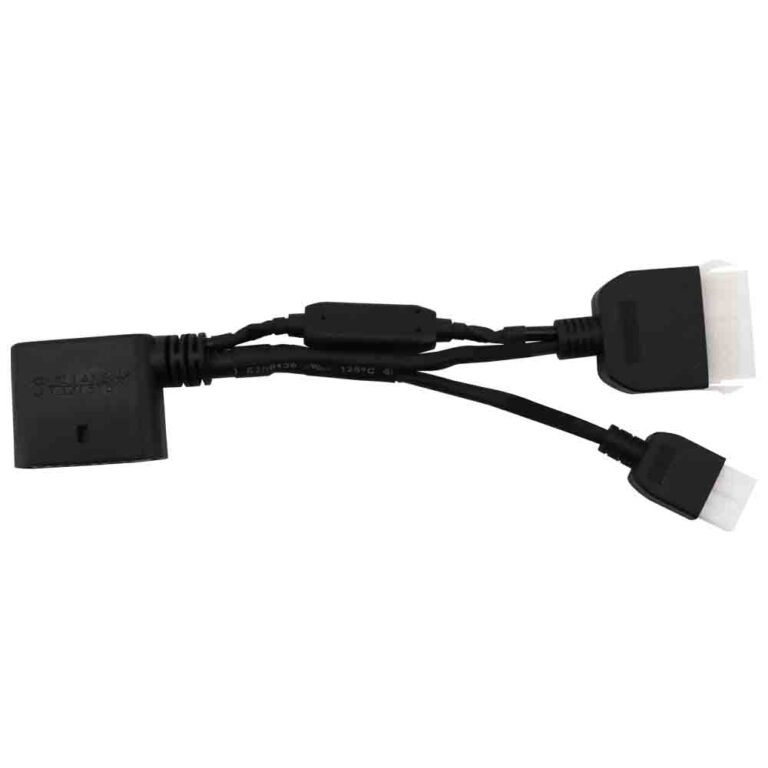
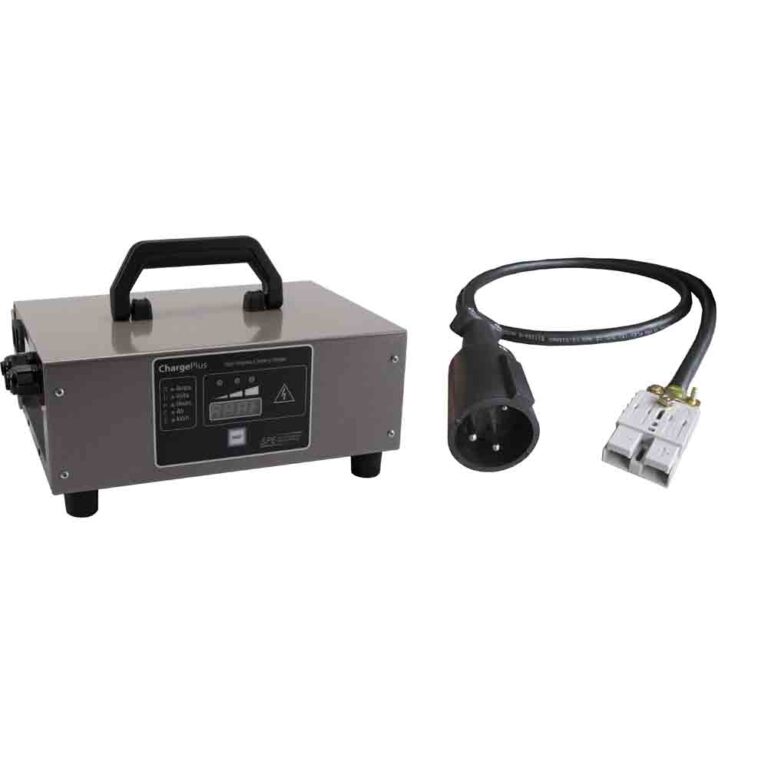
- The charger. Use the charger that comes with the pack. A lead-acid charger is not safe on a lithium pack, even with the same plug. The battery-only Rhino needs a charger Lithium Rhino approves for it; our lithium-profile chargers list their pack voltage and plug.
- The Club Car OBC. Club Car 48V carts from 1995 to 2013 with an active onboard computer need the OBC bypassed when the charger changes. Our OBC bypass guide shows how.
- 12V accessories. Never tap part of a pack for 12V lights; a single lithium pack has no 12V point. The Rhino bundles include a DC-DC converter; with a MODZ pack, add a 48V to 12V converter sized with our voltage reducer guide.
- The main cables. A single pack means one main positive and one main negative. Check the lugs and the cable size; the wire gauge calculator sizes them.
- Hold-downs. Secure the pack so it cannot slide, and route the cables so no terminal can short against the frame.
- Freight. Lithium packs ship by freight, not parcel, and the carrier needs someone to receive a heavy pallet. Freight is charged separately.
Six Mistakes That Waste a New Battery Pack
- Buying before testing. A tired charger, a Club Car OBC, a loose cable or a parasitic draw can make a healthy pack look finished. Run the five tests first.
- Replacing one lead-acid battery in an old set. The new battery is dragged down to the weakest old one. Replace the set, or go to one lithium pack.
- Keeping the old charger. A lead-acid charge profile is not safe on a lithium pack. Use the charger in the bundle, or one the pack maker approves.
- Ordering by badge instead of by tape measure. The same cart can have very different tray space after a lift, a seat kit or a previous owner’s changes. Measure the tray.
- Buying a pack to change the voltage. A 51.2V pack does not make a 36V cart a 48V cart, and a 76.8V pack does not make a 48V cart a 72V cart. The controller, solenoid and charger decide that.
- Charging a cold pack. Charging LiFePO4 below freezing damages the cells. If the cart lives in the cold, buy a heated pack.
Still Not Sure? Three Quick Checks
Torn between two rows? One of these decides it:
- Count the batteries and read one label. Six 6V is 36V, six 8V or four 12V is 48V, six 12V is 72V. That picks the section.
- Measure the tray. Length, width and height to whatever sits above it, with the old batteries out. Cross off every pack whose enclosure is bigger.
- Read the controller label. A stock controller runs happily on any pack in the right section for its use. An upgraded controller, such as a Navitas 440A or 600A, points you to a Rhino from 105Ah up.
If the battery labels are gone, the serial lookups for E-Z-GO, Club Car and Yamaha give the model and year, and the battery wiring diagram tool shows each voltage’s layout.
Prove the charge, the cables and each battery before you blame the pack, then buy by voltage, tray and use. One 38.4V, 51.2V or 76.8V lithium pack replaces a whole 36V, 48V or 72V lead-acid set; pick the capacity for your day and a heated pack if it charges in the cold.
Frequently Asked Questions
What is a golf cart battery pack?
It is the set of batteries that powers the cart, wired in series so their voltages add up to the system voltage: 36V, 48V or 72V. On a lead-acid cart it is six or four separate batteries. A lithium pack does the same job in one case, with a battery management system (BMS) that protects the cells.
How do I know my golf cart batteries are bad?
Charge the pack fully and make sure the charger finishes. Read the whole pack at rest, then each battery on its own; on flooded batteries a cell more than 0.050 below the others on the hydrometer marks a failing battery. Then load test: the battery that sags first under load is the one limiting the pack. Clear the cables and connections before you condemn the batteries.
How do I know which battery fits my golf cart?
Count the batteries and read one label to find the system voltage: six 6V is 36V, six 8V or four 12V is 48V, six 12V is 72V. Buy a lithium pack at the matching voltage (38.4V, 51.2V or 76.8V), then measure the tray with the old batteries out and choose a pack whose published enclosure fits the space.
What is the best replacement golf cart battery?
The best replacement is the one that matches your voltage, fits your tray and suits your day. For most 48V carts that is a 105Ah lithium pack such as the Lithium Rhino CUBE or the MODZ Nano. Carts with a rear seat, a lift or long days with hills are better served by a 170Ah or 175Ah pack, and a heated pack is worth it where the cart charges below freezing.
Can I put a 51.2V lithium battery in a 48V golf cart?
Yes. 51.2V is the nominal voltage of a lithium iron phosphate pack built to replace a 48V lead-acid set, so it runs a 48V cart. Use the lithium charger that comes with the pack, not the old lead-acid charger. A 38.4V pack replaces a 36V set and a 76.8V pack a 72V set the same way.
Can I replace golf cart batteries myself?
Yes, if you can lift the weight safely and work on a live pack with care. Put the cart in tow, photograph the wiring, remove the main negative first, lift out the old batteries, then mount the new pack and connect one main positive and one main negative. Our listings recommend installation by a qualified golf cart technician if you are not comfortable with high-current DC wiring.
Updated September 2026: every row was checked against our live product data and each pack is keyed to its voltage, published enclosure size and box contents.