
The “Voltage Bounce” Test: Using a Load Tester to Find a Dropped Cell
A dropped cell hides behind a healthy resting voltage until you put the pack under load. Here is how to run a defined-load test with real per-battery endpoints, spot the outlier in a series pack, and avoid the made-up universal bounce numbers that mislabel a good battery.
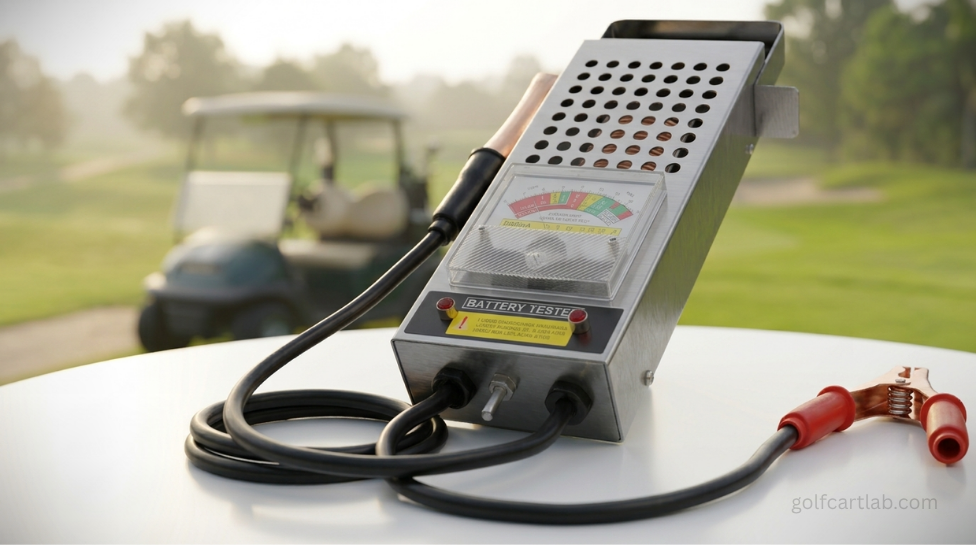
- A load test only means something with the current, temperature, endpoint, and time specified. One voltage number with no load behind it cannot separate a dropped cell from normal sag.
- Real discharge endpoints come from 1.75V per cell: 5.25V on a 6V, 7.00V on an 8V, and 10.50V on a 12V flooded battery, at the battery’s published test current. These are endpoints, not instant pass/fail readings.
- The honest test is a simultaneous comparison. In a series pack every battery carries the same current, so the one that reaches its endpoint first is the pack limiter, full stop.
- There is no published universal bounce delta for 6V and 8V deep-cycle batteries. Compare the traces of all six batteries under the same load rather than trusting a made-up one-minute rebound number.
Surface charge lies to your meter, and a dropped cell hides behind it. A battery with a shorted or shed cell can rest at a nearly normal voltage, then collapse the instant you ask it to work. The voltage bounce test puts the pack under a real load, watches which battery sags hardest, and checks how it recovers. Done with defined numbers it finds the bad battery in minutes; done with guessed thresholds it condemns good ones. The difference is specifying the current, temperature, endpoint, and time.
Why a Defined Load Matters
A useful golf-cart battery load test specifies current, temperature, endpoint, and time. One voltage number without those conditions cannot separate real capacity loss from normal load sag. U.S. Battery rates deep-cycle performance to 1.75V per cell and its diagnostic material compares measured runtime against the battery’s published rating. Battery Council terminology likewise identifies 1.75V per cell as a typical deep-discharge endpoint used to avoid cell reversal. That per-cell figure is the anchor for every honest number in this test.
Real Per-Battery Endpoints
| Battery | Discharge endpoint | What passes | Marginal or failed evidence |
|---|---|---|---|
| 6V flooded, three cells | 5.25V at the specified test current | Runtime to 5.25V is more than 50% of the published rating in the U.S. Battery method | At or below 5.25V is the endpoint, not a universal pass/fail voltage. Runtime under 50% of rating is poor. |
| 8V flooded, four cells | 7.00V at the specified test current | Runtime to 7.00V is more than 50% of the published rating at the same current and temperature | One battery reaching 7.00V much earlier than the other five is the pack limiter. |
| 12V flooded deep-cycle, six cells | 10.50V at the specified test current | Runtime to 10.50V is more than 50% of the applicable published rating | Early endpoint, excessive heat, or one persistently low-SG cell supports failure. |
| 12V cranking battery only | Interstate uses half rated CCA for 15 seconds and 9.6V at 70F | Meets the temperature-adjusted starting threshold and recovers as its guide requires | Do not scale 9.6V or the CCA load to a 6V or 8V deep-cycle golf-cart battery. |
The 5.25, 7.00, and 10.50V endpoints are calculated from the published 1.75V-per-cell figure. They are discharge endpoints, not resting-voltage targets and not 15-second thresholds. Use the battery’s rated 75A, 56A, or 25A discharge or hour-rate table as published; U.S. Battery diagnostic forms specifically accommodate 75A and 56A golf-cart testers and judge total runtime against the published rating.
Voltage Bounce Without a Made-Up Universal Number
Every lead-acid battery rebounds after the load is removed, because the electrochemical gradients relax and the internal-resistance drop disappears. A weak, high-resistance battery can show a dramatic rebound yet hold little capacity, which is exactly how a naive one-minute bounce test gets fooled. No primary golf-cart battery source publishes a single universal per-battery rebound delta or one-minute pass value for 6V and 8V products, so the defensible method is a simultaneous comparison under the same current. Interstate does publish a 12V starting-battery surface-charge procedure (150A for 10 to 15 seconds, or rest 2 to 3 hours) and a starting test using half CCA with a 9.6V threshold at 70F, but those numbers belong to 12V cranking batteries and must not be scaled to deep-cycle units.
Spotting the Outlier in a Series Pack
| Pack observation | Evidence | Diagnosis |
|---|---|---|
| One battery falls first to its 1.75V-per-cell endpoint | All batteries carry the same series current, so the earliest endpoint is a direct outlier | That battery limits usable pack capacity. Confirm its cells with corrected SG. |
| One battery sags far more but rebounds fast after release | High dynamic drop with quick recovery | High internal resistance can create bounce; runtime testing decides if useful capacity remains. |
| All batteries sag and recover together | No single outlier | Check overall state of charge, pack capacity, cable drop, and whether the load is excessive. |
| Resting voltage similar but one cell’s SG is more than 0.050 away | U.S. Battery bad-cell rule | The pack voltmeter was averaging over a cell fault. |
| One connection heats while a nearby battery reads low | Voltage drop localizes at a cable or lug | Repair the connection and repeat before replacing the battery. |
The Pack-Outlier Test
- Fully charge with the approved profile. For accurate open-circuit voltage, Trojan recommends at least 6 hours of rest, preferably 24.
- Measure every battery with one meter and label positions. For flooded cells, record temperature-corrected specific gravity.
- Connect a DC clamp meter and a multi-channel logger, or move one voltmeter quickly across batteries during a repeatable short load. Never disconnect a series cable under load.
- Record current and each battery’s minimum voltage at the same instant. Absolute differences are useful only when current and timing match.
- For a controlled capacity test, use the battery’s published discharge current and stop when the first battery reaches 1.75V per cell, recording each battery voltage and total minutes.
- Release the load and record recovery at consistent times, such as immediately, 30 seconds, and 5 minutes. Compare the six traces rather than applying an unsupported universal bounce threshold.
- Repeat once after checking cables. A repeatable early endpoint plus a low-SG cell or poor runtime is strong failure evidence.
If a tester cannot log all batteries, calculate each battery’s deviation from the pack average at the same current. Do not declare a fixed 0.5V difference universal, because the expected sag changes with current, temperature, and state of charge.
The voltage bounce test works when you anchor it to real numbers: 1.75V per cell for the endpoint, the battery’s published discharge current for the load, and a simultaneous comparison of all six batteries for the verdict. The bad battery is the one that hits its endpoint first or sags hardest under the same current, confirmed by a low-SG cell. Rule out a resistive cable before condemning a battery, and if the pack is old, replacing one battery into a tired set usually just moves the bottleneck rather than fixing it.
Frequently Asked Questions
How do I know if I have a dropped cell in my golf cart battery?
Test under load and compare all batteries at once. A battery with a dropped cell sags far more than its neighbors, reaches its 1.75V-per-cell endpoint (7.0V on an 8V) much sooner, and often fails to recover quickly after the load is removed. Confirm by reading temperature-corrected specific gravity: a cell more than 0.050 below the others is the fault the pack voltmeter was hiding.
What causes a battery cell to drop?
Common causes are vibration breaking an internal lead connector, severe sulfation, and plate shedding from age and deep discharge. Once a cell drops, the battery can no longer deliver its rated amperage, so it becomes the bottleneck of the whole series pack even though the other cells are fine.
Can I replace just one golf cart battery if it has a dropped cell?
If the rest of the pack is less than about a year old, replacing one battery is reasonable. If the pack is 3 to 4 years old, a new battery has much lower internal resistance than its worn neighbors, which unbalances the set and shortens the new battery’s life, so it is usually better to replace the entire pack. Match age and brand as closely as you can.
Is there a universal voltage bounce number for a good battery?
No. No primary golf-cart battery source publishes a single universal rebound delta or one-minute pass value for 6V and 8V deep-cycle batteries, because expected sag and recovery vary with current, temperature, and state of charge. The reliable method is to load all six batteries under the same current and compare their voltage traces, treating the earliest endpoint or hardest sag as the outlier rather than trusting a fixed number.