How Many Lithium Batteries for a 48V Golf Cart?
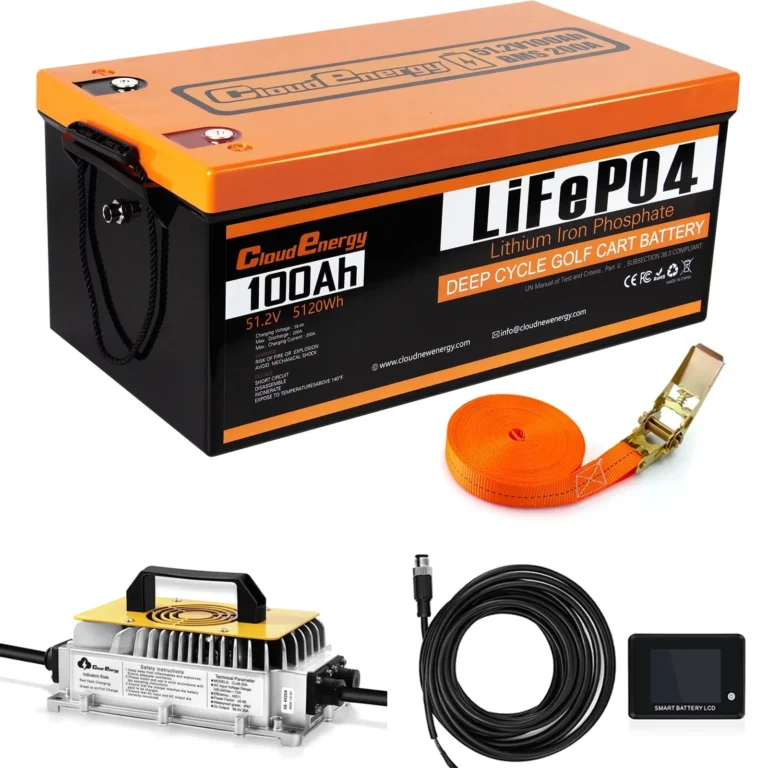
A 48V cart can use one 51.2V full-pack battery, four approved 12.8V lithium batteries in series, or a professionally assembled 16-cell system. Series voltage adds, but amp-hours do not.

- Option 1: use one full-voltage 51.2V LiFePO4 pack designed for a 48V golf cart.
- Option 2: use four 12.8V lithium batteries in series only when the exact model is approved for series operation.
- Choose amp-hours from energy, not a battery count.
- Inspect tray dimensions, seat clearance, hold-down points, terminal direction, cable reach, controller current, contactor rating, charger receptacle, and accessory wiring.
A 48V cart can use one 51.2V full-pack battery, four approved 12.8V lithium batteries in series, or a professionally assembled 16-cell system. Series voltage adds, but amp-hours do not.
Option 1: One 51.2V Unit
Option 1: use one full-voltage 51.2V LiFePO4 pack designed for a 48V golf cart. It contains sixteen 3.2V cells or cell groups in series inside one enclosure, managed by one BMS. A 105Ah example stores 51.2 x 105 = 5,376Wh nominal.
This is usually the cleanest conversion because one BMS measures every series group and one manufacturer defines the charger, current limits, display, and contactor behavior. It still needs a secure tray, correct cables, a lithium charger, and a reducer for 12V accessories.
Parts note: Every Lithium Rhino 48V bundle we stock is one 51.2V pack with its lithium charger, 12V DC-DC converter and state-of-charge display in the box. See lithium bundles
Option 2: Four 12V Lithium Batteries for a 48V Golf Cart
Option 2: use four 12.8V lithium batteries in series only when the exact model is approved for series operation. Series arithmetic is 12.8 + 12.8 + 12.8 + 12.8 = 51.2V. Four 100Ah batteries in series produce 51.2V at 100Ah, not 400Ah. Voltage adds; amp-hours stay the same.
Dakota sells defined four-module 48V sets in 60Ah and 135Ah choices. Eco says not to run its full packs in series. Brand and model approval cannot be inferred from a generic 12V label. The separate four 12V batteries guide covers the series checks.
Choosing Capacity (Amp-Hours)
| Architecture | Pack math | Capacity behavior | Main trade-off |
|---|---|---|---|
| One 51.2V 105Ah pack | 16S internal cells | 105Ah, 5.376kWh | One BMS and simple wiring; larger single case. |
| Four 12.8V 100Ah in series | 4 x 12.8V = 51.2V | 100Ah, 5.12kWh | Four BMS units must stay coordinated and series operation must be approved. |
| Professional 16-cell build | 16 x 3.2V = 51.2V | Determined by cell Ah; series does not add Ah | Requires engineered compression, busbars, fuse, BMS, enclosure, and validation. |
| Two identical 51.2V 60Ah packs in approved parallel | Voltage stays 51.2V | Capacity adds to 120Ah | Only when manufacturer supports parallel operation and current sharing. |
Choose amp-hours from energy, not a battery count. Watt-hours equal nominal volts times amp-hours. At 51.2V, 60Ah is 3.07kWh, 105Ah is 5.38kWh, and 160Ah is 8.19kWh before usable-depth and system losses.
Install Considerations
Inspect tray dimensions, seat clearance, hold-down points, terminal direction, cable reach, controller current, contactor rating, charger receptacle, and accessory wiring. Never leave a lithium pack loose because it weighs less. Never reuse corroded lead-acid cables without a loaded voltage-drop check. The Lithium Battery Bundle Finder takes your cart and tray size and shows the single packs that fit, with the charger included.
Connect the complete system using the lithium battery connection guide. Use insulated tools, correct fuse protection, manufacturer torque, and precharge procedure where required.
What 51.2V Really Means in Cells
A 51.2V pack normally means sixteen 3.2V LiFePO4 cells in series. At a chemistry ceiling of 3.65V per cell, 16 x 3.65 = 58.4V. The actual charger target may be lower, such as 57.6V, because the battery maker chooses the operating window.
Do not build a raw-cell pack from cell count alone. Cell matching, compression, busbar current, insulation, enclosure, fuse interruption rating, BMS sensing, contactor control, and thermal behavior require engineering and test equipment.
Tray Fit by Cart Model
Club Car DS and Precedent trays, EZGO TXT and RXV trays, and Yamaha Drive trays have different wells, braces, and seat clearances across years. A long single case may need a model-specific plate, while four module-size cases may fit the original wells but add cable and BMS complexity.
No universal fit table can replace measurement. Record cart serial, existing battery layout, tray length, width, depth, and clearance to the seat and body. Confirm the exact bracket kit before purchase.
Charger and the Club Car OBC Catch
Use the voltage and charge profile specified by the selected battery. A flooded charger can enter absorption or equalization above the lithium maker’s intended limit. Some smart lithium systems also need CAN communication or a vendor display.
Older Club Car OBC wiring can interrupt an off-board lithium charger’s path and may require a documented bypass. Do not remove safety interlocks at random. Confirm charger polarity and pack voltage before the first connection.
One BMS or Four? Why It Matters
One full-voltage pack has one BMS supervising all sixteen series groups. Four 12.8V batteries have four independent BMS units. If one module reaches high or low voltage first, it can disconnect and open the entire series string. Recovery rules can differ among modules.
Do not mix ages, capacities, brands, or firmware in series. Parallel full-voltage packs also need explicit manufacturer approval, matched voltage before connection, suitable fusing, and current-sharing cables. Allied’s full-voltage Drop-in-Ready modules, for example, are a defined parallel architecture, not a rule for unrelated batteries.
Sizing Capacity to Real Range
Range math starts with usable watt-hours. Example: a 51.2V 105Ah pack has 5.376kWh nominal. At an 80 percent planned use, that is about 4.30kWh. If measured cart consumption is 180Wh per mile, estimated range is 4,300 divided by 180, or about 24 miles. At 240Wh per mile, the estimate falls to about 18 miles.
Measure actual consumption over repeated routes because hills, speed, tire pressure, passenger load, temperature, and stops change Wh per mile. Cross-check general expectations with 48V golf-cart runtime.
The usual answer is one properly sized 51.2V pack. Four approved 12.8V modules are a valid alternative when the manufacturer supports series use and the tray favors them. A raw 16-cell build belongs with a qualified battery integrator. Continue with the 48V versus 51.2V guide and repair guides.
Frequently Asked Questions
How many lithium batteries are needed for a 48V golf cart?
Most 48V carts use either a single 51.2V lithium battery (an all-in-one unit) or four 12V lithium batteries wired in series. Both create the 48V nominal system the cart requires.
What capacity lithium battery do I need for a 48V golf cart?
Capacity is measured in amp-hours and sets your range. A 100Ah pack is a popular all-around choice; larger amp-hour packs travel farther but cost and weigh more. Match capacity to your typical driving distance.
Reviewed and updated July 30, 2026 by the Golf Cart Lab team.