What Year Is My Golf Cart? Serial Number Lookup by Brand
Find your cart’s model year in seconds. Here is exactly how to read a Club Car, E-Z-GO, or Yamaha serial number, with real decode tables and a free decoder tool that does the math for you.
- Each brand encodes the year differently: Club Car puts it right after the model letters, E-Z-GO buries it in a separate manufacturer’s code, and Yamaha uses a Primary ID model-code table.
- The single most common mistake is reading every brand like a Club Car. Start with the brand, the plate location, and the code format before you trust any digits.
- The E-Z-GO long serial is usually just a build sequence; the last two digits of the shorter manufacturer’s code are the model year (F398 = 1998).
- When a plate is faded or gone, body-style milestones (DS to Precedent in 2004, TXT to RXV in 2008) narrow the year, but a decoder or dealer lookup confirms it.
Knowing exactly what year your golf cart is matters every time you order parts, buy a used cart, or look up a wiring diagram. The good news: the answer is stamped right on your cart. Every major brand encodes the model year in its serial number or manufacturer’s code, you just need to know how to read it.
Why your golf cart’s year matters
Golf carts look nearly identical across many model years, but the parts underneath change constantly. A controller, charger receptacle, or front cowl that fits a 2010 cart may not fit a 2014 of the same model. Ordering by year is the single best way to avoid returns.
It matters even more when buying used. Sellers routinely guess (or fudge) the age of a cart. Decoding the serial yourself is the only way to know whether you are looking at a genuinely newer cart or a tired older one wearing fresh seats and tires.
Club Car serial number lookup
Modern Club Cars, including Precedent, Onward, and Tempo models, use a serial that starts with the model prefix, then the year and week: two model letters + two-digit year + two-digit production week + six digits. So PH0908123456 reads as a Precedent-style cart from model year 2009, built in week 08, with the last six digits acting as the unit sequence.
Older DS carts are the main exception. Public Club Car prefix references and dealer guides confirm DS-era serials use a shorter prefix pattern, often a single letter on many DS examples, followed by two year digits. A serial beginning A00 points to a 2000 DS-style electric example, while AG84 is a gas DS-style example from 1984. The exact prefix tells model and powertrain, not just age, so use the first letters and the two digits together.
| Club Car serial part | What it means | Example |
|---|---|---|
| First one or two letters | Model or trim prefix. Club Car publishes a prefix directory for A, AG, PD, PH, RG, RH, Carryall, and many other variants. | PH = Precedent i2 style; RG/RH = newer Onward or Tempo family. |
| Next two digits | Model year on modern Club Car serials and many DS examples. | PH09 = 2009; A00 = 2000 DS-style example. |
| Next two digits (modern) | Production week, not a year. | PH1130 = 2011, week 30. |
| Last six digits | Build sequence. Useful for dealer lookup, not the year by itself. | PH0908123456, the 123456 part is sequence. |
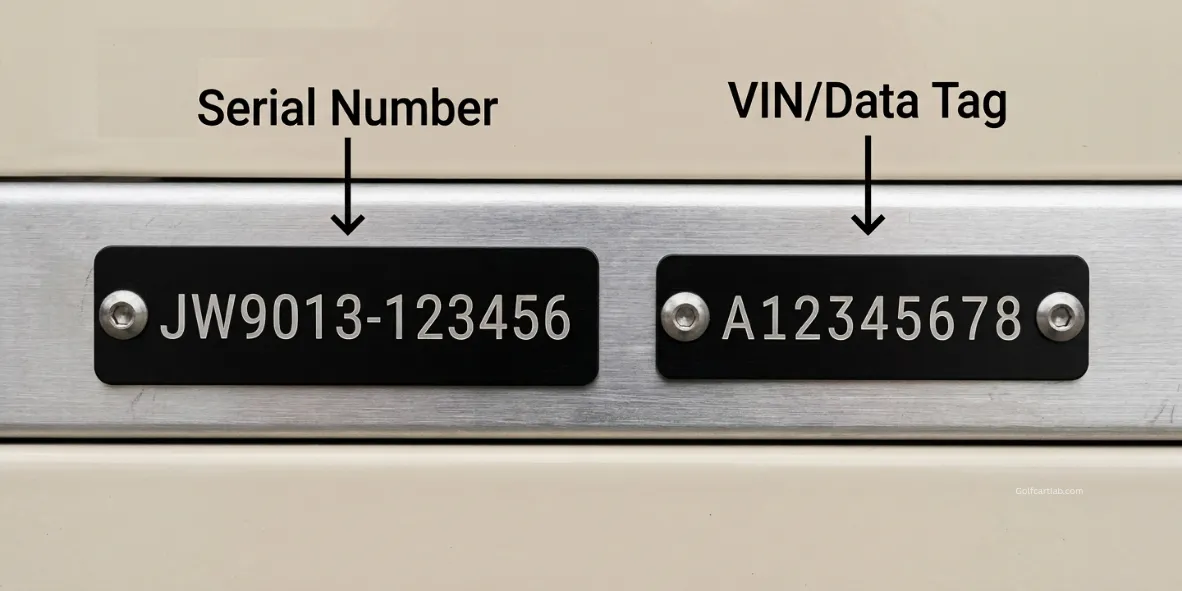
You will usually find the serial on the passenger-side dash or inside the glovebox on a Precedent, Onward, or Tempo. DS plates are commonly under the seat or around the dash and frame area, depending on year. If the decoded year says 2003 or older but the body looks like a Precedent, recheck the prefix before ordering parts.
E-Z-GO serial number and manufacturer’s code
E-Z-GO is the brand that trips people up because the long serial number is usually only a production sequence. For 1979-newer carts, the useful year clue is the separate manufacturer’s code or manufacture date code on the same plate or label. Multiple E-Z-GO parts guides agree on the key rule: the code includes a letter and the last two digits identify the model year. So F398 points to 1998, and L2720 points to 2020.
Month letters are less safely documented in public factory material than the year rule. Some current serial guides decode the letter as an A-through-L month sequence, while other E-Z-GO specialists warn that older formats can rotate the month cycle. Use the month table below only when your plate matches the modern one-letter date-code examples, and treat the last two year digits as the stronger public decode rule.
| Letter | Common month decode | Reader note |
|---|---|---|
| A | January | Use with a one-letter manufacturer’s code such as F398 or L2720. If your plate has an older multi-part code, treat the month as format-specific and confirm by decoder or dealer lookup. |
| B | February | |
| C | March | |
| D | April | |
| E | May | |
| F | June | |
| G | July | |
| H | August | |
| I | September | |
| J | October | |
| K | November | |
| L | December |
Practical decode: find the shorter manufacturer’s code, read the final two digits for the year, then use body era as a sanity check. Marathon covers much of 1981-1994, Medalist is 1994-1995, TXT starts in 1996, and RXV starts in 2008. If the month letter seems to disagree with an older code chart, do not force it. E-Z-GO changed formats, and a dealer lookup by manufacturer code and serial is the safer answer for odd plates.
Yamaha serial number lookup
Yamaha calls the important prefix the Primary ID or model code. Yamaha’s own Primary ID sheets list the code, starting PID number, model year, and model name. That means Yamaha is more table-driven than Club Car: the first three characters tell you the model family, then the following digits place the cart within that model’s production run.
| Yamaha code prefix | Model family | Years in Yamaha references | Gas or electric |
|---|---|---|---|
| J10, J17, J24, J31 | G1 | 1979-1989 across listed G1 gas examples; electric G1 uses J14, J22, J26, J36 through 1987. | Gas and electric, prefix-specific. |
| J38, JA2, J55 / J41, JE2, J56 | G2 | 1985-1991 in Yamaha’s gas and electric tables. | Gas and electric, prefix-specific. |
| JF2 / JF3 | G8 | 1990-1994. | Gas JF2, electric JF3. |
| JG5 / JG6, JH7 | G9 | 1991-1995. | Gas JG5, electric JG6/JH7. |
| JN3 / JN4 | G14 | 1995-1996. | Gas JN3, electric JN4. |
| JN6 / JN8 | G16 | 1996-2002. | Gas JN6, electric JN8. |
| JR1 | G19 | 1996-2002. | Electric. |
| JU0 / JU2 | G22 | 2003-2007. | Gas JU0, electric JU2. |
| JW1, JW8 / JW2, JW9 | G29 “The Drive” | 2007-2016 for Drive examples; JW9 covers later electric Drive years in Yamaha’s 2015 sheet. | Gas JW1/JW8, electric JW2/JW9. |
| JC0 / JC1 | Drive PTV | 2010-2015 in Yamaha’s 2015 PTV table. | Gas JC0, electric JC1. |
| J0A, J0B, J0C, J0K | Drive2 | 2017-newer in Yamaha’s 2018 chart and current Drive2 references. | J0A carbureted, J0B/J0K EFI gas, J0C electric. |
Yamaha does not give every owner a single universal “third digit equals year” shortcut. Match the first three-character prefix to the Yamaha PID table, then compare the full starting PID number for the year. If your exact three-character prefix is not in a public table, the model family and plate location are still reliable clues, but the exact year should come from the decoder tool, Yamaha parts lookup, or a dealer PID lookup.
Use the golf cart serial number decoder
Rather than memorize three different systems, let our tool do it. Pick your brand, type in the serial (or the E-Z-GO manufacturer’s code), and the golf cart serial number decoder returns the model year, model, and likely voltage instantly. It is free, works on your phone in the parking lot, and is backed by the same brand data covered above. If you are still deciding between brands, our guide to the big three golf cart brands is a good next read, and you can browse every how-to in our repair guides library.
If you can’t find or read the serial
Plates fade, get painted over, or fall off. If yours is unreadable, these clues help narrow the year:
- Charger receptacle: round versus rectangular plugs changed in known years for each brand.
- Body and cowl shape: Club Car’s switch from DS to Precedent (2004) and E-Z-GO’s TXT-to-RXV change (2008) are easy visual tells.
- Manufacturer records: brands like Club Car can look up a cart by serial through a dealer if the plate is missing.
Golf cart model years at a glance
Once you know what year your golf cart is, cross-check it against the big model changes. This catches bad seller claims and also keeps you from ordering parts for the wrong generation.
| Brand | Where to find the plate | Where the year lives | Fast sanity check |
|---|---|---|---|
| Club Car | Passenger-side dash or glovebox on Precedent, Onward, and Tempo; DS often under the seat or around the dash and frame area. | Modern format uses model prefix, then two year digits, then two week digits. | DS ran through 2003. Precedent starts in 2004. Onward starts in 2017, Tempo in 2018. |
| E-Z-GO | Passenger-side dash or glovebox on many TXT and Marathon carts; RXV and TXT labels can also be on frame or under-seat areas. | For 1979-newer examples, use the manufacturer’s code, not the long serial. The last two digits are the model year. | Marathon, then Medalist, TXT from 1996, RXV from 2008. |
| Yamaha | Varies by model: rear frame on early G-series, under-seat and frame areas on G2/G9/Drive2, glovebox or engine compartment on many G14-G29 carts. | The first Primary ID model-code prefix plus starting PID table identifies the model and year range. | G1 starts in 1979, G29 Drive covers 2007-2016, Drive2 starts in 2017. |
The common mistake is reading every brand like Club Car. Club Car puts the year right after the model letters on modern serials. E-Z-GO usually needs the separate manufacturer’s code. Yamaha needs the PID model-code table. A quick golf cart serial number lookup should start with brand, plate location, and code format before you trust the digits.
If a seller claims a 2015 Precedent and the serial begins PH09, it is a 2009 Precedent-style decode, not a 2015. If an E-Z-GO code ends in 98, the year clue is 1998 even if the long serial looks unrelated. If a Yamaha prefix is JW9, you are in the Drive electric table, not Drive2. That is enough to negotiate, order the right parts, or walk away.
Frequently Asked Questions
What year is my golf cart?
Your golf cart’s year is encoded in its serial number or manufacturer’s code. On a Club Car, the two digits after the model letters are the year (PH09 = 2009). On an E-Z-GO, read the separate manufacturer’s code where the last two digits are the year (F398 = 1998). On a Yamaha, match the first three-character Primary ID prefix to Yamaha’s model-code table for the model and year range.
Can I tell the year of a golf cart without a serial number?
You can estimate it from the body style, charger receptacle type, and dash design, but the serial number or manufacturer’s code is the only reliable way to confirm the exact model year before buying parts.
Where is the year in an E-Z-GO serial number?
The long E-Z-GO serial number is usually just a production sequence. Read the separate manufacturer’s code on the same plate: the last two digits are the model year, so a code ending in 98 is 1998 and one ending in 20 is 2020.
How do I read a Yamaha golf cart serial number?
Yamaha calls the important prefix the Primary ID or model code. The first three characters identify the model family (for example JN6 is a G16, JW9 is a G29 Drive electric, J0C is a Drive2 electric), then the following digits place the cart within that model’s production run. If your exact prefix is not in a public table, the model family and plate location are still reliable clues and a dealer PID lookup confirms the exact year.