
Can I Convert My 36V Golf Cart to 48V? Full Upgrade Guide
Yes, you can take a 36V cart to 48V, but the pack, charger, controller, and solenoid all have to move together. Here is what each step really costs and where the gotchas hide.
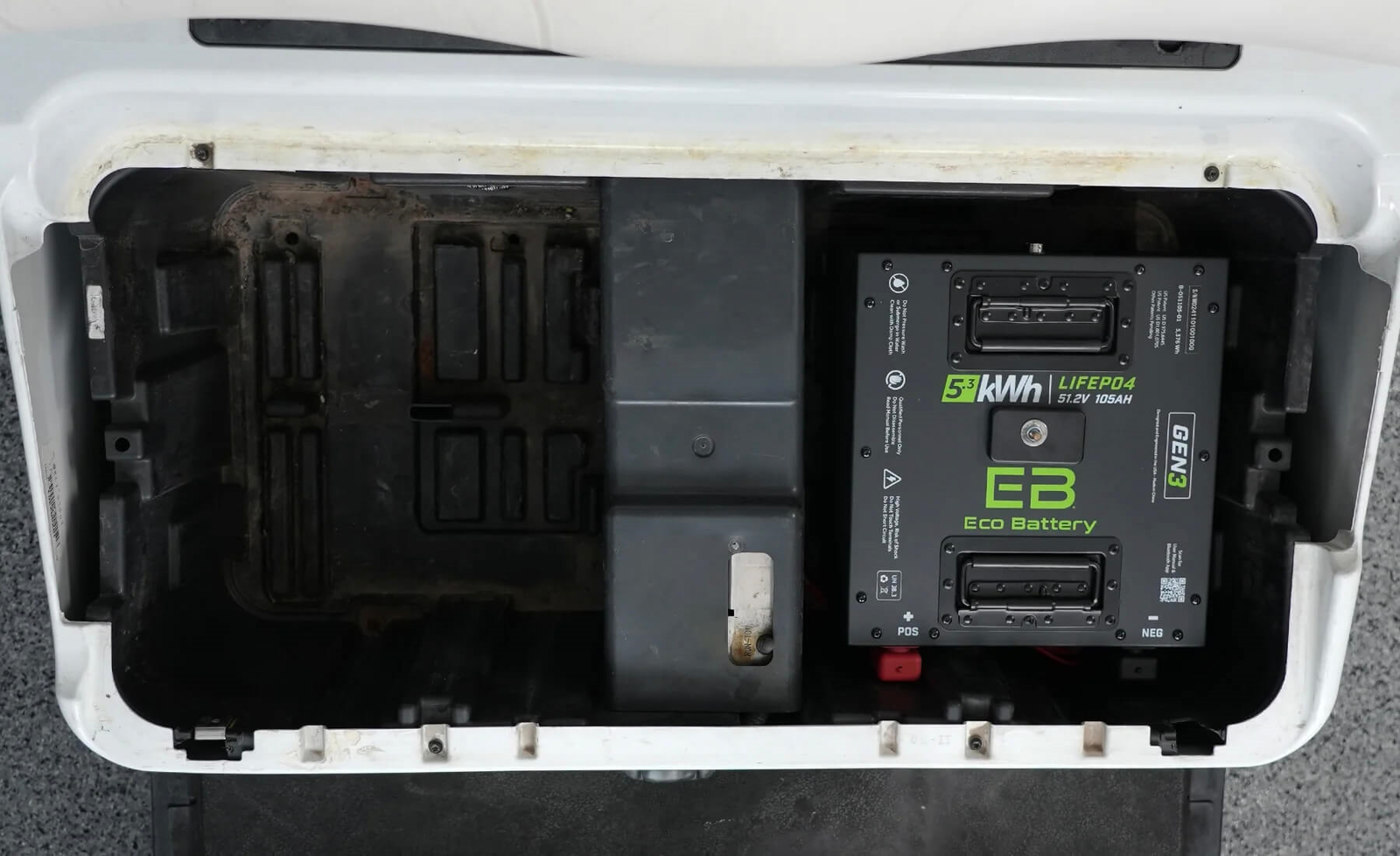
- A 36V to 48V conversion is a system change: batteries, charger, controller, and solenoid all upgrade together, not one part.
- The controller is the main cost and the part that unlocks the real speed and torque, it must be 48V-rated.
- A stock 36V motor usually runs on 48V and simply spins faster, but it also runs hotter, so watch temperature.
- On Club Car especially, the OBC and wiring add real quirks that a clean lithium 48V kit can sidestep.
01 : Step 1: The Battery Pack
Why is 48V more than adding one battery? Series voltage is the sum of every battery in the string, so the pack layout, tray space, weight, cable path, charger profile, and vehicle balance all change together.
| Pack layout | Nominal voltage | What it means for a conversion |
|---|---|---|
| Six 6V batteries | 36V | Common legacy layout. It cannot become 48V without changing battery count or battery voltage. |
| Eight 6V batteries | 48V | Preserves 6V deep-cycle characteristics but usually needs more tray space and adds considerable weight. |
| Six 8V batteries | 48V | Common factory golf-cart layout. Check whether six GC8 cases fit the original 36V tray and hold-downs. |
| Four 12V batteries | 48V | Fewer interconnects and easier packaging, but capacity and cycle life depend on the exact deep-cycle battery. |
| One 48V lithium pack | Usually 51.2V nominal for LiFePO4 | Lower weight and built-in BMS are attractive, but the pack must supply the controller’s peak current and use its approved charger. |
Measure the tray and cable reach before buying. Keep batteries of one chemistry, model, capacity, and age in the same series string. Do not mix new and old batteries. Trojan currently offers 6V, 8V, 12V, and complete lithium golf-cart products, but product availability does not prove that a layout fits a particular cart. Confirm by serial and model. The separate guide to using four 12V batteries in a 48V cart covers that layout in more detail.
02 : Step 2: Controller and Solenoid to Convert My 36V Golf Cart to 48V
The controller must accept a fully charged 48V pack, not just 48V nominal. Alltrax publishes its XCT48 models for 36 to 48V operation with a 62V maximum, and its setup guide recommends at least a 58V overvoltage setting for a 48V lead-acid pack. That headroom matters because a fresh pack sits above nominal voltage. Use the 36V versus 48V 400A solenoid comparison when specifying the contactor circuit.
Choose controller current from the motor, terrain, tire diameter, vehicle weight, and battery discharge rating. A 500A controller does not force 500A through the motor all the time, but the battery, BMS, contactor, cables, and terminals must survive the allowed peak. The solenoid or contactor also needs the correct coil voltage. A 36V coil on a 48V pack is not acceptable. Albright publishes the SW180 with coil options from 6V to 240V and different continuous-current ratings by duty cycle, so order the exact coil and contact configuration rather than relying on the case name.
| Component | Minimum conversion check | Reason |
|---|---|---|
| Controller | 48V pack range, motor type, throttle, current limit, regen support. | Wrong voltage or motor family can destroy the controller or remove safe braking. |
| Contactor | 48V coil, DC contact voltage, continuous and interrupt ratings. | Coil and power contacts have separate ratings. |
| Forward/reverse assembly | Current rating on series carts. | Higher current can overheat old copper contacts. |
| Run/tow and charger interlock | Correct logic voltage and harness. | These circuits protect the controller during service and charging. |
Parts note: For an E-Z-GO TXT PDS with the Curtis 1206MX, the Navitas TSX 3.0 kit we stock runs on 36V or 48V, so it works before and after the pack swap. Pick 600A for a cart converted to 48V. View kit
03 : Step 3: Charger
A 36V charger cannot charge a 48V pack. Use a 48V charger with the exact battery chemistry and charge profile. Flooded lead-acid, AGM, and lithium packs require different voltage stages and termination logic. Delta-Q describes 8 to 12 hours as a typical overnight charge-time range for low-power 24V, 36V, and 48V chargers, but the actual time varies with charger output, chemistry, temperature, capacity, age, and depth of discharge.
If the cart uses an onboard computer, charger interlock, or proprietary receptacle, include the correct bypass or replacement harness in the plan. A charger that reaches the right voltage but ignores the vehicle interlock is not a complete conversion. Club Car owners should follow the dedicated OBC bypass diagnostic guide rather than improvising the interlock wiring.
Parts note: We stock 48V chargers for flooded, AGM and lithium packs, listed by cart and charge plug. See chargers
04 : Step 4: The Motor
A 36V motor sometimes runs on 48V, but survival is not universal. Higher voltage raises potential RPM. High current from hills, heavy loads, tall tires, or aggressive acceleration creates heat in the armature, field, brushes, and commutator. A motor that stays cool on a flat neighborhood route can overheat on a long grade.
Keep the original motor only when the motor builder or a matched controller-kit supplier supports 48V operation for that exact part number. Start with a conservative current and speed limit, verify brush condition and cable connections, and measure motor temperature after the hardest normal route. If the motor has no published limit, replace it with a 48V-rated motor or complete AC kit instead of treating the old unit as guaranteed compatible. The golf-cart motor sizing guide connects vehicle load, hills, tires, and desired speed to the motor decision.
05 : Is It Worth It?
The conversion is worth it when the chassis, brakes, steering, and transaxle are sound, the owner wants a specific performance result, and most power components already need replacement. It is harder to justify on a worn cart that still needs batteries, motor, controller, charger, contactor, cables, brakes, and tires.
| July 2026 planning item | Typical retail planning range | What changes the number |
|---|---|---|
| 48V lead-acid battery set | $1,100 to $1,900* | 6V, 8V, or 12V layout, capacity, core charges, delivery. |
| 48V lithium pack with BMS | $1,800 to $3,500* | Capacity, continuous and peak current, CAN integration, warranty. |
| Controller and vehicle harness | $600 to $1,500* | DC replacement versus complete AC conversion, 400A to 600A class. |
| Contactor and protection hardware | $150 to $350* | Current rating, coil voltage, fuse, precharge, mounting. |
| 48V charger and receptacle work | $400 to $900* | Chemistry, output power, onboard versus portable, interlock. |
| Cables, tray, hold-downs, and labor | $300 to $1,200* | Tray fabrication, cable gauge, corrosion repair, shop rate. |
| 48V motor if required | $700 to $1,800* | DC replacement versus AC motor and adapter package. |
These are planning ranges, not fixed quotes. A clean DC conversion can land near $3,000, while a battery, AC drive, fabrication, and labor build can pass $6,000*. Compare the line items with the broader 36V to 48V conversion cost guide, then compare that total with the price of a sound factory 48V cart before ordering. The higher voltage can support more speed and power, but range still comes from watt-hours, efficiency, tire load, and driving style. Voltage alone does not guarantee more range.
* Estimated planning ranges, not quotes. Real costs change with your cart, the parts you pick and local labor rates, so use them as a guide only.
06 : Which Carts Convert Easiest
Some platforms make the 36V to 48V jump far cleaner than others. A Club Car DS built before 1995 with the resistor-coil V-Glide system is actually one of the trickier conversions, because you are not just raising voltage, you are replacing an entire archaic drive system with a modern controller and solenoid. Later Club Car DS cars with the PowerDrive system and E-Z-GO TXT carts from the mid-1990s are more straightforward since they already use a solid-state controller that you simply swap for a 48V unit.
Yamaha G-series electric carts from the 36V era, such as the G16 and G19, convert reasonably well but often have tighter battery trays, so verify physical fit before buying eight 6V batteries. Always measure the tray and weigh the added battery mass against your suspension before committing.
07 : The Club Car OBC and Other Real Quirks
The single biggest surprise in a Club Car conversion is the onboard computer. On 48V Precedent and later DS cars the OBC monitors charging and can block a modern smart or lithium charger from turning on, so a proper OBC bypass is usually part of the job. Skipping this step is why owners report a freshly converted cart that drives great but refuses to charge.
Another genuine quirk: E-Z-GO RXV carts are already 48V AC-drive from 2008 onward, so there is nothing to convert, and trying to force 36V-era logic onto them causes confusion. Confirm your exact model and year from the serial plate before ordering a single part, because a mismatch here wastes the most money.
08 : Wiring, Gauges, and Safety
Higher voltage and the higher current that comes with a performance controller both stress your cabling. Inspect the main battery cables and the controller-to-motor leads, and upgrade any that are undersized or corroded, because a marginal cable that survived 36V can overheat at 48V under load. Re-torque every lug and use anti-corrosion spray on the terminals to prevent the voltage-drop problems that mimic a weak pack.
Do not overlook the motor temperature question. A stock 36V motor spinning at 48V draws more current and sheds more heat, especially on hills, so on a hard-working cart consider a thermal check after your first few long runs. If the motor gets uncomfortably hot to the touch, that is your signal to step up to a 48V-rated motor for the long haul.
09 : The Lithium Shortcut Worth Considering
Many owners now skip the traditional lead-acid 48V build and go straight to a 48V lithium (LiFePO4) drop-in pack. Lithium packs carry their own battery management system, weigh a fraction of eight lead-acid batteries, and free up tray space, which sidesteps the fit problems that plague some conversions. You still need the 48V controller, solenoid, and a lithium-profile charger, but you gain range, faster charging, and a pack that lasts far longer. For anyone doing a full conversion anyway, pricing out a lithium path alongside the lead-acid route is well worth the few extra minutes.
Keep in mind that a lithium conversion also changes your resting-voltage baseline, a charged 48V lithium pack often reads around 53 to 54V rather than the 50 to 51V of lead-acid, so do not panic when your meter shows a higher number after the swap. Program or select the correct charge profile on your new charger, and the pack will manage its own balancing from there.
36V to 48V Conversion Summary
Yes, you can convert my 36v golf cart to 48v, but upgrade the batteries, charger, controller, and solenoid together. The 36V motor usually runs on 48V (faster/hotter). The controller is the key cost; matched components give big speed and torque gains.
Yes, it works: rebuild the pack to 48V and upgrade the charger, controller, and solenoid to 48V-rated parts. The stock 36V motor usually runs on 48V (faster and hotter), and the controller is the main cost. On a tired cart, weigh a full lithium 48V kit against piecing it together.
Frequently Asked Questions
Can I convert my 36V golf cart to 48V?
Yes. You rebuild the pack to 48V and upgrade the charger, controller, and solenoid to 48V-rated parts. The stock 36V motor usually runs on 48V (faster and hotter). The controller is the main cost.
Will a 36V motor run on 48V?
Most 36V golf cart motors run on 48V and simply spin faster, which is the goal of a conversion. They also run hotter, so monitor temperature; a 48V-rated motor is best for a permanent high-performance build.
How much does it cost to convert a 36V golf cart to 48V?
Budget mostly for the controller and batteries. A basic conversion reusing the stock motor runs a few hundred dollars in parts for the controller, solenoid, and 48V charger, plus the battery pack. A full high-performance or lithium build costs significantly more.
Is it better to convert to 48V or buy a 48V cart?
If the cart is otherwise solid and you enjoy the project, converting can be cost-effective. If the frame, motor, and wiring are tired, the money is often better spent on a cart that is already 48V, especially once a lithium pack is on the shopping list.
