
Lead-Acid Hydrometer Deep Dive
Voltage can be faked, chemistry cannot. This is the cell-by-cell method for reading specific gravity, correcting for temperature, and using the 0.050 variance rule to find the one dead cell that is dragging your whole pack down.
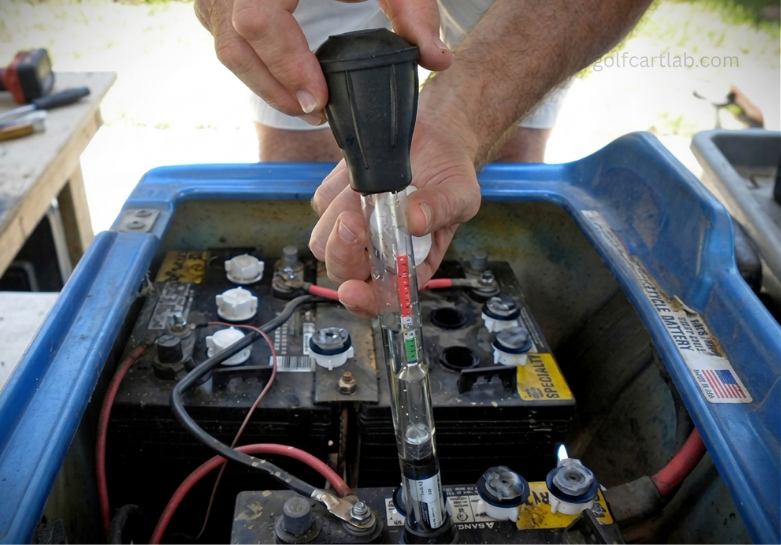
- Specific gravity is the actual strength of the sulfuric acid, so it reads true state of charge no matter what surface voltage claims. A full flooded cell reads 1.277 to 1.285.
- Always test after a full charge and at least 2 hours of rest, never during charging (gas bubbles float the hydrometer high) and never right after adding water (it floats a false-low reading).
- Correct for temperature: add 0.004 for every 10F above 80F and subtract 0.004 for every 10F below. A 1.270 reading at 100F is really 1.278.
- The spread matters more than the average. A pack all within a 0.030 band is healthy; a single cell more than 0.050 below the others is a failing cell, and the battery block must be replaced.
You check your 48V pack with a multimeter and it reads 50.9V, so you assume it is fully charged. Then you hit a hill and the cart dies. Voltage only measures electrical pressure; it says nothing about the chemistry inside. A battery can carry a surface charge that looks good on a meter yet have almost no capacity because the acid has effectively turned to water. A hydrometer measures specific gravity, the weight of the sulfuric acid compared to pure water, and it is the only way to see inside each individual cell and find the one bad apple destroying your pack.
Battery electrolyte is sulfuric acid. Wear safety glasses and gloves. If you splash any on your skin, neutralize it immediately with a baking soda and water solution.
Pulling an Accurate Cell Sample
Most flooded golf-cart packs use six 8V batteries in a 48V system, and the popular deep-cycle units, Trojan T-875 and T-1275 or US Battery US8VGCXC types, share a weak point: the center cell nearest the middle terminal runs hotter and gasses off water faster than the outer cells. Because these batteries have kept the same BCI group format since the mid-2000s, the sampling method has not changed across model years. Before you draw a single sample, wipe the tops of the batteries clean, because dried acid and dust create a conductive film that slowly drains cells and skews readings low on the batteries closest to the frame ground.
Preparation
Charge first, then let the pack rest at least 2 hours before testing; a discharged battery gives low readings that do not reflect its health. Follow the no-water rule: never add distilled water right before a test, because the water sits on top of the acid and produces a false weak reading. If you did add water, drive the cart 15 minutes to mix the electrolyte before testing.
The pull
- Remove the vent caps.
- Insert the hydrometer tip into the first cell.
- Squeeze the bulb and draw enough liquid that the float moves freely, but not so much that it hits the top.
- Hold the hydrometer at eye level and make sure the float is not sticking to the glass sides.
Temperature Correction
Chemistry changes with temperature, and most hydrometers are calibrated for 80F (27C). For every 10 degrees above 80F, add 0.004 to your reading. For every 10 degrees below 80F, subtract 0.004. For example, a meter reading 1.270 at 100F is really 1.278. Skip this correction and a hot summer pack will look healthier than it is, while a cold garage pack will look worse.
The Specific Gravity Scale, Cell by Cell
Every cell is a separate engine. You are looking for two things: absolute value and consistency.
| Specific gravity | State of charge | Lab diagnosis |
|---|---|---|
| 1.277 to 1.285 | 100% | Healthy: optimal acid concentration. |
| 1.225 to 1.250 | 75% | Fair: aging or not fully charged. |
| 1.190 to 1.210 | 50% | Weak: significant sulfation, needs an equalization charge. |
| 1.140 to 1.160 | 20% | Discharged: do not operate, charge immediately. |
| 1.110 to 1.130 | 0% | Dead or sulfated: high risk of internal freezing. |
The 0.050 Variance Rule
Absolute numbers can lie if the whole pack is simply low on charge, so the spread between your best and worst cell matters far more than any single figure. Two carts can both average 1.230, but the one with every cell inside a 0.020 band has years of life left, while the one hiding a single 1.120 cell is already on borrowed time. Trojan and US Battery both publish 1.277 as the fully charged spec and both warn that a 0.030 spread signals the start of trouble, so the tolerance comes straight from the plate chemistry.
| Highest-to-lowest cell spread | Verdict |
|---|---|
| Under 0.030 | Pack is balanced. |
| 0.030 to 0.050 | Trouble starting, retest after equalization. |
| Over 0.050 | A failing cell, replace that battery block. |
Case Study: The Bottleneck
Imagine a battery with three cells reading 1.277, 1.275, and 1.120. The first two are perfect and the third is effectively dead. Because batteries are wired in series, that one dead cell acts as a bottleneck for the entire 48V system: the charger keeps trying to charge the dead cell and eventually cooks the two healthy ones. The verdict is simple, if one cell is more than 0.050 below the others, the battery must be replaced, and doing it now saves the good cells around it.
Brand-Specific Quirks Before You Condemn a Battery
Older Trojan T-105 and T-875 units built before roughly 2015 used a maroon case with removable caps that seal poorly once the rubber gaskets harden, so those cells lose water faster and can read artificially low simply because the plates are exposed. If you see a low reading on an older Trojan, top it up with distilled water, drive 15 minutes to mix the electrolyte, then retest before deciding. Newer 2018-and-up Trojan and US Battery units with flip-top single-point watering caps hold their level much better, so a low reading on those is far more likely to be genuine sulfation.
Field Checklist
- Uniformity is king. A pack that all reads 1.250 is better than a pack that reads 1.277 with one cell at 1.210.
- Rinse the tool. After testing, draw clean water into the hydrometer so acid crystals do not ruin the float.
- Check the color. If the sample looks grey or cloudy, the lead plates are shedding and the battery is near the end of its life.
- Equalize a consistently low pack. If every cell reads around 1.220, a controlled equalization charge can break up soft sulfation, but it will not revive a plate that has hardened over years.
- Log your readings. Write the six-cell values on tape stuck to the hold-down and date it, so a cell that drops another 0.020 next quarter is caught before it cooks its neighbors.
Hydrometer testing bypasses voltage illusions entirely. Correct for temperature, read every cell of every battery, and judge the pack by its spread, not its average. When one cell sits more than 0.050 below the rest, replace that battery block to save the pack, and match the new unit in age and brand so a fresh battery is not dragged down worn out by five tired ones.
Frequently Asked Questions
Should I test specific gravity while the battery is charging?
No. During charging, hydrogen gas bubbles attach to the hydrometer float and make it float higher, giving a false high reading. Wait at least 2 hours after charging for the gas to dissipate, and read after the pack has rested so the number reflects true state of charge.
Can I fix a cell with low specific gravity by adding more acid?
Never add acid unless it has physically spilled out. Low specific gravity means the sulfur has bonded to the lead plates as sulfation, not that the acid is missing. Adding acid only accelerates corrosion and destroys the battery. If the cell is merely low on water, top it with distilled water, mix by driving, and retest before deciding.
What is a good specific gravity for a fully charged 8V golf cart battery?
A healthy, fully charged deep-cycle cell reads between 1.277 and 1.285 after temperature correction. A reading below 1.250 in a freshly charged battery points to aging or sulfation. Just as important, every cell should sit within about 0.030 of the others, because a wide spread signals a failing cell even when the average looks acceptable.
How do I correct a hydrometer reading for temperature?
Most hydrometers are calibrated to 80F. Add 0.004 to the reading for every 10 degrees above 80F and subtract 0.004 for every 10 degrees below. For example, 1.270 measured at 100F corrects to 1.278. Skipping this makes a hot pack look healthier and a cold pack look weaker than they really are.