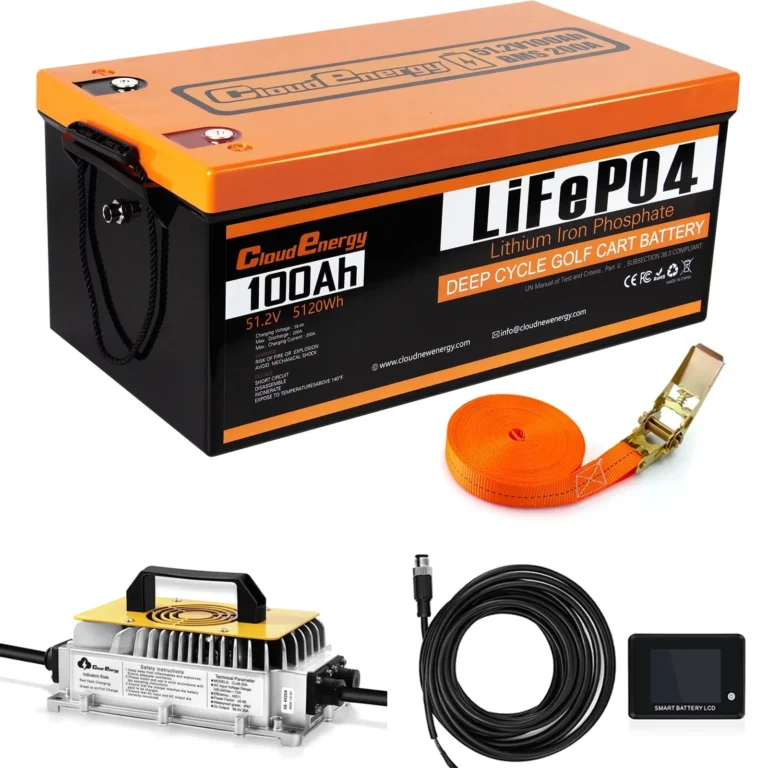
What's the Difference Between 48V and 51.2V Golf Cart Batteries?
A pack sold as 48V lithium is commonly a 16-cell LiFePO4 battery with a 51.2V nominal rating. Compatibility depends on the charger, BMS, controller voltage window, and accessory system, not the label alone.

- 48V is the vehicle class; 51.2V is the nominal voltage of sixteen 3.2V LiFePO4 cells in series.
- The lithium ranges are approximate because LiFePO4 has a flat middle curve.
- Compatibility requires four checks. First, the controller must tolerate the pack's maximum charging voltage.
- The label should not decide the purchase.
A pack sold as 48V lithium is commonly a 16-cell LiFePO4 battery with a 51.2V nominal rating. Compatibility depends on the charger, BMS, controller voltage window, and accessory system, not the label alone.
- Why 48V and 51.2V Golf Cart Batteries Share a System
- The Cell Math Behind 51.2 Volts
- Drop-In Compatibility and the Right Charger
- Should the Voltage Label Change Your Buying Decision?
- What This Looks Like on Real Carts
- Peak, Nominal, and Cutoff Voltages Explained
- Why the BMS Matters More Than the Label
- Getting the Charger Right
- Clearing Up the Common Myths
- FAQ
Why 48V and 51.2V Golf Cart Batteries Share a System
Direct answer: 48V is the vehicle class; 51.2V is the nominal voltage of sixteen 3.2V LiFePO4 cells in series. The arithmetic is 16 x 3.2V = 51.2V. The labels describe compatible systems only when the controller, charger, BMS, and accessories share the required voltage window.
A flooded 48V pack is also not fixed at exactly 48.0V. Six 8V Trojan batteries rest near 50.93V at full charge, and the charger raises voltage higher during charging. Voltage varies with chemistry, state of charge, temperature, and load.
The Cell Math Behind 51.2 Volts
| Point | 48V flooded reference | 16S LiFePO4 reference | Meaning |
|---|---|---|---|
| 100% | About 50.93V rested | About 53.6 to 54.4V rested after charge settles | Neither chemistry rests at its nominal label. |
| 75% | Between Trojan’s 70% 49.49V and 80% 49.99V rows | About 52.8 to 53.2V on the broad plateau | Lithium voltage gives only a rough estimate. |
| 50% | About 48.41V rested | About 52.0 to 52.8V | A shunt or BMS counter is better for lithium. |
| 25% | Between 20% 46.63V and 30% 47.26V | About 51.2 to 52.0V | Load can move both readings. |
| Empty or cutoff | Trojan’s table stops at 10 percent and 46.03V; a zero-percent value is not published there | Roughly 48 to 51.2V before protection; model cutoff may be 40 to 44.8V | Use exact BMS and charger data, not a universal cutoff. |
The lithium ranges are approximate because LiFePO4 has a flat middle curve. A manufacturer-specific BMS percentage or properly calibrated coulomb-counting monitor is more useful than assigning an exact percentage from a tenth of a volt.
Drop-In Compatibility and the Right Charger
Compatibility requires four checks. First, the controller must tolerate the pack’s maximum charging voltage. Second, the charger must use the battery maker’s LiFePO4 target. Third, the BMS continuous and timed peak current must cover the controller. Fourth, any reducer, contactor coil, and gauge must accept the voltage.
One 3.65V LiFePO4 cell maximum multiplied by 16 equals 58.4V, but not every 16S pack should be charged to that ceiling. Current products publish targets such as 57.6V or 58.4V. Use the exact pack and charger manual. A lead-acid charger with equalization must not be used simply because its connector fits. Every bundle in the Lithium Battery Bundle Finder comes with the charger matched to that pack, so the charger question is settled along with the battery.
Should the Voltage Label Change Your Buying Decision?
The label should not decide the purchase. Compare usable watt-hours, continuous current, peak-current duration, case size, weight, low-temperature charging, communication, and warranty. A 51.2V 60Ah pack has about 3.07kWh; a 51.2V 105Ah pack has about 5.38kWh. Both can be sold for 48V carts, but they do different work.
Controller demand is explained in the lithium C-rating guide. Cost and usable energy are compared in the battery ROI analysis.
Parts note: The 48V (51.2V) lithium bundles we stock run from 50Ah to 175Ah, each with its charger in the box. See lithium bundles
What This Looks Like on Real Carts
A stock 48V cart may run normally on a properly engineered 51.2V pack because its original flooded pack also charges and rests above 48V. That is not a universal drop-in promise. Older Club Car charging systems may need an OBC bypass, covered in the Club Car OBC bypass guide.
High-performance controllers can also have programmable overvoltage and undervoltage limits. Confirm those settings before connecting the pack. A BMS cutoff during acceleration can be an overcurrent event even when the dashboard shows charge remaining.
Peak, Nominal, and Cutoff Voltages Explained
Nominal voltage is the chemistry-based operating label. Peak charge voltage is the charger’s controlled upper target. Rested full voltage is measured after surface charge settles. Cutoff voltage is the BMS or controller protection threshold under specified conditions.
These four numbers must not be swapped. An Allied RS 51.2V pack, for example, publishes 58.4V charge, 40V cutoff, and 44.8V reconnect. Another 51.2V pack can use different thresholds.
Why the BMS Matters More Than the Label
The BMS monitors individual cell groups, pack current, temperature, and voltage. It can stop discharge even when pack-level voltage looks acceptable if one cell group falls first. It can also block charging below the permitted temperature.
This protection is why a pack’s current ratings and communication support matter more than whether its sticker says 48V or 51.2V. The limitations are expanded in disadvantages of lithium golf-cart batteries.
Getting the Charger Right
Use the manufacturer-matched lithium charger whenever possible. Confirm AC input, DC output voltage, charge current, connector polarity, interlock, and any CAN requirement. Charge current affects time and heat; a larger charger is not safe unless the BMS and cells permit it.
Remove or permanently disable flooded equalization schedules. After installation, confirm full-charge termination, cable temperature, BMS faults, and gauge calibration before returning the cart to normal use.
Clearing Up the Common Myths
The correct rule is narrow: a 51.2V nominal LiFePO4 pack is commonly designed for the 48V golf-cart class. It is compatible only when its maximum voltage and current fit the cart and it uses the right charger. A lead-acid dashboard gauge will often stay high for most of a lithium discharge because the voltage curve is flat.
Use a BMS display or shunt-based meter for state of charge, confirm every component rating, and continue through the golf-cart repair guides for model-specific work.
Frequently Asked Questions
What's the difference between 48V and 51.2V golf cart batteries?
There is no practical difference. 48V is the traditional rounded label, while 51.2V is the exact nominal voltage of a 16-cell LiFePO4 lithium pack (16 x 3.2V). A 51.2V lithium battery is fully compatible with a 48V golf cart.
Can I put a 51.2V lithium battery in a 48V golf cart?
Yes. A 51.2V lithium pack is the lithium equivalent of a 48V system and drops right in. You will need a lithium-profile charger and, on some Club Car models, an OBC bypass.
Reviewed and updated July 30, 2026 by the Golf Cart Lab team.