Navitas Controller Review: Honest 2026 Verdict
The most feature-rich cart controller you can buy, with Bluetooth tuning and regen braking. Here is what it really costs, the real owner quirks, and whether the sophistication is worth it for you.
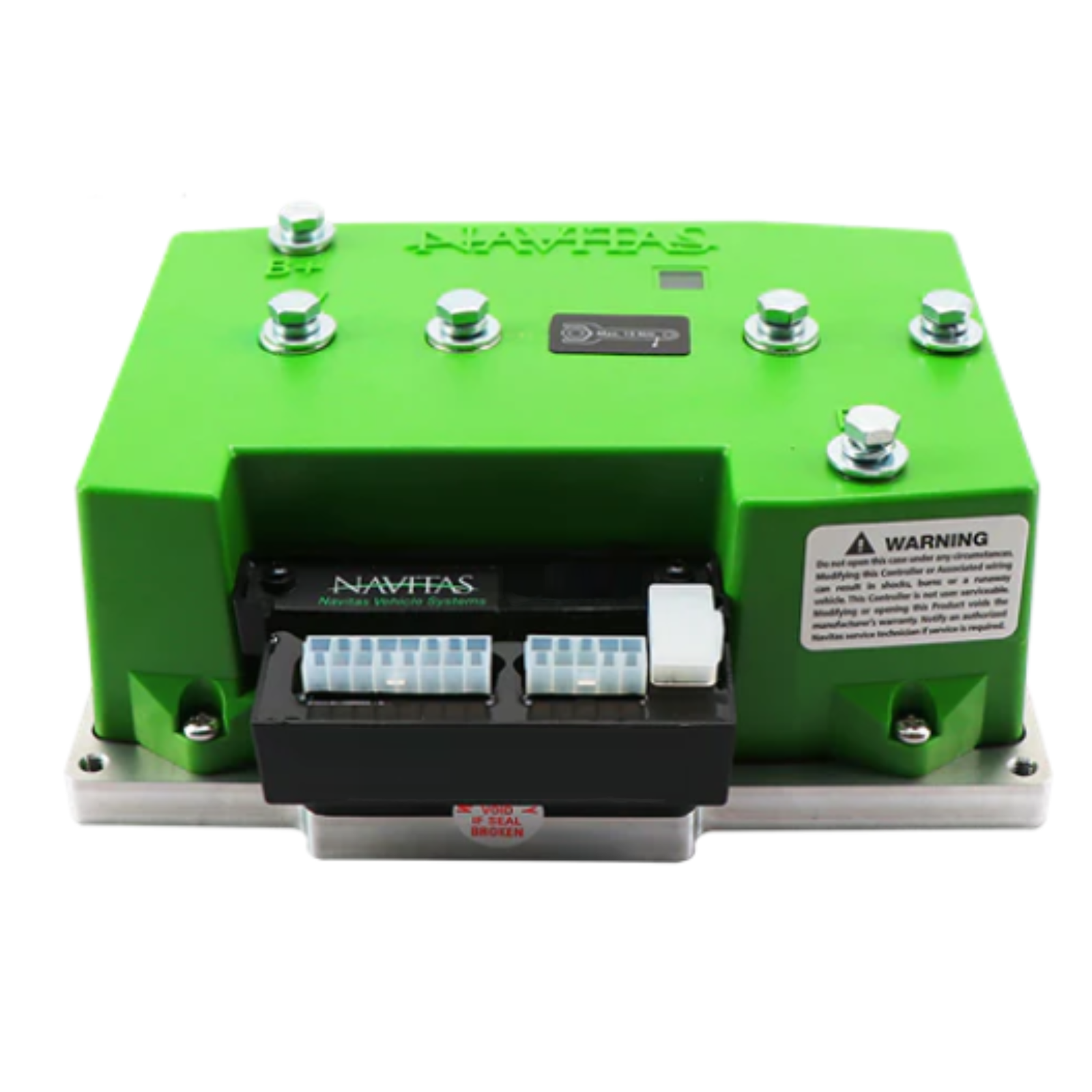
- The Navitas TSX 3.0 is the most feature-rich cart controller: high amperage, Bluetooth/OTF tuning, and regenerative braking.
- Regen braking recycles energy and controls downhill speed, something the basic Alltrax DC controllers do not offer.
- That sophistication brings occasional setup quirks the simpler Alltrax avoids, worth knowing before you buy.
- It is widely considered the best all-around 48V upgrade if you want tuning and features, not just raw power.
Quick verdict: The Navitas TSX 3.0 is the feature king of golf cart controllers, a 600A DC unit with Bluetooth tuning, an on-the-fly programmer, smooth reversing, and regenerative braking that recovers energy. For owners who want the most adjustable, highest-performing controller and will pair it with a quality battery, it is the top all-around pick. Just know that its complexity occasionally brings setup quirks that the simpler Alltrax avoids.
01 : What the Navitas TSX 3.0 Offers and Costs
Why is the product name the first thing to verify? Navitas sells two different controller paths. The TSX3.0 is a 600A DC controller for separately excited motors. The TAC2 is an AC controller offered in 440A and 600A versions and is paired with a compatible AC motor in conversion kits. They are not interchangeable boxes. To see which Navitas kit fits your cart, use the replacement controller finder.
| Current Navitas product | Published electrical specification | What stays or changes | Best fit |
|---|---|---|---|
| TSX3.0 DC | 36 to 48V, 600A MOSFET controller, up to 50A peak field current. | Keeps a compatible SepEx DC motor. Adds electronic reversing, regen, speed input, Bluetooth, and optional OTF. | Compatible Club Car, EZGO, or Yamaha SepEx cart that does not need a motor conversion. |
| TAC2 440A AC | 440A AC controller with regenerative braking, speed sensing, thermal protection, Bluetooth, and CAN on applicable modules. | Requires the matched AC motor, phase cables, feedback harness, mounting hardware, and vehicle harness. | Street, hill, and utility build where efficiency and controlled torque matter more than maximum current. |
| TAC2 600A AC | 600A version of the TAC2 family. | Same system conversion, with higher current capability and stronger battery, cable, and contactor demands. | Heavy, lifted, high-performance, or multi-passenger build with a battery that can support the requested current. |
The TAC2 manual identifies separate 440A and 600A product models for Club Car IQ/Precedent, EZGO TXT, Yamaha G29, and other conversions. Exact motor power varies by kit. The manual shows 4 kW packages on several golf-cart conversions, while Navitas also sells 5 kW motors and packages. Confirm the kit part number instead of assuming every 600A package includes 5 kW.
02 : What Real Navitas Owners Report
The feature advantage is real and measurable. Every current TAC, TAC2, and TSX3.0 controller has Bluetooth support for the Navitas Dashboard app. The app sets tire diameter and axle ratio, tunes speed and acceleration, shows live data, and can share diagnostic logs with support. The optional On-The-Fly programmer adjusts speed, regen, and acceleration within limits set in the app and can be physically locked.
The setup burden is also real. The controller must know the throttle type, nominal battery voltage, tire diameter, axle ratio, motor feedback, and vehicle switch logic. Navitas warns users not to pair the phone through the normal Bluetooth menu because the Dashboard app handles the connection. A cart that jitters, will not connect, or reports the wrong speed should be diagnosed through settings and inputs before parts are blamed. The measured-data comparison in Navitas versus Alltrax controller research is useful when the brand decision is still open.
03 : The Honest Navitas Trade-offs
| Feature | TSX3.0 DC | TAC2 AC |
|---|---|---|
| Motor retained | Compatible SepEx DC motor stays. | DC motor is replaced by matched AC motor. |
| Current options | 600A published controller. | 440A or 600A. |
| Regenerative braking | Yes on the matched SepEx platform. | Yes, controlled through the AC drive system. |
| Bluetooth app | Yes. | Yes. |
| Installation load | Controller, harness, setup, and supporting power parts. | Controller, motor, adapter, phase cables, feedback harness, setup, and supporting power parts. |
| Main risk | Buying for a series motor or wrong throttle platform. | Under-specifying battery discharge, contactor, cables, or motor fitment. |
AC can be more efficient because the controller can regulate motor flux and torque across a wide operating range, and it has no brushes to service. Regen can return some energy while slowing and reduces brake use, but it does not create free range. Battery limits, controller settings, vehicle weight, hills, and speed still dominate energy use.
04 : Is the Navitas Controller Worth It for You?
Choose TSX3.0 when the cart already has a healthy compatible SepEx motor and the goal is Bluetooth tuning, stronger current capability, smooth electronic reversing, and regen without replacing the motor. Do not buy TSX3.0 for a series motor. Club Car-specific harness and platform decisions are covered in Navitas controller upgrades for Club Car.
Choose TAC2 440A when a complete AC conversion is wanted and the vehicle is a street, hill, or utility build with a moderate current target. Choose TAC2 600A for a heavy or high-performance build only after confirming the battery’s continuous and peak discharge limits, BMS behavior, cable size, contactor rating, motor package, and drivetrain condition.
Skip Navitas if the owner wants a basic stock replacement with no app, no tuning, and minimal setup. The value comes from system control. Without a matched motor, harness, battery, and careful configuration, the extra capability becomes installation complexity. For a brand-neutral sequence, use the main golf-cart controller upgrade guide.
Parts note: The TSX 3.0 and TAC2 kits we stock are listed by cart and by the stock controller they replace. See controller kits
05 : The Bottom Line on the Navitas Controller
The Navitas TSX 3.0 is the most capable and adjustable golf cart controller most owners can buy, and for performance-minded drivers it is the top pick, the torque, tunability, and regen braking are a real step beyond a basic DC controller. The trade is complexity: paired with a strong battery and set up patiently, it shines, but its feature depth means there is more that can need configuring than with a plug-and-play Alltrax. If you want the best and are willing to tune, the Navitas is worth it; if you want simple and bulletproof, that is Alltrax’s lane.
Worth it if you want the most capable 48V controller and will use the Bluetooth tuning and regen braking, it is the best all-around feature set available. Think twice if you just want simple, set-and-forget power, where a basic Alltrax is easier to live with and avoids the setup quirks.
Frequently Asked Questions
Is the Navitas TSX 3.0 controller good?
Yes, it is the most feature-rich golf cart controller, offering 600A, Bluetooth/OTF tuning, and regenerative braking, and is widely considered the best all-around 48V upgrade. Its sophistication can bring occasional setup quirks the simpler Alltrax avoids.
Does the Navitas controller have regenerative braking?
Yes, the TSX 3.0 includes adjustable regenerative braking that recycles energy and controls downhill speed, a feature the basic Alltrax DC controllers do not offer.
Will a Navitas controller fit my golf cart?
Navitas offers controllers and full AC conversion kits for common EZGO, Club Car, and Yamaha platforms. Match the kit to your exact model and drivetrain, and confirm whether you need the DC controller or a full AC drive system before buying.
Is the Navitas worth it over an Alltrax?
If you want the most features, Bluetooth tuning, and regen braking, the Navitas is the stronger pick. If you just want simple, reliable added power without setup complexity, a basic Alltrax is easier to live with and usually cheaper.