What Are the Top 3 Golf Cart Brands?
Walk into any golf community in the United States and three names dominate every parking lot, maintenance shed, and dealer showroom: Club Car, EZGO, and Yamaha. These three manufacturers have earned their reputation through decades of engineering, millions of units sold, and a level of aftermarket support that no challenger has matched. This guide ranks them based on build quality, powertrain reliability, parts availability, resale value, and real ownership cost, pulling from fleet maintenance records, dealer surveys, and side-by-side dyno data to give you a clear, unbiased breakdown.
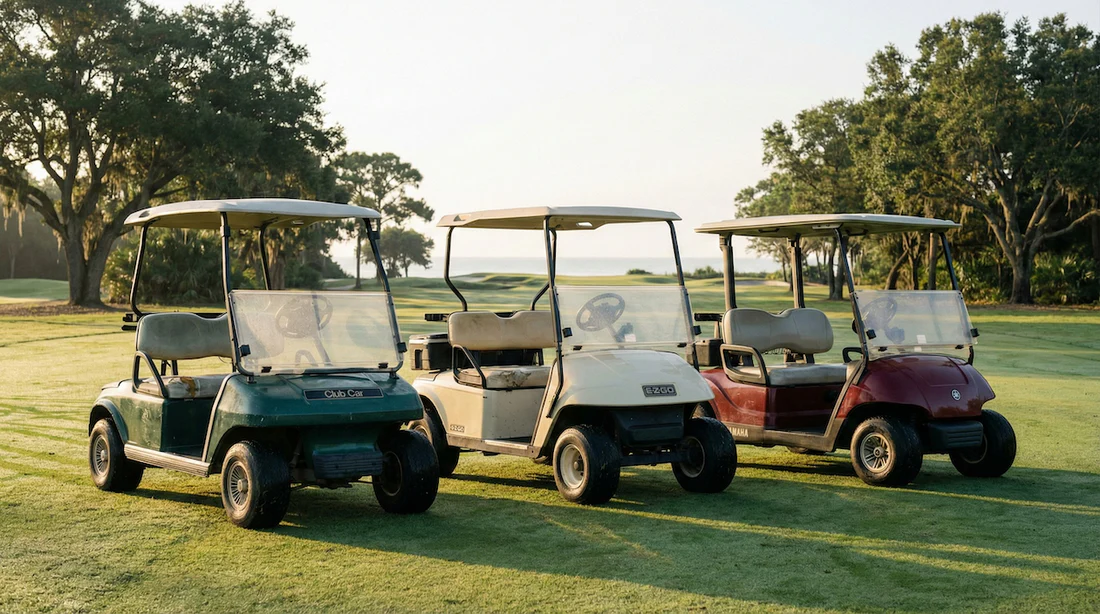
01 : Club Car, The Industry Benchmark
Club Car, now owned by Platinum Equity after its sale from Ingersoll Rand, has been building golf carts since 1958. Their Augusta, Georgia manufacturing facility produces the Onward, Precedent, and Villager lines, models that dominate both course fleets and private ownership. The reason Club Car sits at the top of most rankings comes down to one material decision: aluminum frames. While EZGO and Yamaha use steel, Club Car builds on rust-proof aluminum chassis that outlast steel by a factor of two in humid or coastal climates.
Their electric models run on 48V systems with Curtis or proprietary controllers. The Onward Lifted HP, their premium consumer model, pushes 19.9 mph stock and accepts aftermarket controller upgrades from Navitas or Alltrax with minimal wiring changes. Resale value runs 55-65% after five years, the highest in the industry.
Key Strengths
- Aluminum frame eliminates rust concerns entirely
- Highest resale value among all golf cart brands
- Massive dealer network across North America with certified service centers
- Onward platform accepts both gas and electric powertrains on the same chassis
- Precedent models still in fleet service after 15+ years with original frames
Where Club Car Falls Short
Parts cost more than EZGO equivalents, roughly 15-25% premium on OEM components. The proprietary On-Board Computer (OBC) on older Precedent models locks you into Club Car chargers unless you bypass it. And the MCOR throttle system on Precedent carts is a known maintenance item, jerky acceleration from a worn MCOR is one of the most common complaints.
02 : EZGO, The DIY Favorite
EZGO, owned by Textron Inc., has been in production since 1954. Their manufacturing facility in Augusta, Georgia (yes, the same city as Club Car) turns out the TXT, RXV, and Liberty lines. EZGO sells more golf carts than any other manufacturer in the United States, and their aftermarket ecosystem is unmatched. Walk into any auto parts store or golf cart supply shop and EZGO parts outnumber Club Car and Yamaha combined.
The RXV (introduced in 2008) brought the AC drivetrain to EZGO, featuring a regenerative braking system and an electronic speed controller that delivers smooth acceleration from zero. The TXT remains EZGO s most popular model, with a steel tube frame and a 36V or 48V DC system depending on the year. The platform is so well-documented that first-time owners regularly handle battery terminal repairs, reed switch bypasses, and motor swaps in their own garages.
Key Strengths
- Largest aftermarket parts catalog, OEM and third-party options everywhere
- Lowest cost of ownership for DIY mechanics
- RXV regenerative braking extends brake life and recovers energy on downhills
- TXT platform spans 1994 to present with high parts interchangeability
- Strong dealer network with Textron backing for warranty support
Where EZGO Falls Short
Steel frames rust. Period. If you live in a coastal area or a region with salt on the roads, an untreated EZGO frame will show corrosion within 5-7 years. The RXV state-of-charge meter throws cryptic error codes that confuse owners. And EZGO s stock speed on the TXT (12-15 mph) is slower than Club Car and Yamaha equivalents out of the box.
03 : Yamaha, The Gas-Powered King
Yamaha entered the golf cart market in 1979, decades after Club Car and EZGO established themselves. But the Japanese engineering giant brought something neither competitor could match: engine expertise from their motorcycle and marine divisions. Yamaha s gas-powered golf carts, particularly the Drive2 and G29 platforms, are considered the most refined combustion-powered carts ever sold.
The QuieTech EFI engine on the Drive2 is whisper-quiet compared to EZGO s gas models, and the electronic fuel injection eliminates the carburetor maintenance that plagues older carts. Their electric models run 48V systems with competent controllers, but Yamaha s real dominance is in the gas category. The Drive2 fuel system is overengineered in the best way, thick fuel lines, dual-filtration, and a sealed tank that resists ethanol damage.
Key Strengths
- Best gas-powered golf cart engines in the industry, bar none
- QuieTech EFI runs quieter than most electric carts at idle
- Independent rear suspension on Drive2 models (most competitors use leaf springs)
- Yamaha manufactures their own engines and drivetrain components, no outsourcing
- Strong 48V electric platform with proven reliability in fleet applications
Where Yamaha Falls Short
Yamaha s dealer network is thinner than Club Car and EZGO, especially in rural areas. Aftermarket parts are less common, and some components like the G29 steering box have known wear patterns that require adjustment. Resale value trails Club Car by about 10 percentage points.
04 : Head-to-Head Comparison Table
Here is how the top three brands stack up across the metrics that actually matter for daily ownership:
| Category | Club Car | EZGO | Yamaha |
|---|---|---|---|
| Frame Material | Aluminum | Steel | Steel |
| 5-Year Resale Value | 55-65% | 45-55% | 45-55% |
| Aftermarket Parts | Good | Excellent | Moderate |
| Best Powertrain | Electric | Electric | Gas EFI |
| Stock Speed (Electric) | 19.9 mph | 15-17 mph | 17-19 mph |
| DIY Friendliness | Moderate | Excellent | Good |
| Dealer Network | Extensive | Extensive | Moderate |
05 : Which Brand Should You Actually Buy?
The right brand depends on three factors: how you plan to use the cart, where you live, and whether you want to wrench on it yourself.
- Choose Club Car if you want maximum resale value, plan to keep the cart in a humid or coastal environment, or prefer a premium feel. The Onward Lifted HP is the strongest stock consumer electric cart on the market. Budget around $9,500-$14,000 new depending on configuration.
- Choose EZGO if you enjoy DIY maintenance, want the cheapest long-term ownership cost, or need a platform with massive aftermarket support. A used TXT from 2015-2020 runs $4,000-$6,500 and has parts available at every golf cart shop in the country. If you plan to upgrade to lithium batteries or install a Navitas controller, EZGO has the most documented upgrade paths.
- Choose Yamaha if you want a gas cart, need the quietest engine possible, or prefer independent rear suspension for rougher terrain. The Drive2 QuieTech is the gold standard for gas-powered golf carts, and Yamaha s engine reliability is unquestioned. Expect $8,500-$13,000 new for a gas Drive2.
06 : Maintenance Cost Breakdown by Brand
A single annual average hides the expensive years. The useful comparison is which recurring parts each platform consumes and how easily you can buy them.
| Cost driver | Club Car | E-Z-GO | Yamaha |
|---|---|---|---|
| Lead-acid battery set | Roughly $900 to $1,800 for common 36V/48V sets, plus installation; capacity, battery count, brand, and core charges drive the range. Expect replacement about every 4 to 7 years when watered and charged correctly, sooner under heat or neglect. | ||
| Lithium pack | Common drop-in systems run about $2,000 to $4,500. Club Car and E-Z-GO have the widest vehicle-specific kits; Yamaha fitment is available but may offer fewer plug-and-play harness choices. | ||
| Controller or inverter | Often $700 to $1,800 for an OEM or matched aftermarket unit; OBC/ERIC generation matters. | Often $600 to $1,700; TXT/PDS/RXV systems differ, but aftermarket choices are strongest. | Often $800 to $2,000; factory-specific AC parts and connectors can cost more and require closer model matching. |
| Common wear parts | Brake shoes, bushings, tie rods, MCOR/throttle parts; broad dealer and aftermarket supply. | Brake parts, bushings, solenoids, pedal-box parts, and DC motor brushes on older carts; usually the cheapest DIY sourcing. | Brake and steering parts on electric carts; gas models add oil, filters, spark plug, drive belt, and starter-generator belt. |
| Parts availability | Excellent OEM network and strong Precedent/Tempo/DS aftermarket; OEM electronics can carry a premium. | Best overall used and aftermarket availability, especially for TXT; RXV electronics are more specialized. | Good dealer availability, but fewer generic alternatives can raise price or lead time outside strong Yamaha markets. |
For routine service excluding a battery or controller year, budget roughly $150 to $450 for an electric cart and $250 to $600 for a gas cart when paying a shop. DIY owners can spend much less. Tire size, lift kits, climate, hours, and local labor rates matter more than the logo.
Frequently Asked Questions
What are the top 3 golf cart brands?
Club Car, EZGO, and Yamaha are the top 3. Together they hold the large majority of the U.S. market thanks to decades of engineering, dealer networks, and aftermarket support.
Which of the top 3 is best for customization?
EZGO, especially the TXT platform, has the widest and cheapest aftermarket for lifts, seats, and body kits, making it the top choice for custom builds.
Which top 3 brand has the lowest running costs?
Costs are similar, but Club Car and EZGO benefit from the deepest parts networks, so common wear items are cheap and fast to source. A lead-acid pack is the biggest recurring cost on any brand.
Is a gas or electric top-3 cart better?
Electric suits low-noise, low-maintenance use and dominates resale demand; gas suits long range and heavy towing. Yamaha’s EFI gas carts are the efficiency leader among gas models.