Club Car OBC Bypass Guide
When the factory charger will not click on, a dead On-Board Computer is the usual suspect. This guide proves the fault, walks the model-specific bypass, and matches the right smart or lithium charger to your cart.
- A charger that will not click even with a healthy pack and a healthy charger is the classic dead-OBC symptom. Prove it with the gray sense-wire jumper test before cutting anything.
- The bypass is not one universal splice. DS Regen 2 or IQ, legacy Precedent, and ERIC Precedent or Tempo or Onward each use different wiring, and ERIC carts have no separate OBC to bypass at all.
- Reroute the receptacle charge-negative to the main battery negative, then jump the vehicle lockout so the cart still drives. Seal every splice with heat shrink and re-torque the new ground.
- Match the charger to the cart state and battery chemistry: Lester 26610-21 works with a live OBC, Summit II or Links replaces a bypassed one, and the ERIC Delta-Q 940-0008 uses a battery-approved profile.
A click only tells half the story. It means the AC wall power is working and the charger relay is engaging. When you hear no click at all, the roadblock sits in the control circuit, and on a Club Car that circuit runs through the On-Board Computer (OBC). You can spend a few hundred dollars on a replacement module, or you can bypass it and move to a smart charger that manages the charge itself. This guide does both jobs safely, but only after you have proven the OBC is actually the fault.
The Brain That Bricks
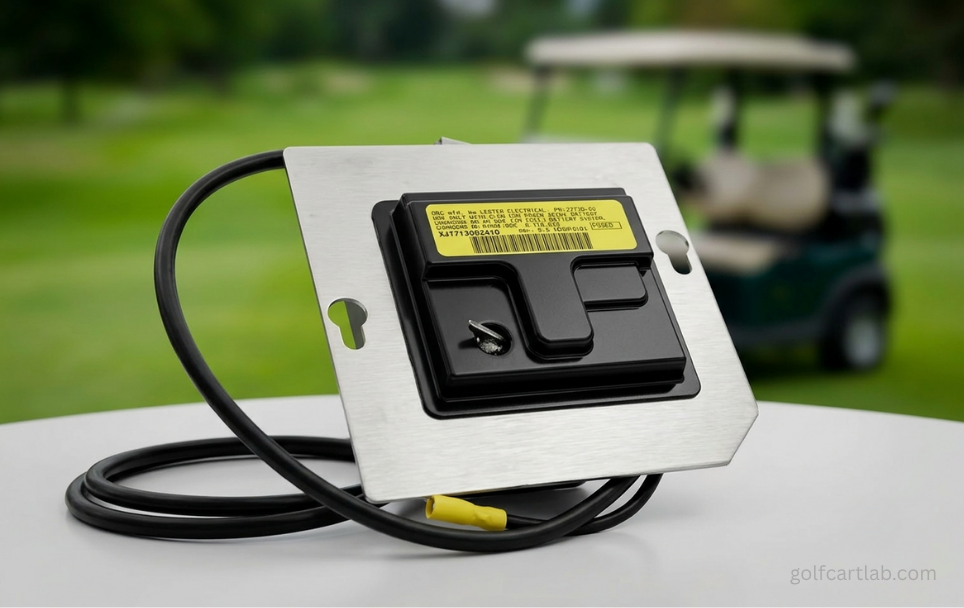
The OBC is a small potted module that lives in a hot, damp, vibration-heavy spot right on top of the battery pack. It tracks energy use and tells the factory charger when to run and when to stop. Over years of charge cycles, moisture and corrosion creep into the connector pins and the internal current shunt degrades. The classic symptom is a charger that will not click on even though the pack and charger are both healthy.
A real quirk worth knowing: a marginal OBC can let the cart run fine yet refuse to charge only when the pack is deeply discharged, because the module cannot wake the charger at low voltage. That intermittent behavior fools many owners into replacing a perfectly good charger first. The jumper test below removes all doubt in under a minute.
The Relay Test
Before cutting a single wire, confirm the OBC is the culprit. Switch Tow/Run to TOW, remove the key, and follow the factory battery-disconnect order first.
- Plug in the charger and listen for a click within five to ten seconds. No click is your starting signal.
- Locate the gray sense wire and its inline fuse near the charge receptacle.
- Pull the fuse and use a jumper to connect the gray wire to the main battery negative.
- If the charger now clicks on, the OBC is dead and the bypass just proved the charger itself works.
On the 2008 DS factory procedure, the gray sense lead sits near pack voltage before the charger plug goes in, drops to about 4 volts, then rises back to pack voltage after the relay closes. Those values belong to that DS OBC circuit only. They are not a Tempo, Onward, or ERIC test, so if your architecture does not match the diagram, stop before moving a wire.
Before any splice, set Tow/Run to TOW and disconnect the main positive and negative battery cables in the factory order. Club Car calls for waiting at least 90 seconds after disconnect so the controller capacitors discharge. Working on live 48V wiring can arc-weld your tools.
Rerouting the Charge Current
With the OBC out of the loop, the charging current has to reach the pack another way. You route it around the module directly to the battery negative.
- Find the thick black charge-negative wire on the back of the charging receptacle.
- Cut it as close to the wire-harness tube as possible.
- Crimp a 5/16 inch ring terminal onto the receptacle side of the wire.
- Bolt that new ring terminal directly to the main battery negative post and torque it to the manual spec for that terminal.
Bypassing the Drive Lockout
The OBC also runs a safety circuit that keeps the cart from driving while it is plugged in. Remove the OBC and that circuit stays open, which leaves the cart dead. You have to jump the lockout, and the wires differ by platform.
Club Car Precedent (legacy)
Locate the six-pin Deutsch connector near the OBC. On the harness side, join the blue and white wires. Confirm the exact pair against the Lester bypass-kit instruction for your connector rather than assuming a universal color pair.
Club Car DS (Regen 2 / IQ)
Find the wire-harness connector behind the batteries and jump the light blue wire to the white wire, again verifying against the kit sheet for your specific plug.
The gray sense wire
If you are fitting a smart charger, cut the gray sense wire and cap it, because smart chargers read voltage on their own. If you are keeping the stock charger as an emergency measure, connect the gray wire to main negative through a fuse and use a wall timer, because it will no longer shut off on its own.
OBC Fitment, Wiring, and Charger Reference by Platform
An OBC bypass is not one universal wire splice. Club Car changed the charging architecture, receptacle connectors, and vehicle lockout path across DS and Precedent production, and later ERIC vehicles have no separate legacy OBC at all. Start with the serial number, controller family, charge receptacle, and connector count, then use the matching factory service manual. A wire color seen on another cart is not a substitute for that identification. Confirm every part number below by serial, model, and connector.
| Platform & architecture | Location & documented job | Receptacle conductors / bypass approach | Service reference (confirm by serial) |
|---|---|---|---|
| DS 48V PowerDrive, Regen 2, or IQ with OBC | In the rear electrical compartment near the controller and solenoid. Pack-negative passes through it. Controls charge, energy tracking, charger shutoff, regen input, and the charger-plug drive lockout. | DS diagram shows a 10 AWG red positive, a 10 AWG black charge-negative routed through the OBC, and a fused gray sense lead at the receptacle. Use the connector-specific Lester kit, not a generic blue-to-white splice. | 1019099-01 or 103359401 seen across legacy variants |
| Precedent with legacy PowerDrive charger and OBC | Reached behind the rear bagwell access panel. Legacy system uses the OBC for charge control and lockout. | Lester kit 38836 covers Packard, six-pin Deutsch, bullet, and quick-disconnect ends. No single universal color pair applies; use the assembly that matches your six-pin connector. | 103359401 service-kit / catalog reference |
| Precedent built with ERIC after September 2013 | No separate legacy OBC. ERIC is a high-frequency charger and the vehicle controller performs the old OBC data functions. | There is no OBC bypass wire pair. Diagnose the ERIC receptacle, controller interlock, battery profile, and charger. | Confirm build date and charger model |
| Tempo and Onward with ERIC | No separate legacy OBC in the ERIC architecture. | Do not apply DS or early Precedent bypass steps. Diagnose the charger profile, receptacle, pack voltage, and controller. | Confirm by serial / model in the current manual |
Smart-Charger Compatibility
The charger algorithm matters as much as the connector. A flooded, AGM, and lithium profile each use different voltage limits and termination logic, so a bypass only changes the control path, it does not make a wrong algorithm safe. Select an algorithm approved by your battery manufacturer, and if the profile you want is not on the charger’s approved list, contact the vehicle, charger, or battery maker rather than guessing.
| Vehicle state | Documented charger path | Compatibility decision |
|---|---|---|
| Working legacy OBC retained | Factory PowerDrive charger follows the OBC command. Lester lists model 26610-21 as the aftermarket charger designed to work with an active OBC. | Do not assume an ordinary stand-alone smart charger will receive the OBC command. |
| Legacy OBC intentionally bypassed | Lester lists its 29840-21 Links replacement and Summit Series II options. Summit installs may need the vehicle-specific harness that disables the OBC. | Match AC input, nominal pack voltage, chemistry, connector, and algorithm. Bypass changes control only. |
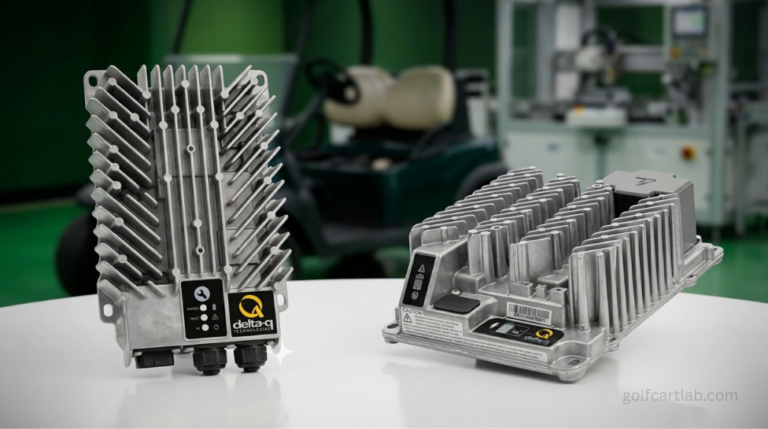
| ERIC charger | Delta-Q identifies Club Car ERIC 940-0008 / IC0650-024-CC, with profile 31 for OE flooded batteries and profile 188 for Trojan T-875. | Use only the profile supported for this OEM charger. These are not generic field-programmable QuiQ units. |
Parts note: For a 48V Club Car with the 3-pin charge receptacle and the OBC bypassed, the TORO720 15A multi-chemistry smart charger we stock plugs straight in, no adapter needed. View charger
A Safe Model-Specific Decision Sequence
- Set Tow/Run to Tow where fitted, remove the key, disconnect AC, and follow the factory battery-disconnect order. Wait at least 90 seconds for the controller capacitors to discharge.
- Read the cart serial and charger model. Find the legacy OBC and confirm whether pack-negative physically routes through it. No OBC means no OBC bypass.
- Photograph the receptacle and every connector before disassembly, then compare against the exact factory diagram or Lester kit sheet. DS colors do not authorize a color-for-color Precedent change.
- Test pack voltage, receptacle voltage, fuse continuity, and the model-specific sense and relay behavior before condemning the computer. A deeply discharged or open pack can imitate an OBC failure.
- When bypass is justified, use a purpose-built harness, fuse every positive lead, keep the strain relief, and torque hardware to the manual. Lester specifies 22 in-lb for the DS receptacle nut only, which is not a battery-terminal torque.
- After install, verify the drive lockout with the charger connected, confirm the charger profile, and watch the first full cycle. Stop for excess heat, venting, odor, or a battery that diverges from the pack.
The dividing line is simple: legacy OBC carts can either keep the OBC with a compatible commanded charger or remove it with a documented harness and a stand-alone charger, while ERIC carts use a different architecture and should be diagnosed as ERIC systems. Bypassing pairs especially well with lithium, because a LiFePO4 pack manages its own balancing and cutoff and the lead-acid-era OBC only gets in the way. Keep a photo of your splices and re-torque the new ground after the first few cycles, since a loose bypass ground is the most common reason a good bypass fails a week later.
Frequently Asked Questions
What does the Club Car OBC do?
The On-Board Computer monitors battery charge and controls the factory charger, telling it when to turn on and off. It also runs the drive lockout that stops the cart while it is plugged in. If the OBC fails, the charger may not activate even when the batteries are low.
How do I bypass the OBC on a Club Car Precedent?
On a legacy Precedent, reroute the black charge-negative wire from the receptacle directly to the main battery negative, then jump the blue and white lockout wires on the six-pin Deutsch harness so the cart still drives. Confirm the exact wire pair against the Lester bypass-kit sheet for your connector, because ERIC-era Precedents have no OBC to bypass.
Can I use a smart charger without an OBC?
Yes. Smart and lithium chargers such as the Lester Summit Series II or a proper 48V lithium charger read pack voltage on their own and are designed to work without the OBC. Installing one usually requires bypassing the OBC so the charger can sense the battery directly, and you must still match the charger algorithm to your battery chemistry.
Which Club Cars actually have an OBC to bypass?
48V DS models with Regen and IQ drive systems from 1995 and legacy Precedents from 2004 use a separate OBC. Pre-1995 36V DS carts with a resistor-coil system have none. Precedents built after September 2013, plus Tempo and Onward, use the ERIC charging system where the vehicle controller handles those functions, so there is no OBC bypass on those carts.