
Golf Cart Stuttering? Club Car MCOR Diagnosis & Fix
Is your cart jerking or hesitating? The "Digital Hiccup" is the hallmark of a failing throttle sensor. We show you how to confirm the failure.
01 : The “Digital Hiccup”
Inside the black plastic box under your floorboards is a potentiometer, a wiper arm that slides across a carbon track. It translates foot pressure into a 0-5k Ohm signal.
Why it Fails: Over thousands of pedal presses, the wiper wears a groove into the carbon. This creates “dead spots” where the signal drops to zero instantly, causing the stutter.
02 : Field Diagnostics
Before breaking out tools, try these two specific field tests to confirm the theory.
Test 1: The “Pump Method”
A temporary fix that works 90% of the time to confirm the diagnosis.
- Turn Key OFF and Tow/Run switch to TOW.
- Rapidly pump the accelerator (floor it and release) 30 times.
- The Science: This friction scrapes away oxidation on the internal track.
- Result: If the jerking stops, the MCOR is confirmed bad.
Test 2: The “Creep” Test
Drive extremely slowly. If the cart shudders at low speed but smooths out when floored, the “beginning” of the throttle track is worn out.
03 : Multimeter Lab Test
To be 100% sure, we visualize the resistance signal drop.
- Access: Locate the 3-Pin connector coming from the MCOR (Throttle Control).
- Setup: Set Multimeter to 20k Ohms. Probe the White and Yellow wires.
- The Reading: Pedal Up should be ~6.8k Ohms. Pedal Down should be ~1k Ohms.
- The Fail: If numbers jump erratically (e.g., 6.0… 0.0… 4.2) while pressing slowly, you have found the dead spot.
04 : MCOR Generation Guide
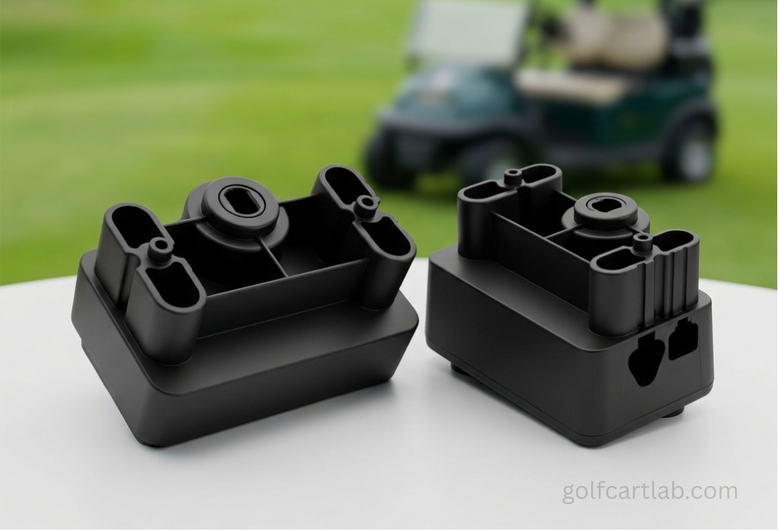
[Image comparing Club Car MCOR 1, MCOR 2, and MCOR 4 units side-by-side to show visual differences]Club Car has updated this part multiple times. Do not buy the wrong version.
| Version | Era / Model | Visual ID | Action |
|---|---|---|---|
| MCOR 1 | 2000-2004 DS | Tall Black Brick | Use Conv. Kit AM293201 |
| MCOR 2 | 2004-2011 Precedent | Pedal Mounted | Use Conv. Kit AM293001 |
| MCOR 4 | 2012-Present | Identical to MCOR 3 | Direct Replacement |
05 : Why Club Car Uses an MCOR at All
The MCOR exists because the Club Car DS and Precedent moved away from the old multi-microswitch V-glide throttle to a smooth, solid-state pedal input. Instead of a stack of switches clicking through speed steps, the MCOR feeds the controller one continuous resistance signal that maps pedal travel to power. That is great for a smooth ride, but it puts all your throttle eggs in one wear-prone potentiometer. When that carbon track develops a groove, the controller briefly reads zero, cuts power, then reads a real value again and slams the power back on. That off-then-on cycle is the exact stutter and lurch owners describe, and it is why the symptom is so distinctive: a pure electrical dead spot produces a mechanical-feeling jerk.
06 : Rule Out the Cheap Stuff First
Before you condemn the MCOR, eliminate the imposters that mimic its symptoms. A stuttering Club Car can also be caused by loose or corroded battery connections that sag under load, a tired battery pack that browns out on acceleration, or a worn solenoid whose contacts arc and chatter. The tell that separates these from an MCOR fault is where the stutter lives. An MCOR dead spot is tied to a specific point in pedal travel and repeats at that same spot every time, usually right off the line. A battery or solenoid problem tends to get worse under heavy load or on hills and correlates with pack voltage, not pedal position. Load-test the pack and wiggle-test every high-current connection before spending on a throttle sensor.
07 : Installation Notes That Save a Redo
When you do replace the unit, the details matter on a Club Car. Always disconnect the main battery pack and set the Tow/Run switch to Tow before you unplug anything, because working live on the throttle circuit can spike the controller. On the pedal-mounted MCOR 2 and later, confirm the pedal returns fully and the sensor arm seats correctly against its stop, since a lazy return or a slightly misaligned arm will read as a low resting resistance and create a whole new set of drivability complaints. After the swap, cycle the key and do a slow creep test in a clear space to confirm the dead spot is gone through the entire pedal range, not just at the top.
08 : Do Not Get Caught by the Generation Trap
The single most common ordering mistake is buying by looks. An MCOR 4 is visually identical to the older MCOR 3, and a Precedent pedal-mounted unit will not bolt into a DS the way an MCOR 1 brick did, which is exactly why the pre-2012 carts need the correct conversion kit rather than a raw sensor. Match the part to your model year and platform using the generation table above, and resist the temptation of the twenty-dollar unbranded clones. Those units use inferior carbon tracks and thin wiper arms, so they wear a fresh dead spot within a season and you end up doing the whole job twice. An OEM or AM-prefix unit is the difference between a repair that lasts years and one that fails again before the next season.
One last field reminder: keep the old MCOR connector clean and dry when you swap. A perfect new sensor plugged into a corroded three-pin connector will still read erratically, so give those pins a look, treat them with dielectric grease, and lock the connector fully before you call the job done.
09 : MCOR voltage sweep and generation limits
For the 48V Club Car DS IQ procedure, the three-pin MCOR uses a white reference and yellow signal wire. With the black probe on battery number 4 negative, the white wire should be about 4.65V. The yellow signal should be about 0.32V with the pedal up and rise smoothly to 4.65V at full pedal. The controller detects a throttle fault below 0.20V or above 4.80V. These are DS IQ values, not a universal MCOR pinout.
| Test point | DS IQ reading | Meaning |
|---|---|---|
| White reference | About 4.65V | Reference must be present before judging signal. |
| Yellow signal, pedal up | About 0.32V | Should remain above the 0.20V fault boundary. |
| Yellow signal, full pedal | About 4.65V | Below about 4.60V can prevent rated speed. |
| Handset sweep | 0% to 100% | Rise must be smooth, not just correct at endpoints. |
Identify controller family, MCOR generation, connector count, and wire colors first. The factory diagnostic is a powered voltage sweep, so a resistance figure from a different DS or Precedent generation is not substituted here.
FAQ
What is normal MCOR voltage?
On the cited DS IQ system, the yellow signal rises from about 0.32V to 4.65V. Confirm the generation before applying it.
Can a bad MCOR cause stutter?
Yes. An interrupted or non-smooth signal can make controller output change abruptly. Check supply, signal, connectors, limit switch, and pedal adjustment.
Can I test with resistance only?
Use the correct powered voltage-sweep procedure. Resistance tests vary by generation and do not prove the controller receives a usable live signal.
Is a Precedent MCOR test the same as a DS test?
Not automatically. Identify controller family, connector and wire colors before using a DS IQ test value.
The same component appears under different names across brands. The cross brand naming and the sweep method are covered in the golf cart pedal sensor test guide.
