EZGO TXT Reed Switch Bypass for Consistent Charging
If your EZGO TXT randomly refuses to move, or the charger won’t kick on despite healthy batteries, a failed reed switch inside the charger receptacle is the likely cause. Here is the verified bypass procedure, wiring reference, and safety checks.
- A failed reed switch makes the cart act like the charger is still plugged in, killing drive power even with a healthy battery pack.
- Bypass only the small fused interlock lead, never the two heavy charge-current wires.
- Wire colors and receptacle style differ between 36V PowerWise and 48V Delta-Q harnesses; match your receptacle before cutting anything.
- Keep the inline fuse in the circuit and land the interlock lead on true pack positive, not an intermediate battery jumper.
- Bypassing removes the drive-away interlock, so tag the charger cord and train every driver to unplug before moving the cart.
If your EZGO TXT randomly refuses to move, or the charger won’t kick on despite having healthy batteries, you are likely dealing with a failed reed switch. This tiny, fragile glass component inside the charger receptacle is notorious for breaking and disabling the entire cart. If you would rather replace the part than bypass it, a direct-fit replacement reed switch fits 1996-2008 TXT, Medalist, Shuttle, and ST Express carts. This guide covers the exact EZGO TXT reed switch bypass procedure, the verified receptacle wiring, and the checks that confirm you are actually looking at a reed switch failure before you start cutting wires.
What Is a Reed Switch on a Golf Cart?
A reed switch is a small magnetically operated switch: two thin ferrous contacts sealed inside a glass tube, which snap together when a magnet comes near and spring apart when it moves away. It has no moving lever and nothing to press, so it can be sealed away from water and dust entirely. That sealed, contactless design is exactly why golf cart makers use it.
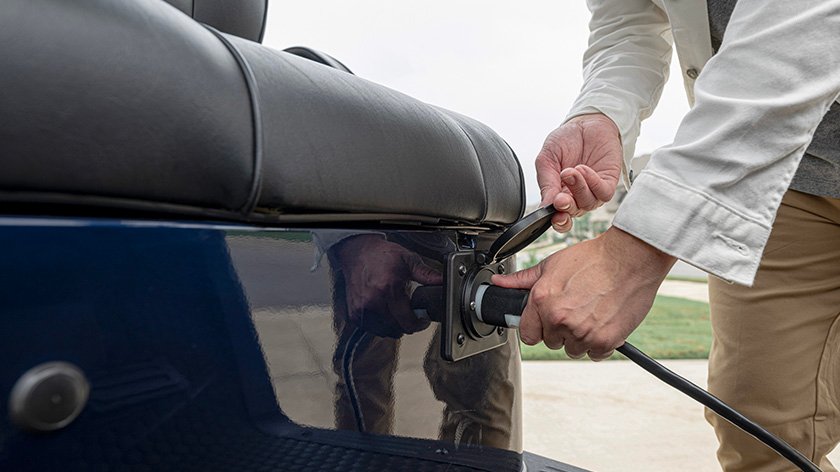
On an EZGO TXT, the reed switch sits in the charger receptacle circuit. When you plug the charger in, a magnet in the plug closes the reed switch, and that closed switch is what tells the cart it is on charge, locking out the drive system so nobody drives off with the cord attached. When the reed switch fails, it usually fails open, and the cart simply never registers that the charger is connected. The charger sits there doing nothing, which is why a dead reed switch reads to most owners as a dead charger or a dead battery pack.
They fail because glass contacts are fragile and the contacts themselves erode. Vibration cracks the tube, moisture creeps into a cracked seal, and the contacts pit and stop conducting after enough charge cycles. It is a cheap part in a punishing location. The rest of this guide covers confirming that diagnosis and bypassing it. For the circuit itself, including what each element does and how to trace it, see the reed switch wiring and circuit path guide.
Understanding the Reed Switch Failure
The reed switch is the charger interlock on many older E-Z-GO TXT and Medalist electric carts. With the charger unplugged, the fused interlock lead supplies the run circuit so the key, direction selector, pedal switch, and solenoid can wake up. When the PowerWise charger handle is inserted, the magnet in the handle opens the reed switch and interrupts that feed so the cart cannot drive away while plugged in.
That behavior is real, but the wire colors are not universal across every TXT year and charger style. The common 36V PowerWise TXT and Medalist receptacle uses two heavy charge leads plus a small fused reed-switch lead, often red or red with a white tracer depending on harness year. Later 48V Delta-Q style harnesses use a different receptacle, and the service wiring references an ignition interlock lead in the charger receptacle harness instead. Do not use a generic color rule until you match your receptacle label, manual, and battery pack voltage.
Before you bypass it, prove it is the reed switch
- Pack voltage is normal: a healthy 36V lead-acid pack is usually near 38V after rest, and a healthy 48V pack is usually near 51V. A flat pack can mimic a bad interlock.
- Charger unplugged test: unplug the charger from the cart and wall, key on, direction selected. If the cart is dead but accessories work, continue with interlock checks.
- Fuse check: inspect the small inline fuse on the reed-switch lead. Replace only with the same rating used on your harness, commonly 10A on many TXT bypass writeups.
- Meter check: with the cart safely in Tow or with the pack disconnected for cutting work, identify the fused small lead and verify whether it loses pack-positive feed through the receptacle when the switch fails.
Meter Readings That Confirm a Failed Reed Switch
Before cutting anything, put a meter on the circuit. These are the readings that separate a failed reed switch from a flat pack, a blown fuse, or a bad solenoid.
| Measurement | Healthy Reading | What a Bad Reading Means |
|---|---|---|
| Pack voltage at rest, charger unplugged | Near 38V on a healthy 36V lead-acid pack, near 51V on a healthy 48V pack | Well below that is a discharged or failing pack, which mimics an interlock fault. Charge before diagnosing further. |
| Across the inline fuse on the interlock lead | Voltage on both sides, essentially the same reading | Voltage on one side only means the fuse is open. Replace with the same rating, do not bypass it. |
| Cart-side interlock lead, charger unplugged | Full pack positive present | No feed with the charger unplugged is the classic failed reed switch signature, the cart thinks it is still plugged in. |
| Same lead while wiggling the charge plug | Steady reading, no dropouts | A reading that flickers or wakes the cart briefly confirms an intermittent reed switch rather than a solenoid or key switch fault. |
Tools Required
This is a quick, inexpensive fix that requires minimal supplies. For OEM replacement parts and safety guidelines, always refer to the E-Z-GO official support manuals.
- Hardware: 9/16″ or 1/2″ insulated wrench (for battery terminals), wire cutters, and wire strippers.
- Materials: one 5/16″ or 3/8″ ring terminal matched to your battery stud size, and a wire crimper. Heat shrink tubing is highly recommended.
- Optional replacement part: if the receptacle is cracked or you would prefer a factory-spec repair over a permanent bypass, an OEM reed switch restores the original charger interlock instead of removing it.
- Safety: switch the cart to TOW mode (if equipped with a Run/Tow switch) before disconnecting any battery cables.
The Bypass Procedure
Follow these steps for the classic EZGO TXT reed switch bypass on 36V PowerWise TXT and Medalist carts. If your cart has a 48V Delta-Q receptacle, use the reference table below first. The bypass target is the fused interlock lead, not either large charger-current cable.
| Receptacle style | Lead to identify | Function | Bypass point |
|---|---|---|---|
| 36V PowerWise TXT / Medalist | Small fused red or red/white reed-switch lead | Feeds the run or solenoid enable circuit when charger is unplugged | Move the fused cart-side lead to main pack positive, using the correct ring terminal |
| 36V PowerWise charge leads | Two heavier charge wires, often pack positive and pack negative by harness | Carry charger current to the battery pack | Do not jumper these for a reed-switch bypass |
| 48V TXT / RXV Delta-Q style | Charger receptacle harness with main pack leads plus ignition interlock lead | Service diagrams show main pack connections and an ignition interlock lead to the control harness | Match the service manual for your serial range; do not assume the 36V red-wire procedure applies |
- Locate the receptacle: lift the seat and find the rear of the charge receptacle. Confirm whether it is a 36V PowerWise style or a 48V Delta-Q style before cutting anything.
- Identify the fused interlock wire: on the common 36V PowerWise setup, look for the small fused wire coming out of the molded reed-switch area. Leave the inline fuse in the circuit.
- Cut only the cart-side fused lead: cut the small interlock lead at the receptacle body. Tape and isolate the abandoned receptacle-side stub so it cannot contact the pack.
- Crimp the terminal: strip about 1/4 inch of insulation, crimp on a ring terminal that matches your battery or solenoid stud, and seal it with heat shrink.
- Land it on true pack positive: attach the fused small lead to the main positive battery pack stud, not to an intermediate jumper between two batteries. Tighten the hardware to the torque listed for your battery terminal style or battery maker.
Verified receptacle part references
| Part reference | Where it fits | Use note |
|---|---|---|
| 73051G29 and related 73051 / 73063 PowerWise refs | Common 36V PowerWise TXT and Medalist replacement listings, usually 1996 and newer TXT / Medalist electric | Use only on matching 36V PowerWise carts. Check the old receptacle and charger plug before ordering. |
| 602529 | 48V Delta-Q style E-Z-GO receptacle listings for RXV and some 48V TXT applications | Not the same as the 36V PowerWise receptacle. Wiring and interlock behavior differ by harness. |
| Factory service parts manual by serial range | All TXT and Medalist variants | Best source when a cart has been converted from lead-acid, changed charger style, or had the receptacle replaced before. |
Testing the Circuit
Once the fused lead is bolted to true pack positive, switch the cart back to Run, turn the key on, select Forward, and press the pedal. You should hear the solenoid click and the cart should attempt to move. If it does not click, stop and meter the circuit before replacing the solenoid.
- Pack-positive confirmation: place the meter black lead on main pack negative and red lead on the new ring terminal. It should show full pack voltage, not 6V, 8V, or 12V from a single battery.
- Fuse confirmation: meter both sides of the inline fuse. Voltage on one side only means the fuse is open.
- Solenoid confirmation: if the interlock feed is present but the solenoid stays silent, move to key switch, direction switch, pedal switch, and solenoid coil testing.
- Charger confirmation: plug the charger in only after the drive test. A charger that still will not start may have a pack-voltage, charger, OBC, or receptacle-current-lead problem rather than a reed-switch problem.
Parts note: Circuit tests good but the cart still will not charge? The charger is the next suspect. Our E-Z-GO chargers are listed by receptacle and battery type. E-Z-GO chargers
Critical Tech Warnings
- Do not bypass the inline fuse: the small interlock wire is not sized like a charger cable. The fuse protects that control feed.
- Do not jumper the large charge leads: those are pack-current conductors. The bypass applies only to the small fused interlock lead.
- Do not copy a wire color blindly: old TXT carts often have repaired harnesses, lithium conversions, and aftermarket receptacles. Use the meter and the manual.
1. Confirm pack voltage, charger unplugged, and inline fuse good. 2. Identify the small fused reed-switch or interlock lead, not the heavy charge leads. 3. Move the fused cart-side lead to true main pack positive only if your receptacle matches the 36V PowerWise bypass layout.
Frequently Asked Questions
How do I know it is the reed switch and not a dead battery or solenoid?
Check pack voltage first. A healthy 36V lead-acid pack reads near 38V at rest and a healthy 48V pack reads near 51V. If voltage is normal, unplug the charger completely, key on, select Forward, and try the pedal. If accessories and lights work but the cart will not move only while the charger memory is stuck, and wiggling the charge plug briefly wakes it up, that intermittent plug-sensitive behavior points to the reed switch rather than the solenoid or key switch.
Which wire do I actually cut for the EZGO TXT reed switch bypass?
On the common 36V PowerWise TXT and Medalist receptacle, it is the small fused interlock lead, often red or red with a white tracer, never the two heavier charge-current wires. On a 48V Delta-Q style receptacle the harness differs, so match your service manual and meter the circuit before cutting anything.
Is it safe to permanently bypass the reed switch?
The bypass removes the factory interlock that stops the cart from driving away while the charger is plugged in. It is a widely used repair, but only the fused small interlock lead should be modified, the fuse itself must stay in place, and every driver should be trained to unplug the charger before moving the cart.
Will this bypass work on a 48V EZGO with a Delta-Q charger?
Not automatically the same way. The 48V Delta-Q style receptacle and harness reference an ignition interlock lead rather than the 36V PowerWise reed-switch wiring. Match the wiring to your service manual by serial range instead of applying the 36V procedure to a 48V cart.