Can You Run 4 12V Batteries in a 48V Golf Cart?
Running four 12V batteries is a common way to build a 48V pack, but only wired correctly in series. Here is how it works, when it is the right choice, and how it compares to 6V and 8V setups.
01 : How the Series Wiring Works
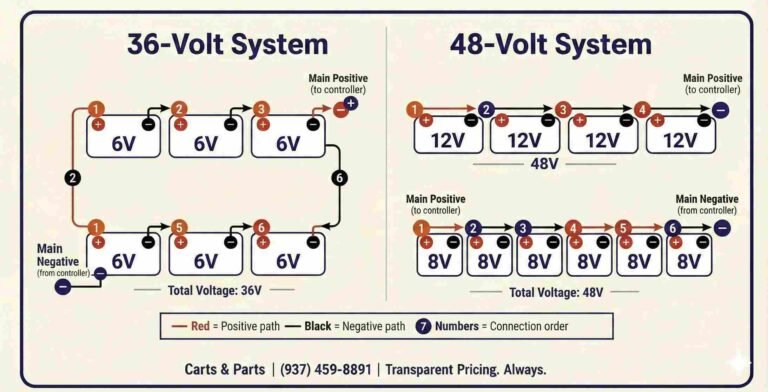
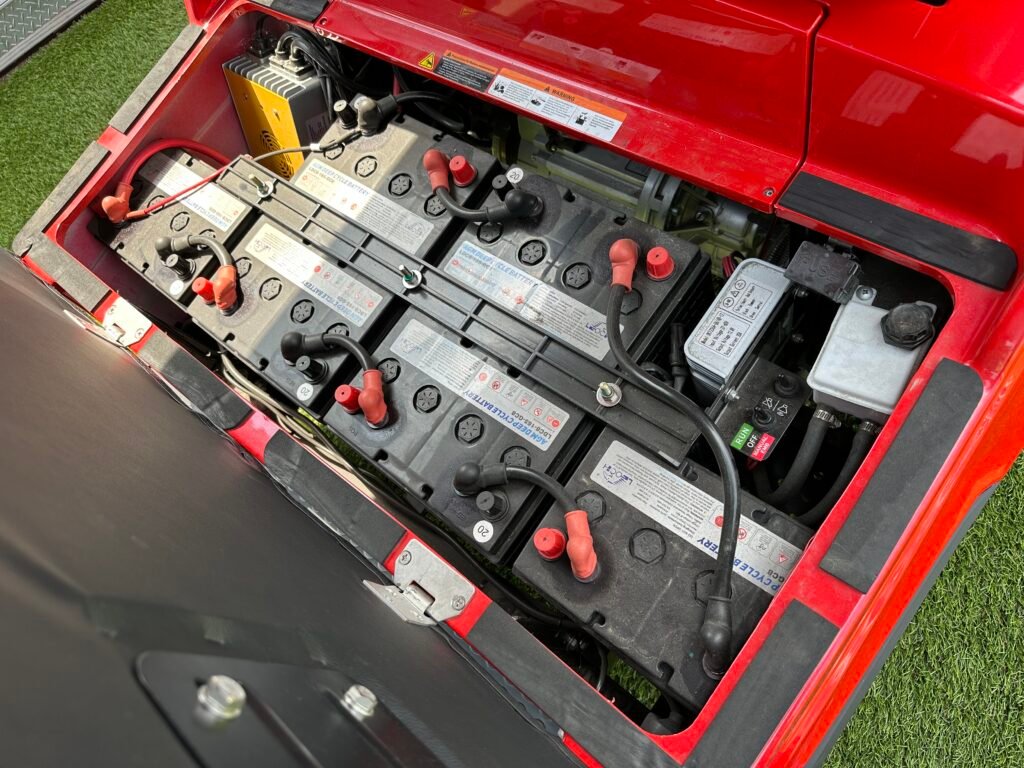
Yes, you can run four 12V batteries in a 48V golf cart, and it is one of the most common conversions on EZGO TXT/RXV, Club Car DS/Precedent, and Yamaha Drive platforms. The math is simple: four 12V batteries wired in series (positive of one to negative of the next, all the way down the string) sum to 48V nominal. This replaces the more traditional layout of six 8V batteries or eight 6V batteries that many stock 48V carts use. Series wiring adds voltage while keeping the amp-hour (Ah) capacity of a single battery, so the string voltage climbs but the capacity stays whatever one 12V battery is rated at.
Voltage adds up when batteries are wired in series. Connecting the positive terminal of one battery to the negative of the next, in a chain of four 12-volt batteries, sums to 48 volts: 12 + 12 + 12 + 12 = 48V. The free positive on one end and free negative on the other become your main pack terminals that feed the controller.
This is the same principle used for any golf cart pack, only the building-block voltage changes. If you want the deeper math on how series voltage drop affects the whole system, the voltage drop test guide shows how to verify each connection is solid.
02 : Why Use 4 12V Batteries in a 48V Golf Cart
The appeal of four 12V batteries is simplicity. Fewer batteries means fewer terminals to clean, fewer cables to fail, and faster swaps. It is also the standard arrangement when converting to many drop-in lithium packs, which are commonly built as 12V or 51.2V modules.
- Fewer connections: Four batteries means six fewer inter-cell links than an eight-battery 6V pack, fewer points of corrosion and resistance.
- Easier maintenance: Less watering (for flooded) and faster cleaning.
- Lithium-friendly: Many lithium conversions naturally use four 12V modules.
03 : The Range And Amp-Hour Trade-Off
Series wiring adds voltage but does not add amp-hours. Four 130Ah batteries in series create a nominal 48V, 130Ah pack, not 520Ah. The frequently quoted “12V has less range” rule is directionally useful for Group 31 batteries, but it is not universal: Trojan’s purpose-built 12V T-1275 is rated 150Ah at the 20-hour rate, while its 8V T-875 is 170Ah at that same rate.
| 48V pack layout | Battery count | Published capacity example | Relative range | Maintenance points | Fitment note |
|---|---|---|---|---|---|
| 4 x 12V flooded | 4 | Group 31: 130Ah at 20-hour rate; GC12 T-1275: 150Ah at 20-hour rate | Usually lowest to medium among common lead layouts; a true GC12 can outperform a smaller Group 31. | 24 cells to water, 8 posts, 3 series jumpers | Needs a tray-safe hold-down. Group 31 and GC12 cases are not the same size. |
| 6 x 8V flooded | 6 | T-875: 170Ah at 20-hour rate | Common 48V reference range | 24 cells to water, 12 posts, 5 series jumpers | Fits many factory 48V trays, but confirm case dimensions and hold-down. |
| 8 x 6V flooded | 8 | T-105: 225Ah at 20-hour rate | Usually the longest of these common lead examples | 24 cells to water, 16 posts, 7 series jumpers | Requires room and support for eight cases and the higher pack weight. |
| Single 48V-class LiFePO4 | 1 pack | Current OnePack family starts at 105Ah; model capacity varies | Do not compare Ah alone. Lithium usually allows more usable depth and holds voltage flatter. | No watering; two main terminals plus BMS, charger, and communication connections | Requires the pack maker's bracket, charger profile, BMS current capability, and controller compatibility. |
No fixed percentage range loss applies to every 4 x 12V conversion. Compare published capacity at the same rate, then account for vehicle load and voltage under acceleration. The lead-acid versus lithium cost analysis covers usable energy and lifecycle cost.
04 : Wiring The Pack Safely
Secure every battery with a tray-compatible hold-down and protect cables from edges and moving parts. Use four batteries of the same model and age. Cable size must come from the vehicle and controller instructions, cable length, and duty cycle, not merely the number of batteries. Tighten each terminal to the battery maker’s published value for that terminal type; there is no universal golf-cart torque. After assembly, verify polarity and pack voltage at the main terminals before connecting the controller.
Club Car OBC caveat: changing from six 8V lead batteries to four 12V lead batteries does not inherently require “reprogramming” the OBC because the nominal pack remains 48V. On an OBC-equipped cart, the main negative cable still has to pass through the OBC current-sense opening and the charger must match a 48V lead-acid profile. A lithium conversion may require the battery maker’s OBC bypass and lithium charger instructions, but that is a chemistry and charging-system change, not simply a battery-count change.
Do not mix case sizes or use starting batteries to fill a tray. Confirm the cart’s actual voltage with the 36V or 48V identification guide, disconnect power using the serial-matched service procedure, and use insulated tools and eye protection. The existing voltage-drop test is the right final check for a hot or weak series connection.
Frequently Asked Questions
Can you run 4 12V batteries in a 48V golf cart?
Yes. Four 12V batteries wired in series (12 plus 12 plus 12 plus 12) equal 48V nominal and run reliably. Verify 48V at the main terminals before connecting the controller.
Do 4 12V batteries give less range than 6 8V?
Usually yes. A series string carries the amp-hours of a single battery, so four 100Ah 12V batteries make a roughly 100Ah pack versus about 170Ah for six 8V golf-cart batteries.
What wire size do I need for the series links?
Typically 4 to 6 AWG for the jumper links, torqued to spec. A single loose series connection carries full pack current and will heat, arc, and burn a terminal.
Do I need to reprogram a Club Car after switching battery count?
On Club Car the On-Board Computer meters charge and may need reprogramming or bypassing after a battery-count change, and the charger must match the new pack voltage and chemistry.
Lab Verdict: Yes, 4 12V batteries in a 48V golf cart wired in series gives exactly 48 volts and runs reliably. Expect simpler maintenance but often less range than a 6V/8V pack. Match batteries, wire series links cleanly, and verify 48V before connecting the controller.