Club Car DS Won’t Go Forward or Reverse: Fix Guide
When a Club Car DS won’t go forward or reverse, the fault is almost always in one of five places. This guide tests them in the fastest order so you stop guessing and start driving.
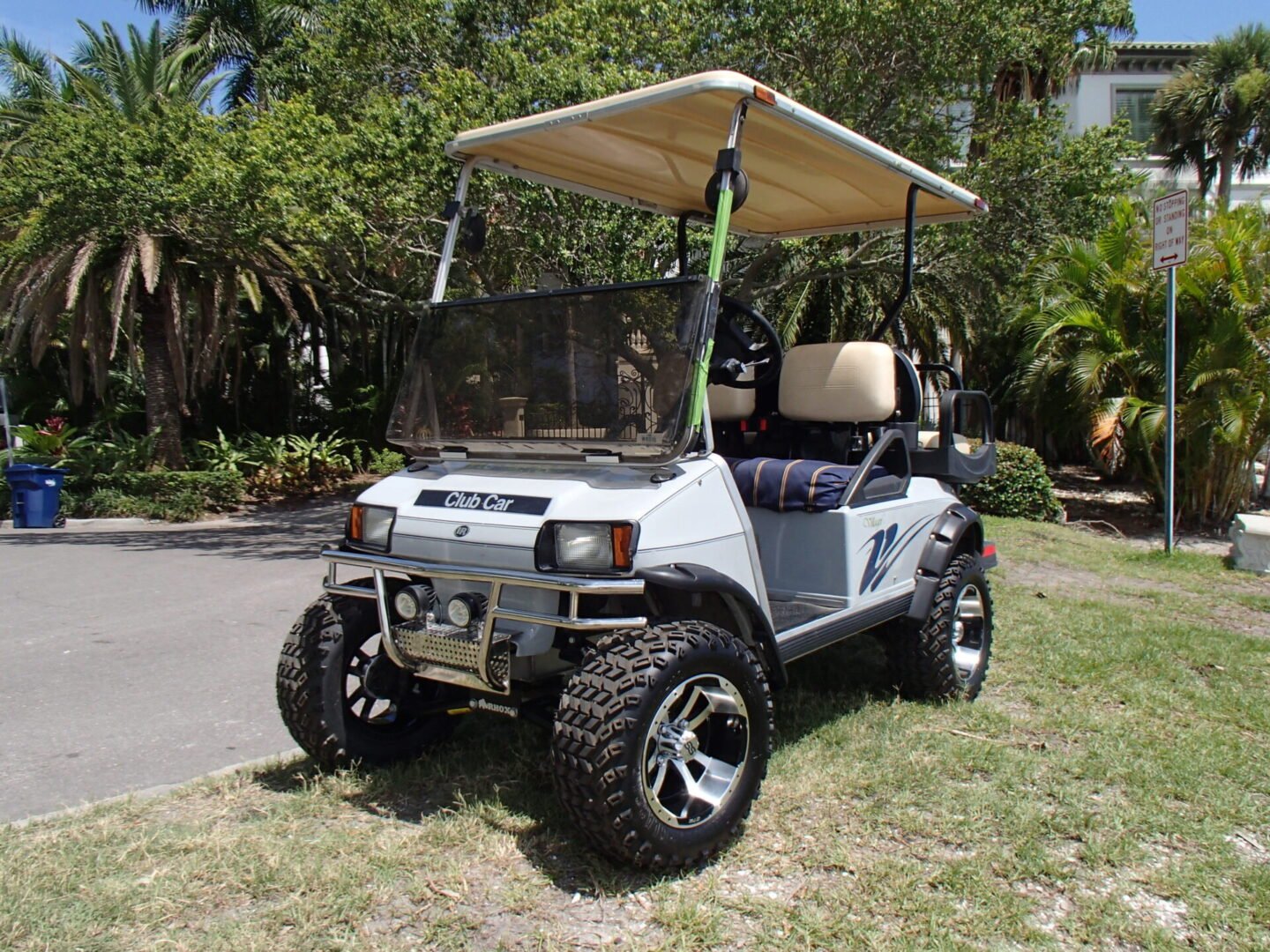
- The DS drive circuit is a chain: battery, key switch, F/R switch, controller, solenoid, motor. Any broken link produces the same no-move symptom.
- A rested 48V DS pack should read near 50.9V; a rested 36V pack near 38.2V, per Trojan’s voltage table.
- The forward/reverse switch is the #1 DS culprit, Club Car’s owner manual specifically calls out checking its contacts and connections.
- If the solenoid clicks but the cart won’t move, test voltage across the large posts, near 0V is good, several volts means burnt contacts.
A Club Car DS that has lights, a working horn, and a charged pack but refuses to move in either direction is sending a clear message: power is reaching the cart but not the motor. The break sits somewhere between the key switch and the motor terminals. Diagnose it in order, cheapest, most common faults first, and you will usually find the culprit in under 30 minutes with nothing more than a multimeter.
01. Start Here: Confirm You Have Power
Before you chase the drive circuit, rule out the simplest causes. A DS that is completely dead, no lights, no key-on tone, has a power problem, not a drive problem. A DS that has accessories but no movement is the classic “power in, nothing out” pattern this guide solves.
Trojan’s flooded deep-cycle voltage table gives the useful battery baseline: after the pack has rested with no charging or discharging, 100% state of charge is about 38.20V on a 36V pack and 50.93V on a 48V pack. Trojan also says to charge batteries that test from 0% to 70% state of charge and warns that voltage alone does not confirm a bad battery. So the low-voltage numbers below are diagnostic stop signs, not Club Car controller cutoffs.
- Pack voltage: A rested 48V DS should be near 50.9V fully charged; a rested 36V DS should be near 38.2V. If a 48V pack is around 46V or a 36V pack is around 34V, it is deeply discharged enough to mimic a drive fault. Charge and battery-test first.
- Battery connections: Wiggle every cable lug. Trojan lists terminal torque by terminal type and warns that overtightening can damage posts, so snug means correct torque for the installed battery, not as tight as possible.
- Main fuse / breaker: Some DS layouts have inline fusing, a gray sense-lead fuse, or model-specific charge and OBC wiring near the receptacle. Check the wiring diagram for your DS generation before calling it a controller failure.
02. Why a Club Car DS Won’t Go Forward or Reverse
The DS drive circuit is a chain: battery, key switch, forward/reverse switch, controller, solenoid, motor. The cart only moves when every link passes current. Break any one link and you get the exact same symptom, a cart that sits still in both directions. That is why “it won’t move” feels mysterious: a dozen different parts produce one identical result.
The good news is that the chain is also the diagnostic map. By testing for voltage at each junction in order, you find the precise point where power stops. Whatever sits just past that point is your faulty component. A symptom-first walkthrough like our interactive golf cart troubleshooter follows this same logic if you prefer to be guided question by question.
03. Step-by-Step Diagnosis (Fastest Order)
Set your multimeter to DC volts. Lift the rear wheels off the ground or jack the cart safely so it can’t lurch. Then work the chain:
- Battery pack at rest. Confirm the pack is charged before diagnosis. Trojan’s table puts a rested 48V flooded pack at 50.93V full and 46.03V at roughly 10% state of charge; a rested 36V pack is 38.20V full and 34.52V at roughly 10% state of charge.
- Key switch output. Probe the small wire leaving the key switch with the key ON. No voltage out with voltage in means a bad key switch or upstream feed.
- F/R switch. Club Car’s DS owner manual specifically calls for checking Forward/Reverse switch contacts and wire connections for condition and tightness. With voltage reaching the F/R switch, select Forward and check for output on the forward wire, then Reverse.
- Micro-switch / pedal. On many DS carts the accelerator closes a micro-switch that energizes the solenoid. Press the pedal and listen, you should hear the solenoid click.
- Solenoid. No click means the coil is not being energized or the coil is dead. A click with no movement means burnt contacts, see section 05.
- Controller. If voltage reaches the controller but never leaves toward the solenoid or motor, and everything upstream tests good, the controller is the prime suspect.
This is the same disciplined, measure-don’t-guess approach we use when deciding whether parts even swap between carts, see whether golf cart motors are interchangeable before you buy a replacement motor you may not need.
04. The Forward/Reverse Switch: The #1 DS Culprit
On the Club Car DS, the forward/reverse switch is a real maintenance item, not just a forum suspicion. Club Car’s DS owner manual tells owners to check the F/R switch contacts and wire connections and make sure connections are tight. The 2004 DS service manual also shows generation-specific F/R and charger-receptacle wiring differences, so year matters.
Pull the switch cover and inspect the copper contacts. Black, pitted, or carbon-glazed contacts cause intermittent or no power transfer. Light pitting can be cleaned with fine emery; heavy burning means replace the switch assembly. Catalog references vary by year and drive system: Red Hawk lists FR-001 for DS 36V electric 1983.5+, FR-003 for DS PowerDrive 48V electric 1996+, FR-021 as a heavy-duty DS 48V electric 1996+ switch, and FR-022 as a heavy-duty DS 48V 1996+ / 36V with controller 1990-1994 reference. Treat those as fitment examples and confirm by serial number before ordering.
05. Solenoid and Controller: When It Clicks But Won’t Move
If you hear a firm click but the DS still won’t move, you’ve narrowed it to two parts. Test the solenoid first because it is cheaper and fails more often. With the pedal pressed and the solenoid engaged, measure across the two large solenoid terminals: it should read close to 0V because the contacts are closed and passing current. A reading of several volts across engaged contacts means the contacts are burnt or resistive and the solenoid is suspect.
Solenoid fitment also varies by year, voltage, and controller system. Red Hawk’s catalog separates examples such as SOL-1006 for 36V DS electric 1988-2005, SOL-1010 for 36V V-Glide models, and 48V Club Car electric listings such as SOL-1005, SOL-1014, and SOL-1035. Do not call one 400A or 48V solenoid universal. Match the coil voltage, terminal count, mounting, and vehicle serial.
If the solenoid passes that test and full voltage reaches the controller but the motor stays dead, the controller is the likely failure, especially if it runs hot or shows no output. Controllers are the most expensive link, which is exactly why you test them last, only after clearing the cheaper suspects. For a deeper look at high-current switching parts, our guide to the 400 amp solenoid upgrade for 36V vs 48V carts explains how contact rating affects reliability.
Club Car’s charging and computer wiring can also confuse diagnosis on some DS models. The 2004 DS service manual identifies PowerDrive charger storage behavior, the onboard computer, charger receptacle wiring, and a gray sense-lead fuse holder, but that is not a universal “10-second reset” for every no-move symptom. Use the wiring diagram for your year before bypassing or replacing OBC-related parts. For related charging quirks, see our Club Car OBC bypass guide.
06. Bottom Line
A Club Car DS that won’t go forward or reverse is a chain-break problem, not a mystery. Confirm pack voltage and the main fuse, then walk the circuit from key switch to F/R switch to solenoid to controller, stopping at the first junction where voltage disappears. Nine times out of ten you’ll land on the forward/reverse switch or the solenoid, both inexpensive, both DIY-replaceable in an afternoon. Test in order, replace only what the meter condemns, and you’ll have the DS rolling again without throwing money at parts it never needed.
Power in but no movement equals a break between key switch and motor. Test fuse, then key switch, then F/R switch, then solenoid, then controller, in that order, and replace only the link the meter proves bad.
All of the checks above assume the fault is electrical. If the motor spins while the cart stays still, the electrical side has already proved itself and the break is mechanical, which is covered in the guide to a golf cart that will not move while the motor spins.
Frequently Asked Questions
Why won’t my Club Car DS go forward or reverse?
The most common reasons a Club Car DS won’t go forward or reverse are a blown fuse or tripped breaker, a worn forward/reverse switch, a failing solenoid that no longer passes battery current, or a dead controller. Test them in that order with a multimeter to isolate the fault.
How do I know if it’s the solenoid or the controller?
With the key on and pedal pressed, listen for a solenoid click. No click usually points to the solenoid coil, key switch, or F/R switch. A solid click with no movement points to burnt solenoid contacts or a failed controller, confirm by checking for full battery voltage on both large solenoid terminals when engaged.