Are Golf Cart Motors Interchangeable? Axle Spline Counts Explained
Whether a motor bolts in comes down to five things: axle spline count, shaft and mount, voltage, series-versus-SepEx-versus-AC type, and controller matching. Here is how to check each before you buy.
- Golf cart motors are NOT freely interchangeable. Five things must line up: spline count, shaft and mount, voltage, motor type, and controller.
- Axle spline count is the first hard barrier, an EZGO 19-spline and 21-spline shaft will not share the same input.
- A Series motor and a SepEx motor are wired and controlled differently, so they are not drop-in swaps for each other.
- Always confirm the exact spline count and type by serial before buying a replacement.
If your motor is failing, do not purchase a random replacement until you verify your transaxle requirements. For step-by-step motor continuity testing, head over to the Diagnostic Lab.
01 : The Mechanical Barrier: Axle Spline Counts
Why can two motors with the same voltage still fail to interchange? The motor must match the transaxle coupler, pilot diameter, mounting face, bolt circle, shaft depth, and available case space. Spline count is only the first gate. A motor can have the right 19-tooth female spline and still place its housing, terminals, speed sensor, or end cap where the cart cannot accept it.
| Platform reference | Common published motor spline | Voltage and motor family | Fitment warning |
|---|---|---|---|
| Club Car DS series | 10-tooth female spline in D&D and Navitas replacement families. | Commonly 36V series on older carts, with later 48V applications. | Series motor needs a series controller and correct F/R circuit. Confirm transaxle and serial. |
| Club Car DS IQ, Precedent, and Onward DC | 10-tooth replacement option is common. | 48V separately excited, also called SepEx, on many IQ systems. | Speed sensor, field terminals, harness, and controller calibration must match. |
| EZGO Marathon, Medalist, and TXT series, 1988 and later examples | 19-tooth female spline is published on common Dana-axle replacement motors. | 36V series, with some 48V series builds. | Do not confuse the 19 motor splines with the 21-tooth gear on the differential side of some input shafts. |
| EZGO DCS, PDS, and TXT48 SepEx | 19-tooth is common in the replacement market. | 36V or 48V separately excited. | A series motor is not a drop-in replacement. Controller, field wiring, and speed sensing differ. |
| EZGO RXV | Model-specific, do not generalize from TXT. | AC drive on many RXV carts, with an electronic motor brake. | Use a complete RXV-compatible motor and controller package and confirm by serial. |
| Yamaha early G-series | 10-tooth appears on older-Yamaha replacement tables. | Mostly 36V DC applications. | G-series overlap is real. Count the coupler and match the motor number. |
| Yamaha G8, G9, G14, and G16 examples | A published AMD 19-tooth series motor lists these models with EZGO applications. | 36V series in the cited fitment. | That listing does not make every Yamaha 19-tooth. Confirm exact model and transaxle. |
| Yamaha G19, G22, G29 Drive, and Drive2 | 10-tooth and 19-tooth systems exist across Navitas motor options and Yamaha generations. | 48V SepEx or AC depending on model. | Use the original motor tag, Yamaha parts catalog, coupler count, and controller type before ordering. |
Catalog cross-references must be confirmed by serial and model. Count the internal grooves in the motor coupler, not the helical gear teeth deeper inside the differential. Photograph the motor tag and measure the pilot diameter, mounting-face depth, bolt spacing, shaft engagement, and case length before removing the old motor.
02 : The Electrical Barrier: Series vs. Sepex
Series and separately excited motors route current differently. A series motor carries armature and field current through one series circuit and usually uses a mechanical forward/reverse switch to swap field direction. A SepEx motor gives the controller separate armature and field control, which enables electronic reversing, speed regulation, and regenerative braking when the platform supports it. An AC induction motor needs three-phase output plus a speed and temperature feedback system from its matched AC controller.
| Motor type | Typical terminals and feedback | Controller requirement |
|---|---|---|
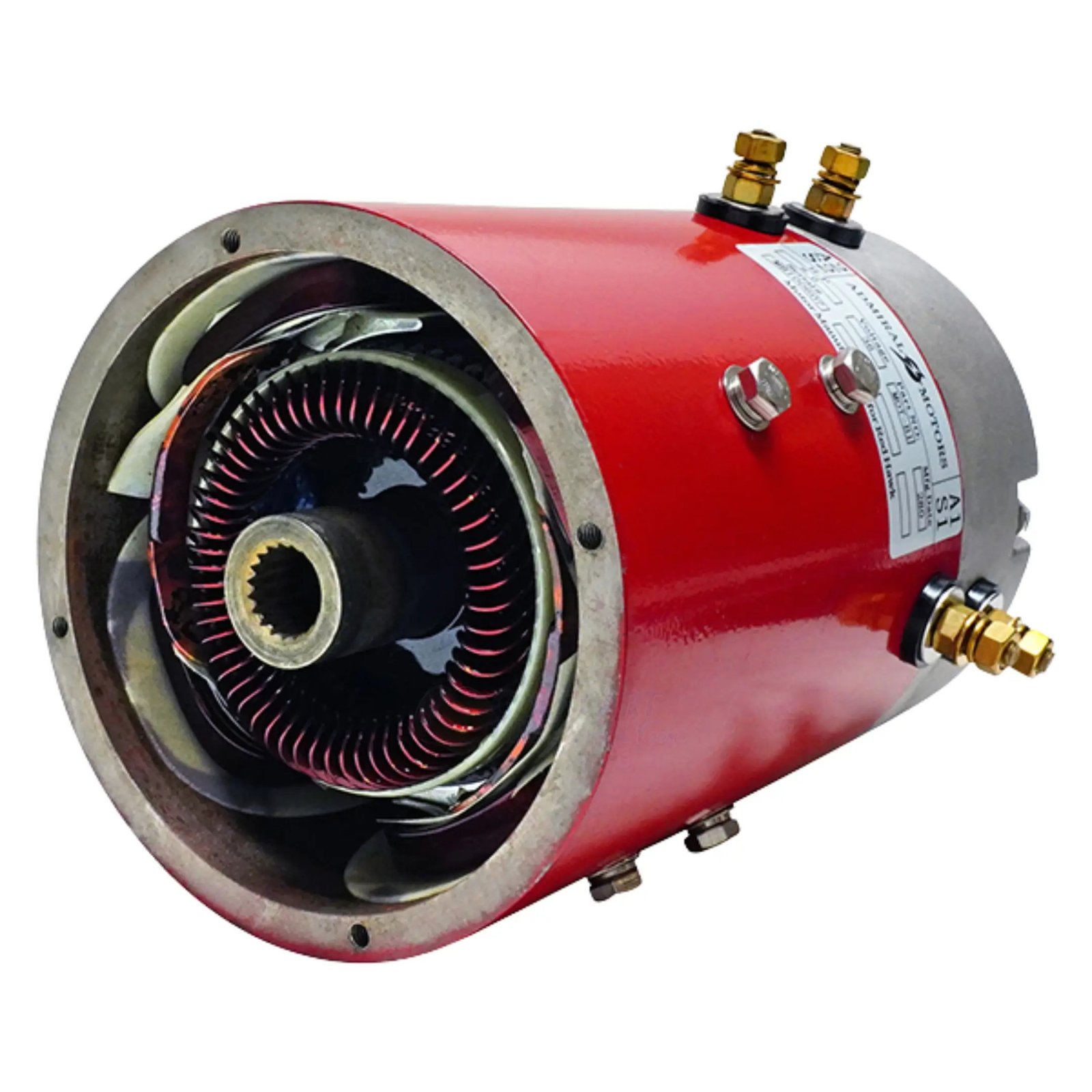
| Series DC | A1, A2, S1, S2, usually no speed sensor. | Series controller and correctly rated forward/reverse and contactor circuit. |
| SepEx DC | Armature and field terminals, often a speed sensor. | Platform-specific SepEx controller with the correct throttle, field map, and harness. |
| AC induction | Three motor phase cables plus encoder or speed and temperature feedback. | Matched AC controller, harness, motor adapter, and software profile. |
A matching bolt pattern cannot solve an electrical mismatch. A series motor on a SepEx controller will not be controlled correctly, and a random AC motor cannot run from a DC controller.
03 : Voltage Mixing: 36V vs 48V Motors
Voltage is a system rating, not a permission slip. A 36V series motor may spin on a 48V pack, but the higher available voltage raises unloaded RPM and heat risk. The result depends on motor design, controller current limit, tire diameter, axle ratio, load, hill use, cooling, and duty cycle. The cited 19-spline AMD motor is specifically published at 8 hp on 36V and 11.4 hp on 48V with a minimum 400A controller, upgraded cables, solenoid, and forward/reverse switch. That is evidence for that motor, not every stock 36V motor.
A 48V motor on 36V may run weakly or outside its intended efficiency range. Never choose by voltage alone. Match the motor’s published voltage and current limits to the controller, contactor, battery, and cable system.
04 : AC Motor Conversions
An AC conversion is interchangeable only as a complete engineered kit. The Navitas TAC2 manual lists separate 440A and 600A controllers with a 4 kW motor, mounting plate, phase cable, speed and temperature harness, and vehicle-specific adapter. Club Car IQ/Precedent, EZGO TXT, and Yamaha G29 conversions use different harness modules and instructions even when the controller family is the same.
AC gains come from precise field control, efficient operation over a wider speed range, regenerative braking, and fewer wear items because there are no brushes. The price is more integration work. Battery discharge capability, contactor, cable size, charger interlock, motor temperature sensing, throttle type, tire size, and axle ratio all have to be configured. The definitive rule is straightforward: a donor motor is usable only when the mechanical interface, electrical family, controller software, feedback devices, voltage, and physical envelope all match.
Related Diagnostics
Before buying any replacement, confirm five things match: axle spline count, shaft and mount, pack voltage, motor type (Series, SepEx, or AC), and a compatible controller. Verify the spline count and motor type by your cart’s serial, a size that looks right is not proof the motor drops in.
Spline damage is also a failure mode in service, not only a fitment question. A stripped input spline leaves the motor spinning with the cart stationary, as covered in the motor spins but cart will not move diagnosis.
Frequently Asked Questions
Are EZGO and Club Car motors interchangeable?
Not directly. They use different mounts, shaft splines, and often different controllers. A motor built for one platform will not simply bolt into the other without matching the spline count, mount, voltage, and controller type.
What is the difference between a Series and a SepEx motor?
A Series motor ties its field and armature windings in series and is controlled by a simpler controller. A SepEx (separately excited) motor powers the field independently, which allows regen and finer speed control, but it needs a matched SepEx controller and is not swap-compatible with a Series setup.
How do I find my golf cart motor spline count?
Pull the motor or inspect the input shaft and count the splines, or match your cart by serial number against the parts catalog. EZGO commonly uses 19 or 21 spline shafts, so the count must be confirmed before ordering a replacement.
Can I put a more powerful motor in my golf cart?
Only if it matches the spline, mount, and voltage and is paired with a controller rated for the extra current. Dropping in a high-power motor without upgrading the controller will either underperform or trip faults, and a mismatched spline will not connect to the axle at all.