Golf Cart Turf Tires
Turf tires spread load across a wide, shallow-tread footprint to reduce shear damage during turns. Their gentle pattern protects grass but gives up self-cleaning traction in mud, wet slopes, and loose gravel.
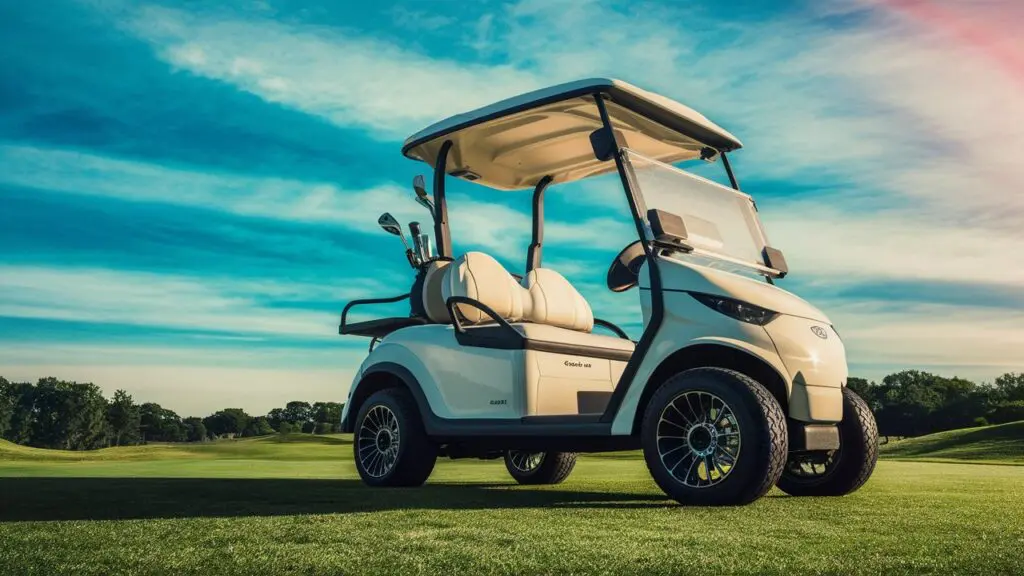
- Turf damage is driven by pressure and shear.
- K389 and Links are the safest golf-cart-specific starting points.
- Turf tread gives up self-cleaning voids. Wet grass, mud, steep slopes, and gravel can overwhelm it.
- Turf tires are worth it for courses, lawns, parks, and neighborhood pavement.
Turf tires spread load across a wide, shallow-tread footprint to reduce shear damage during turns. Their gentle pattern protects grass but gives up self-cleaning traction in mud, wet slopes, and loose gravel.
What golf cart turf tires are built to do
Turf damage is driven by pressure and shear. A wide footprint spreads vertical load, while shallow sawtooth or siped tread reduces the soil-cutting action during turns. Smooth throttle and wide turns matter as much as the tire.
| Turf model | Verified size example | Ply, load, pressure | Pattern |
|---|---|---|---|
| Kenda K389 | 18×8.50-8 | 4PR, 815 lb, 22 PSI | Sawtooth golf-cart tread |
| Carlisle Links | 18×8.50-8 | 4 ply, 825 lb, 22 PSI | Wide flotation sawtooth |
| Carlisle Turf Saver | 18×8.50-8 | 2 ply, 520 lb, 10 PSI catalog example | Chevron, wide contact patch |
| Kenda K500 | Multiple lawn/turf sizes | Size-specific 2PR to 6PR data | Siped lugs |
Only install a tire whose load capacity covers the loaded axle. A mower tire sharing a size is not automatically suitable for a passenger cart.
Top turf tire picks
K389 and Links are the safest golf-cart-specific starting points. Turf Saver can work in a verified size and load, but its catalog includes mower applications with lower capacity. K500 is a commercial-turf family that must also be selected by exact SKU.
Compare the dedicated Carlisle versus Wanda turf guide rather than treating every shallow pattern as equivalent.
The honest limits of turf tires
Turf tread gives up self-cleaning voids. Wet grass, mud, steep slopes, and gravel can overwhelm it. More throttle then spins the tire and damages turf. Use all-terrain tires when loose-ground traction is the real priority.
Course operators may require approved turf patterns and restrict carts after rain. Their rule controls even if a sidewall says turf.
Are turf tires worth it for you?
Turf tires are worth it for courses, lawns, parks, and neighborhood pavement. They are a poor choice for hunting property or repeated mud. Choose the exact load and mounted diameter, then verify body and steering clearance with the size guide.
Use the pressure printed for the exact tire and adjust within the vehicle and tire maker’s instructions. Published examples vary widely: Kenda K389 18×8.50-8 4PR lists 22 PSI, its 6PR version lists 34 PSI, and Carlisle Turf Saver sizes range by construction. One universal golf-cart PSI would be unsafe.
The bottom line on turf tires
The best all-around turf choice is a golf-cart-specific 18×8.50-8 with published capacity, such as the K389 or Links. A wider low-pressure mower-style tire may protect grass but cannot be used unless its rated load and speed cover the cart.
Driving technique is part of the verdict: avoid sharp powered turns, wheelspin, saturated ground, and overloaded rear seats. Compare total value with other upgrades.
Pressure, care, and lifespan of turf tires
Check pressure cold, rotate if the tread is nondirectional and the cart maker permits it, inspect for weather cracking, and remove embedded debris. Underinflation can increase flex and heat even when the footprint looks gentle.
Pressure should be chosen from the exact tire and vehicle guidance, then kept even across an axle. A Kenda K389 18×8.50-8 4PR and Carlisle Links in the same nominal size both publish 22 PSI, but that does not turn 22 PSI into a universal turf number. Different ply versions and mower-oriented tires publish different limits.
Use chalk across the tread for a short low-speed contact check only after setting the documented cold pressure. Uneven wear can come from pressure, toe, bent wheels, worn bearings, overloaded rear seating, or repeated sharp turns. Do not solve center or shoulder wear by moving outside the manufacturer’s approved pressure.
Turf preservation also depends on route management. Avoid saturated ground, steep side slopes, and repeated traffic through one turn. Accelerate before the climb rather than spinning on the slope, brake smoothly, and take a wider arc. Course restrictions and ropes override the tire’s advertised use.
Load capacity must cover the heaviest axle with passengers and cargo. A 520 lb mower-oriented 18×8.50-8 example is not interchangeable with an 815 or 825 lb golf-cart tire just because the dimensions look alike. Confirm wheel capacity, bead seat, rim width, and speed service too.
After mounting, check both steering locks, suspension compression, brake cables, and body clearance. Perform a low-speed figure-eight and stop test, then inspect for scuffing, bead movement, heat, or lug loosening. Record model, SKU, load, pressure, wheel width, and measured diameter.
Store the cart on clean, dry tires away from petroleum products and direct heat. During long storage, maintain maker-approved pressure and move or support the cart as the vehicle manual specifies to reduce flat spotting.
Frequently Asked Questions
What are the best golf cart turf tires?
Smooth, grass-friendly treads like the Carlisle Fairway Pro, plus GTW and RHOX turf tires, lead the value field. The Fairway Pro is the benchmark for even wear and grass protection.
Do turf tires work off-road?
Not well. Turf tires use a smooth, soft tread that slips on dirt, gravel, mud, and wet slopes. If your cart sees mixed ground, a moderate all-terrain tire is the better compromise.
Reviewed and updated July 30, 2026 by the Golf Cart Lab team.