Golf Cart Tire Size Guide: Fitment, Lift & Speed
How to read golf cart tire sizes, real factory stock sizes by brand, what fits without a lift, the speed-versus-torque trade-off, and how to pick the right tire.
- Yamaha’s Drive2 PTV ships with a verified 205/65-10 DOT tire; E-Z-GO’s Liberty offers 23×10-12 or 23×10-14 packages.
- Most stock non-lifted carts fit tires up to about 20 inches; taller tires usually need a 3 to 6 inch lift kit.
- The common golf cart wheel pattern is 4 on 4 inches (4×101.6mm) across Club Car, E-Z-GO, and Yamaha, per GolfCartStuff’s wheel guide.
- A tire’s stamped diameter is unloaded, it squats under weight, so measure loaded rolling height for an accurate speed recalibration.
Golf cart tire size affects three things at once: how fast the cart goes, how it accelerates and climbs, and whether you need a lift kit. Bigger tires raise top speed and ground clearance but reduce torque and make the speedometer read low. Most stock carts fit tires up to about 20 inches without a lift; taller tires usually need a 3 to 6 inch lift kit.
Golf cart tire size basics
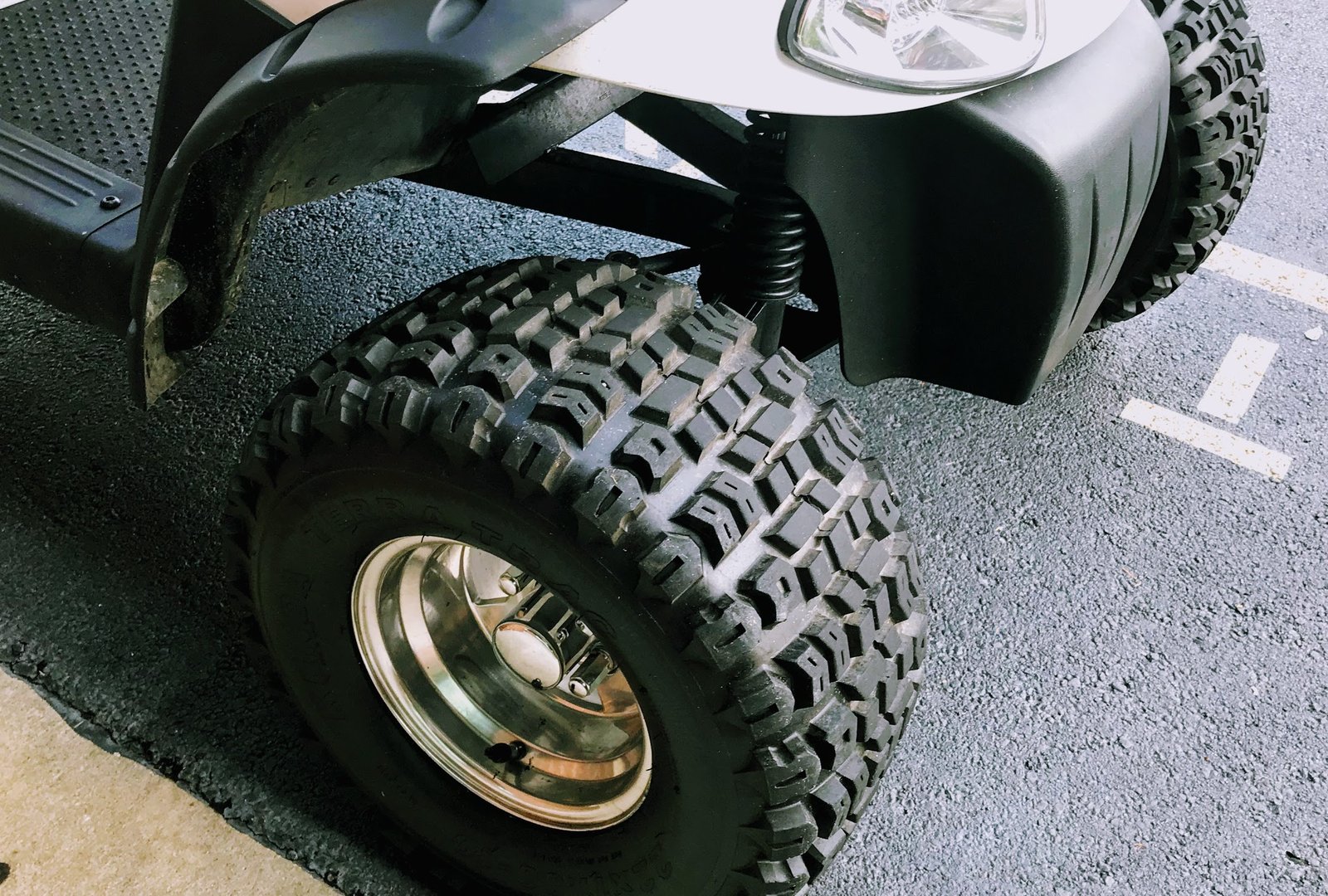
Golf cart tires are sized two common ways. Traditional sizing looks like 18×8.5-8, where 18 is the overall tire diameter in inches, 8.5 is the width, and 8 is the wheel diameter it mounts on. Low-profile street tires often use a metric-style number instead, like 205/30-12, similar to car tires. The number that matters most for performance is the overall diameter, because that is what changes your speed, torque, and clearance.
When you change diameter, top speed and speedometer reading change by the same ratio. Go from an 18 inch to a 22 inch tire and that is about 22 percent more diameter, so a cart that did 19 mph could reach roughly 23 mph, and a stock speedometer would read about 22 percent low. You can see your own numbers instantly with the golf cart tire size calculator.
Factory stock tire sizes by brand
Most sizing guides explain the math but never anchor it to real stock sizes, so there is no baseline to compare against. Here is what current OEM spec pages actually publish:
| Brand/model | Factory tire or wheel baseline | Source caveat |
|---|---|---|
| Club Car Onward 4 Passenger | Non-lifted 10 inch and 12 inch wheel/tire options; lifted 14 inch wheel/tire options. | Club Car’s spec page confirms wheel sizes but does not publish the exact molded tire sidewall size for every package. |
| Club Car Tempo / older fleet carts | 8 inch wheels with roughly 18 inch overall tire diameter is the common stock reference. | Use the tire sidewall or parts manual for a specific cart, model pages vary in tire detail. |
| E-Z-GO Liberty | MT Paramount 23×10-12, MT Paramount 23×10-14 radial, or Kruizer 185/60-14 package options. | Liberty is a modern lithium model with multiple packages, not a universal TXT or RXV baseline. |
| E-Z-GO TXT / RXV | Most stock non-lifted references center around 8 inch wheels and about 18 inch overall tires. | Confirm from the sidewall or build sheet before comparing to Liberty’s 23 inch package options. |
| Yamaha Drive2 PTV | 205/65-10 DOT tires with a 4 ply rating, per Yamaha’s current Drive2 PTV spec page. | A clean current OEM anchor, better than a generic 18×8.5-8 assumption for Drive2 PTV. |
What size tires fit without a lift
Clearance is the practical limit. Stock suspension and fenders only allow modest tires before the tire rubs at full steering lock or suspension compression. For an instant per-platform answer, run your cart and lift through our lift & tire fitment calculator. The chart below is a general rule of thumb; exact fitment depends on the make, model, wheel offset, and suspension travel.
| Tire Diameter | Typical Lift Needed | Notes |
|---|---|---|
| Up to 20″ | None to 2″ | Often fits stock or with a small spacer lift |
| 21″ to 23″ | 3″ to 4″ | Most common all-terrain upgrade range |
| 24″ to 25″ | 5″ to 6″ | May need offset wheels and fender trimming |
| 26″+ | 6″+ | Heavy-duty lift; review geometry and braking |
Retailers such as Buggies Unlimited publish similar fitment guidance. When in doubt, measure your existing clearance and test-fit before committing to a tall tire.
The common 4-lug golf-cart wheel pattern is normally described as 4 on 4 inches, or 4×101.6mm, across Club Car, E-Z-GO, and Yamaha golf carts. GolfCartStuff’s wheel guide describes Club Car as using the 4×101.6mm pattern and says that pattern is used by almost all major golf cart manufacturers. That supports the old 4-lug claim, but lug-nut thread size and seat style can still vary, so match the wheel, studs, and nuts to the actual cart.
One measurement subtlety trips people up: the molded sidewall diameter is the unloaded size, but the tire squats under the weight of the cart, so a tire stamped 22 inches may roll as a 21-inch tire once you and a passenger are aboard. That is why two owners with the same tire can report slightly different top speeds, and why the fitment ranges above are guidelines rather than guarantees. When you calculate a new speed or recalibrate a speedometer, measure the actual loaded rolling height (mark the tire, roll one full revolution, and measure the distance) rather than trusting the sidewall number, especially on soft all-terrain tires that squat more than hard street tires.
Speed vs torque: the trade-off
Taller tires act like a taller gear. They raise top speed but reduce the torque reaching the ground, so the cart accelerates more slowly and climbs hills less easily. On a stock motor and controller, very large tires can leave the cart feeling sluggish from a stop, especially loaded or on inclines. Many owners who go big on tires also fit a lower (numerically higher) gear ratio to recover that lost low-end pull. To see how gearing and motor RPM set your baseline speed before any tire change, use the top speed calculator, and read our deeper guide on tire size vs torque and efficiency.
Choosing the right tire
Match the tire to how you actually use the cart. Smooth, hard street tires roll efficiently and preserve range and speed for paved neighborhoods. All-terrain tires add grip and a bit of lift for grass, gravel, and light trails at a small efficiency cost. Aggressive mud or off-road tires look great and clear obstacles but are heavy, loud on pavement, and cut into range and top speed. Because larger and heavier tires raise effective gearing, they also slightly reduce miles per charge, which you can estimate with the range calculator.
Pick the diameter first, because it drives everything else. The 21 to 23 inch range with a 3 to 4 inch lift is the sweet spot for most owners. Recalibrate a digital speedometer for the new diameter so your speed readings stay honest, and remember that bigger tires trade acceleration, hill climbing, and a little range for speed and looks.
Frequently Asked Questions
Will bigger tires make my golf cart faster?
Yes, taller tires raise top speed in proportion to the diameter increase, as long as the controller still lets the motor reach the same RPM. The trade-off is slower acceleration and weaker hill climbing, because larger tires behave like a taller gear.
Do I need to change wheels to fit bigger tires?
Sometimes. Going taller on the same 8-inch wheel is common up through the low-20-inch range, but many 12- and 14-inch low-profile and off-road tires require a matching larger wheel. GolfCartStuff documents the common golf cart wheel pattern as 4 on 4 inches (4×101.6mm) across Club Car, E-Z-GO, and Yamaha, but lug thread size and seat style can still vary, so match the wheel, studs, and nuts to the actual cart.
How do I know my current golf cart tire size?
Read the numbers molded into the sidewall. Traditional sizes look like 18×8.5-8 (diameter x width – wheel size), while low-profile tires use a metric style like 205/30-12. The first number sets your speed and clearance.