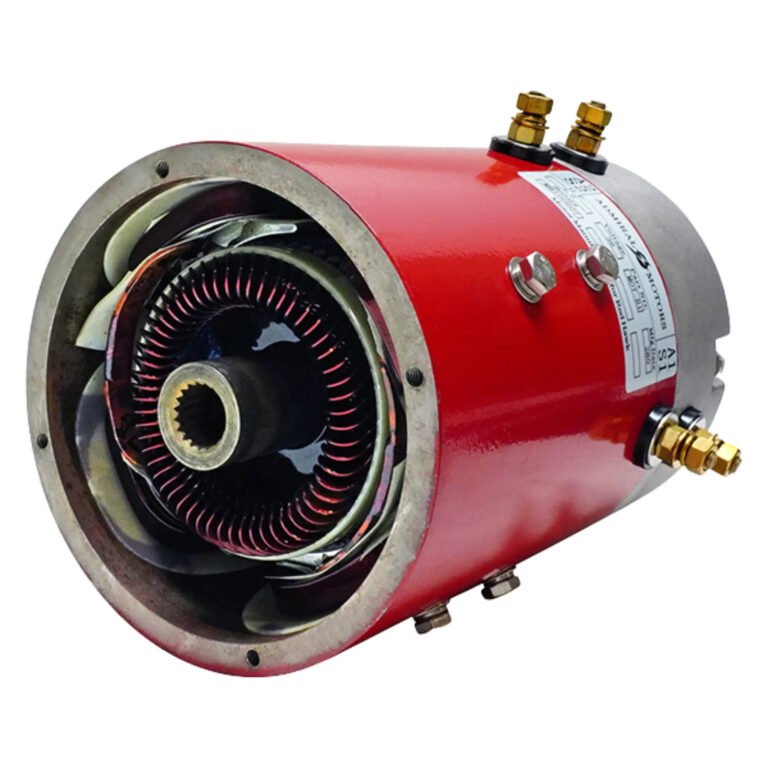
The Two Types of Golf Cart Motors
Almost every electric golf cart runs a series-wound or a Sepex motor. Knowing which you have changes how you diagnose power loss, what controller you can fit, and whether regen braking is possible.
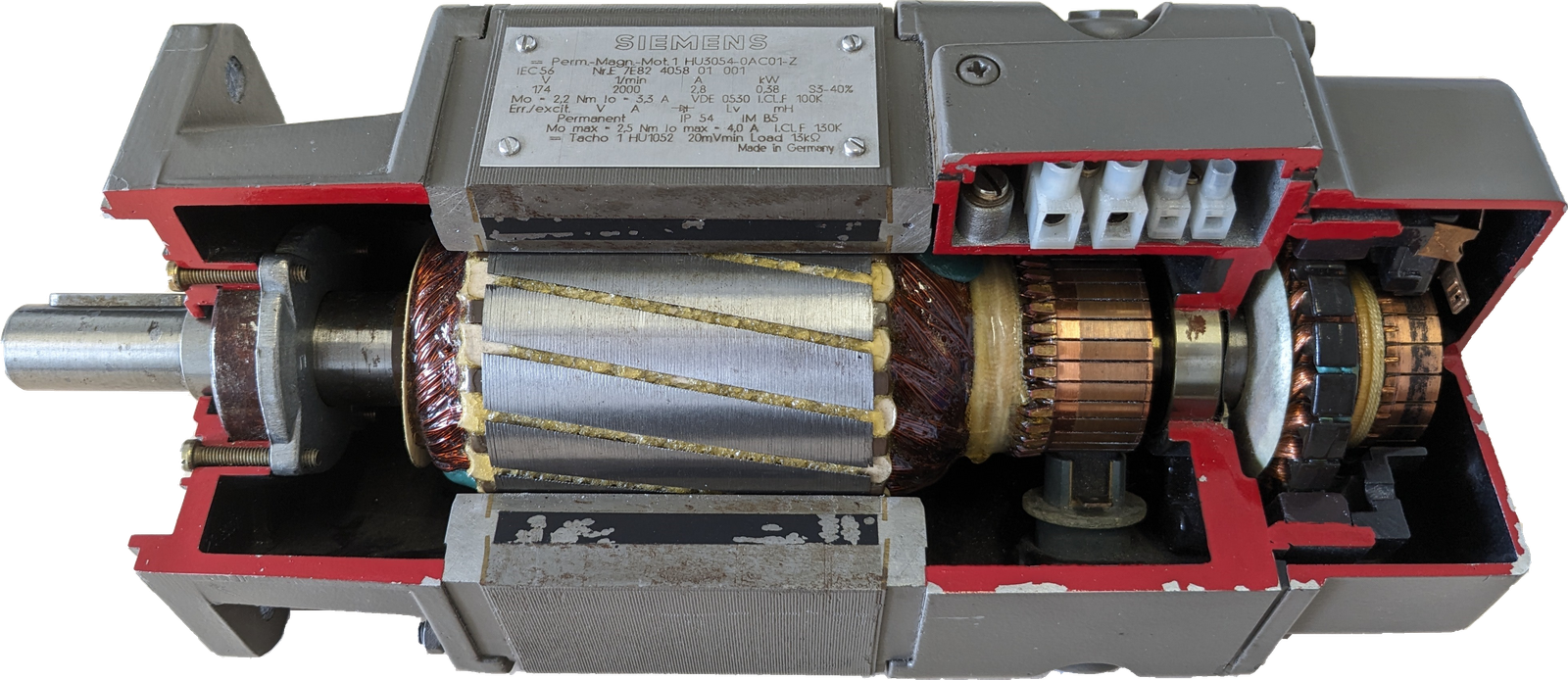
01 : The Series-Wound Motor
The series-wound motor is the original golf cart workhorse and still the most common motor on EZGO and Club Car DS models. In this design, the field coils and armature coils are wired in series, so the exact same current flows through both. This is what gives the series motor its defining trait: massive torque at low RPM.
When you mash the pedal from a dead stop on a hill, current surges through both windings simultaneously, and torque rises sharply. That is why series motors are the go-to for hilly courses, lifted carts, and towing. The trade-off is that a pure series motor has no simple way to control speed electronically or to provide regenerative braking, and it will overspeed dangerously if the load is ever removed from the output shaft. If your series-motor cart is bogging down on inclines, the guide on power loss going uphill walks through the most common causes.
02 : The Sepex (Separately Excited) Motor
The Sepex motor, short for separately excited, is the modern evolution found on carts like the Club Car IQ and many post-2000 fleet vehicles. Instead of wiring the field and armature in series, the controller energizes the field winding from its own separate circuit. This separation is the key to everything a Sepex motor can do that a series motor cannot.
Because the controller commands the field independently, it can precisely vary speed, deliver smooth and predictable acceleration, prevent rollback on hills, and recover energy through regenerative braking when you slow down. The cost of this sophistication is complexity: Sepex systems rely heavily on a healthy controller and wiring, so diagnosis often involves the electronics as much as the motor itself. The breakdown of series vs Sepex motors for hills and speed compares both designs head-to-head with real-world data.
03 : The Two Types of Golf Cart Motors Compared
The two classic golf-cart motor types are series and separately excited DC. AC is included because a modern identification guide that stops at two types can misclassify an RXV or Drive2.
| Feature | Series DC | Sepex or shunt DC | AC drive |
|---|---|---|---|
| Motor terminals | A1/A2 armature plus S1/S2 series field. | A1/A2 armature plus a separate field pair, commonly F1/F2. Some drawings use different field labels, so follow the motor diagram. | Three motor phases, commonly U/V/W, plus encoder, resolver, or speed-feedback wiring. |
| Regenerative braking | No conventional battery regen in a basic series system. Plug braking may be controller-dependent. | Yes when the controller, motor, and vehicle wiring support it. | Yes when implemented by the inverter and battery system. |
| Anti-rollback | Usually mechanical parking brake only; not inherent to the motor. | Controller and platform dependent. Do not assume it from four field terminals alone. | Platform controlled. The RXV uses an AC system with an electric motor brake; confirm the exact generation. |
| Speed-control method | Controller meters armature current through the series field; mechanical F/R hardware often reverses field polarity. | Controller varies armature and field current separately, enabling field weakening and controlled regen. | Inverter controls three-phase current, frequency, and torque from rotor feedback. |
| Typical carts and years | Many legacy E-Z-GO Marathon/TXT and Club Car DS series carts. Year breaks vary, so confirm by serial. | E-Z-GO DCS/PDS/TXT48 and Club Car IQ/Precedent are common examples. The 48V TXT manual identifies a shunt-wound motor. Confirm by serial. | E-Z-GO RXV from 2008 onward is a common AC example; Drive2 PowerTech AC is another current example. |
| Controller type | Series controller such as Alltrax SR or a compatible Curtis 1204/1205. | Shunt controller such as Alltrax XCT or the serial-matched OEM unit. | Vehicle-specific AC inverter matched to the motor feedback, battery voltage, and communication network. |
A series motor is the simplest high-torque legacy layout. Sepex adds independent field control for smoother speed management and possible regenerative braking. AC moves commutation into the inverter and cannot be converted by swapping only the motor.
04 : Which Motor Type Do You Have?
You can usually identify your motor type without pulling it apart. Use these checks:
- Check the cart model and year, pre-2000 EZGO and Club Car DS carts are almost always series-wound, while Club Car IQ/Precedent and most newer fleet carts use Sepex.
- Count the large motor terminals: a classic series motor typically has terminals labeled A1, A2, S1, S2 (four posts), while Sepex motors add a separately wired field pair fed by the controller.
- Look for regen braking behavior, if releasing the pedal noticeably slows the cart and it holds on hills without rolling back, you almost certainly have a Sepex (or AC) drive.
- Read the controller label, controllers are matched to motor type, so the controller part number often confirms whether the system is series or Sepex.
If you are weighing a motor swap or controller upgrade, confirm compatibility first, the guide on whether golf cart motors are interchangeable explains the spline and mounting limits that govern what will actually bolt in.
05 : A Note on AC Motors
While series and Sepex are the two classic DC types, modern premium and high-performance carts increasingly use AC induction motors. AC drives offer the strongest regenerative braking, the best efficiency, and excellent low-speed control, but they require a more sophisticated (and expensive) controller and are not a drop-in replacement for a DC system. For most owners maintaining an existing cart, though, the practical decision still comes down to the two DC types, series for brute torque, Sepex for controllability. If top speed is your goal regardless of motor type, see the roundup of the fastest stock golf carts.
Frequently Asked Questions
What are the two types of golf cart motors?
The two types are series-wound (raw low-end torque, simple, no regen) and Sepex or separately excited (electronically controlled, smooth, regen braking, anti-rollback).
How do I tell which motor I have?
Check cart model and year, count the motor terminals (series motors show A1, A2, S1, S2), and watch for regen behavior. A cart that holds on hills and slows on lift-off is likely Sepex or AC.
Which motor is better for hills?
A series-wound motor produces the strongest low-end torque for hills and towing, while a Sepex motor delivers controlled, consistent torque with anti-rollback.
Can I swap a series motor for a Sepex motor?
Not directly. Series and Sepex systems use different controllers and wiring, so the motor, controller, and throttle must be matched as a package.
Lab Verdict: The two types of golf cart motors are series-wound (raw low-end torque, simple, no regen) and Sepex (electronically controlled, smooth, regen braking, anti-rollback). Identify yours by cart model, terminal layout, and regen behavior before any motor or controller upgrade.