EZGO TXT Carburetor Adjustment: Idle, Throttle Cable and Governor Baseline
Identify the engine and carburetor, clean the fuel system first, set cable free play and idle in the right order, and leave factory mixture and top-speed settings alone unless the exact manual says otherwise.
- Identification comes first. Robin 295/350 twin-cylinder and Kawasaki FJ400D systems do not share one adjustment procedure.
- Clean before adjusting. Water, debris, blocked jets, air leaks, weak ignition, and poor compression cannot be corrected with a screw.
- Set the linkage in order. Throttle closure, microswitch timing, cable free play, idle, and governor action affect one another.
- Avoid universal turn counts. Some pilot or mixture screws are factory set, and current TXT EX1 models use EFI rather than a carburetor.
E-Z-GO TXT carburetor adjustment is not one universal screw setting. Gas TXT carts have used different engines, carburetors, throttle linkages, and later electronic fuel injection. A reliable baseline starts by identifying the hardware, correcting fuel and ignition faults, and restoring cable and throttle closure before any permitted idle adjustment.
Identify the engine and carburetor
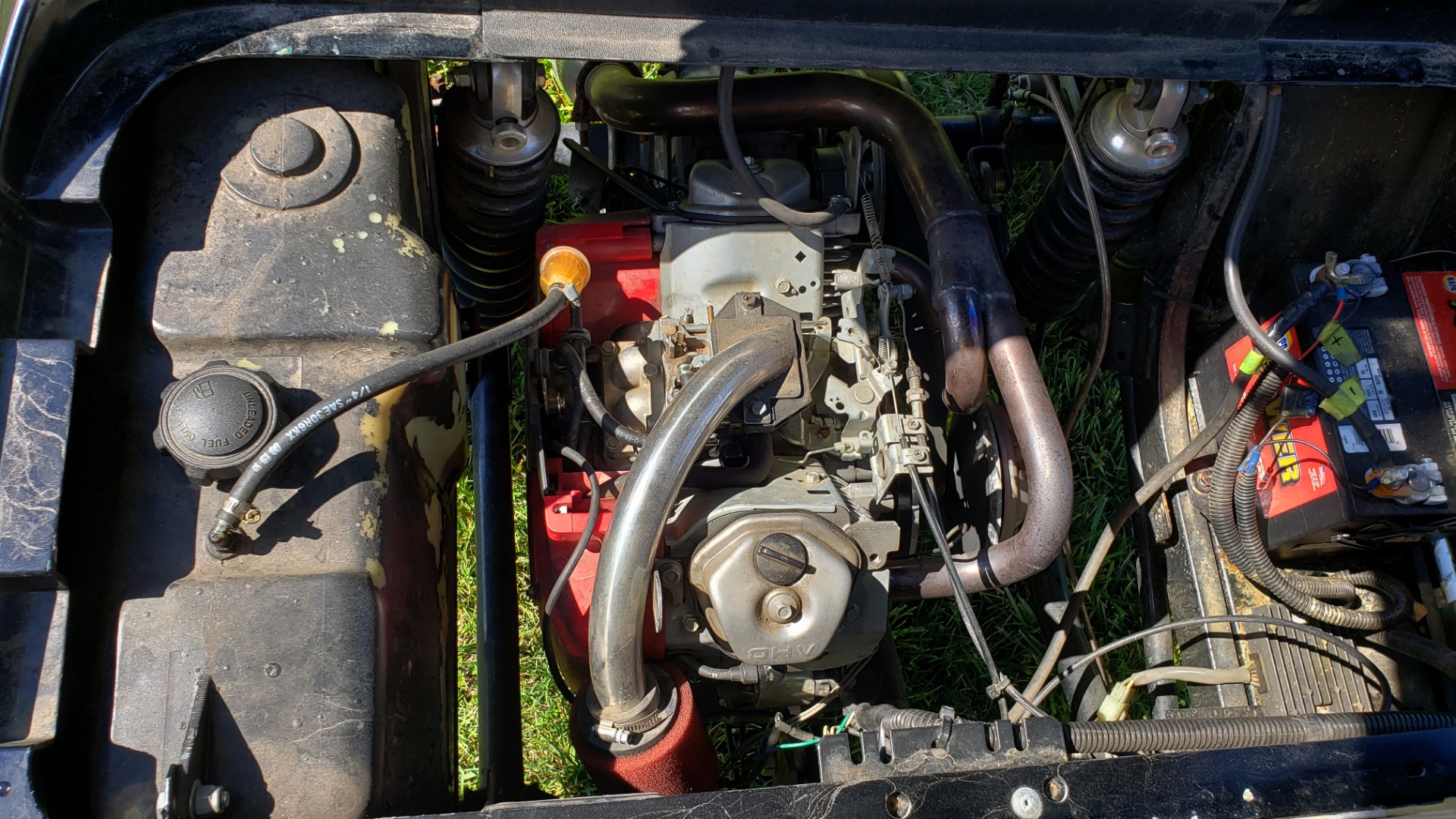
Open the seat and record the engine label, carburetor markings, vehicle serial number, and any emissions label. Older TXT gas carts commonly use Robin or Fuji 295 cc or 350 cc twin-cylinder engines. Later carbureted carts use the Kawasaki FJ400D single-cylinder engine. Current TXT models with the EX1 engine use electronic fuel injection and do not have a carburetor to adjust.
Use the E-Z-GO model-year guide to narrow the vehicle, then match the engine code to its service manual. Engine swaps are common, so a body year does not prove which carburetor is installed. If the carburetor has been replaced with an aftermarket unit, document its maker and part number rather than assuming every screw matches the original.
| TXT engine branch | Fuel system clue | Adjustment rule |
|---|---|---|
| Robin/Fuji 295 or 350 twin | Older twin-cylinder layout and fixed-jet carburetor in the cited technician manual | Restore throttle closure and cable timing; do not disturb the factory-set pilot screw |
| Kawasaki FJ400D | 401 cc single-cylinder engine with Nikki carburetor variants | Use the exact FJ400D and E-Z-GO equipment procedure |
| EX1 TXT | Electronic fuel injection | No carburetor adjustment; diagnose EFI inputs and fuel delivery |
Fix fuel and ignition faults before adjustment
Adjustment should be the final step after the engine can receive clean fuel, breathe freely, ignite consistently, and develop compression. The Robin technician manual specifically says to verify the ignition system before condemning the carburetor. A weak spark or incorrect valve condition can look like a lean idle.
- Drain a fuel sample into an approved clear container and check for water, rust, or sediment.
- Inspect the fuel filter, pulse line, pump output, tank vent, and fuel hoses for restriction or air leaks.
- Check the air filter and intake boot for blockage, cracks, or a loose clamp.
- Verify spark-plug condition and ignition performance using the engine manual.
- Confirm compression or valve condition if the engine will not respond consistently.
- Clean carburetor passages with the documented disassembly procedure before changing settings.
The official Kawasaki FJ400D service manual also directs inspection for water or dirt in the fuel system and cleaning when contamination is found. If the cart runs well at low demand but sputters at speed, use the E-Z-GO high-speed sputter guide. That symptom often involves supply volume, tank venting, pump pulses, or ignition rather than an idle screw.
Work in a ventilated area away from flames, sparks, heaters, and hot exhaust. Let the engine cool, disconnect the battery as the vehicle manual directs, capture fuel in an approved container, and clean spills immediately. Do not run the engine with guards removed or loose clothing near the clutch.
Set throttle cable free play and switch timing
Throttle adjustment starts with full closure. On the older Robin/Fuji procedure, the accelerator cable is adjusted so the carburetor throttle is completely closed while the pedal retains about 1 inch of travel at the top. The pedal microswitch should click at 1/2 to 5/8 inch of pedal travel, and the throttle cable should remain slack until after that click. These measurements belong to the cited older system, not every TXT.
- Disable the cart. Chock the wheels, select neutral where required, and follow the service mode procedure.
- Inspect pedal return. Make sure the accelerator and carburetor lever return freely without floor-mat interference or a stretched spring.
- Confirm throttle closure. With the cable relaxed, the throttle lever must reach its closed stop without the cable holding it open.
- Check switch timing. On systems with a pedal microswitch, verify the switch changes state before the cable begins opening the throttle, using the exact model measurement.
- Check full travel. The linkage should reach the documented wide-open position without forcing the throttle shaft against its stop.
- Tighten and repeat. Secure the adjusters, operate the pedal several times, and recheck closure and free play.
If the gas pedal or linkage does not return, stop before tuning. The TXT stuck-pedal and linkage guide covers springs, pivots, and cable problems. Setting idle around a cable that holds the throttle open creates a false baseline and can cause unexpected starting movement.
Establish a safe idle baseline
Golf cart engines often start when the accelerator switch closes, so idle setup is tied to starter-generator and governor behavior. Warm-up, tachometer connection, service mode, and driven-wheel support must follow the vehicle manual. Never estimate engine speed by sound when a manual specifies rpm.
For the older fixed-jet Robin/Fuji carburetor described in the technician manual, throttle-shaft baseline is set by backing the throttle stop screw away, holding the shaft fully closed, turning the stop until it contacts the tab, and then adding one-quarter turn. That is a model-specific mechanical baseline, not permission to use one-quarter turn on another carburetor.
The Kawasaki FJ400D engine manual distinguishes carburetor low idle from governed low speed and warns that equipment specifications can vary. Use the E-Z-GO vehicle specification when it differs from the general engine manual. A tachometer reading that will not stabilize suggests a dirty slow circuit, intake leak, unstable ignition, binding governor linkage, or incorrect valve condition, not merely a stop-screw problem.
After adjustment, let the throttle return several times and verify the engine stops or idles according to the vehicle design. Confirm there is no creep, clutch engagement, or delayed return. Restore every service-mode control before a level-ground functional test.
Treat mixture screws as model-specific
There is no safe universal instruction such as turn the mixture screw out a fixed number of turns. The older E-Z-GO technician manual describes a fixed-jet carburetor and identifies the pilot screw as factory set. Disturbing that setting can mask a clogged jet or create an emissions and drivability problem.
Some Kawasaki FJ400D carburetor variants include a slow or pilot adjustment, but the correct baseline depends on the exact carburetor specification and equipment application. Count and record an existing position only when the service procedure tells you to remove the screw for cleaning. Never force a tapered needle against its seat because the tip and seat can be damaged.
If no exact specification is available for the carburetor number, leave the screw alone. Clean the passages, repair air leaks, set float level by the manual, and restore the documented throttle stop. A replacement carburetor with an undocumented adjustment should be set up by a technician with an exhaust analyzer and the correct equipment specifications.
Leave the governor at factory speed
The governor is a safety and engine-protection system, not an idle-mixture control. The older E-Z-GO manual directs governor service to qualified personnel and warns against adjustment above factory governed speed. Changing spring tension to cure hesitation can overspeed the engine, clutch, or driveline while leaving the original fuel fault unresolved.
Inspect the governor cable and spring for binding, wrong routing, stretched coils, and interference. Compare parts and dimensions only with the exact service manual. If the throttle reaches full travel too soon, confirm cable geometry and carburetor closure before altering the governor.
After any linkage work, use a calibrated tachometer to verify governed speed under the service procedure. Do not use vehicle road speed as the only measurement because tire diameter, clutch condition, load, and final-drive ratio can change miles per hour without changing engine rpm.
Read rich, lean, and linkage symptoms
Possible rich condition
Black exhaust smoke, fuel odor, a sooty plug, rough warm running, or fuel level too high can indicate excessive fuel, a restricted air filter, choke trouble, or a float and inlet-needle problem.
Possible lean condition
Surging, hesitation, intake popping, a pale plug, or improvement with partial choke can indicate a blocked passage, low fuel supply, intake leak, or incorrect float level.
Possible linkage fault
High idle that changes when the cable is moved, delayed return, inconsistent microswitch timing, or a lever that misses its stop points to cable, spring, pivot, or adjustment trouble.
Possible non-carb fault
Misfire under heat, erratic spark, low compression, or a valve that loses clearance can imitate mixture trouble and will not respond reliably to carburetor adjustment.
Use symptoms to choose a test, not to skip identification. If the carburetor needs removal, photograph linkage and spring positions and use new seals specified for the exact unit. The carburetor cleaning overview explains cleaning principles, but Yamaha settings and parts do not transfer to an E-Z-GO.
A good TXT carburetor baseline is clean fuel, proven ignition, full throttle closure, correct pedal and switch timing, stable manual-specified idle, and an untouched factory mixture setting unless the exact carburetor procedure says otherwise. Identify the engine before turning a screw, and keep the governor at factory speed.
Frequently Asked Questions
How many turns should an E-Z-GO TXT mixture screw be set?
There is no universal turn count. Some older TXT carburetors have a factory-set pilot screw, while other engine and carburetor combinations use different specifications. Identify the exact unit and manual.
Should the throttle cable hold the carburetor slightly open?
No. At rest, the throttle must reach the closed position specified by the manual. The cable needs the model-specific free play and switch timing before it begins opening the throttle.
Can carburetor adjustment fix high-speed sputtering?
Not necessarily. Restricted fuel flow, tank venting, pump pulses, ignition failure, contamination, and valve or compression problems can cause high-speed sputtering.
Can I adjust the governor to make a TXT faster?
The governor should remain at the factory speed. Increasing governed rpm can damage the engine, clutch, or driveline and does not repair a carburetor problem.
Does a current E-Z-GO TXT have a carburetor?
Current TXT models with the EX1 engine use electronic fuel injection. A carburetor-adjustment procedure does not apply to that EFI system.
Updated September 2026: Rechecked against the Robin/Fuji TXT technician manual, the official Kawasaki FJ400D service manual, and current E-Z-GO owner documentation.