What Year Is My EZGO? Decode the Serial Number
Are you wondering what year is my EZGO, take a look at this manufacturer code to identify the model year, likely model line, and original voltage, with real code examples and an honest month-letter caution.
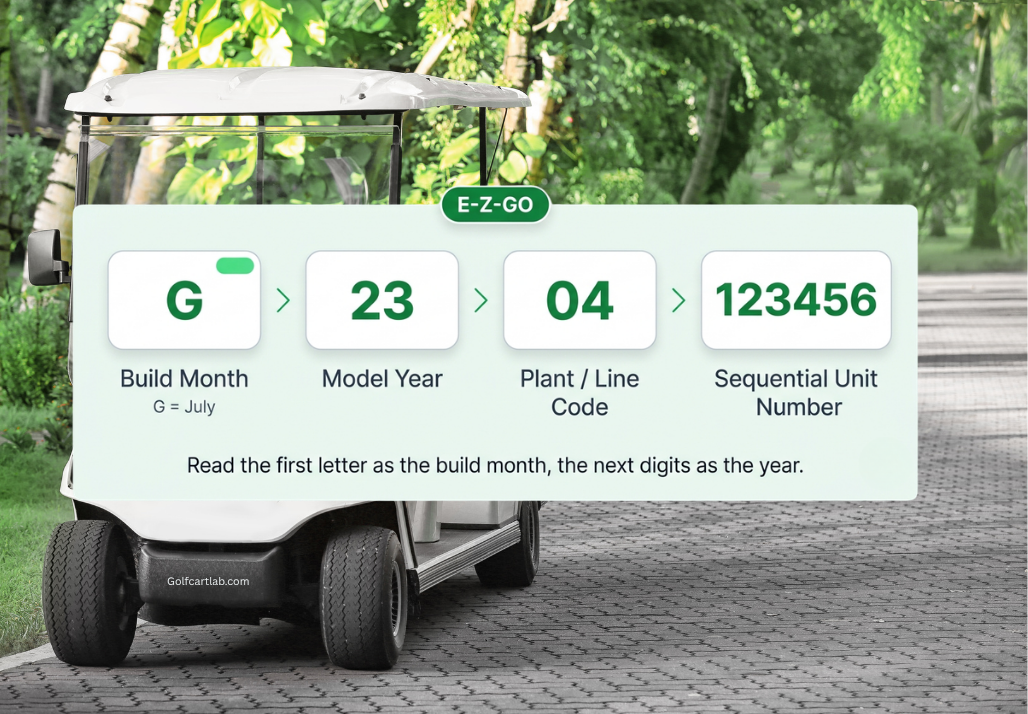
- Read the manufacturer code, not the plain serial number, to date an E-Z-GO.
- The leading letter is a production-month cycle, but it is format-specific: in many dealer guides A means July, not January.
- Real code examples: L101 decodes to June 1, 2001; A1288 to July 12, 1988; a modern F2121 points to model year 2021.
- Confirm the model family (Marathon, TXT, RXV) by body style, since the date code does not name the model.
Where to find your E-Z-GO serial number
E-Z-GO carts carry both a serial number and a separate manufacturer’s code, and it is the manufacturer’s code that encodes the build date. Look under the glove box, beneath the seat, or on the frame near the rear of the cart for a metal plate or sticker. On many models there are two numbers; the one that decodes to a date is the manufacturer’s code. If you only find a long serial number, enter it anyway, because the decoder tries multiple patterns.
Location shifts a little by era, which trips people up. On the long-running TXT (1994 onward) the plate is usually on the body cowl under the glovebox on the passenger side, or stamped into the frame just under the seat near the driver-side rear. On the RXV (2008 onward) E-Z-GO moved to a 13-character alphanumeric serial that reads more like a VIN, and the model year is baked into that string rather than a short month-letter code, so an RXV owner and a 1980s Marathon owner are literally reading two different formats off the same brand of cart. That is the single biggest reason a plain eyeball guess fails: the rule that decodes a 1990s TXT code will not decode a modern RXV string, so let the tool detect the pattern length first.
The fastest way to read it is the E-Z-GO serial number lookup tool, which converts the code into a model year, a likely model line, and the voltage for that era. For a brand-agnostic walkthrough of dating any cart, see what year is my golf cart.
E-Z-GO month code letters
The old universal A-through-L month table needed a caveat: E-Z-GO manufacturer-code formats are era-specific. Reputable E-Z-GO serial guides agree on the important rule that the manufacturer’s code, not the longer serial number, is the year clue. They also show that older codes used several layouts, including all-number strings, letter-day-year strings, and year-letter-day strings.
| Era or format | What the code usually tells you | Month-code caution |
|---|---|---|
| 1970 to 1976 examples | Early numeric layouts can put month and year digits at the front of the code. | No A-to-L table applies. Read the full format, not just one character. |
| 1977 to 2004 dealer-guide formats | Examples include L101 for June 1, 2001 and A1288 for July 12, 1988. | The letter represents a production-month cycle. In these guides, A is July, not January, and production start can vary. |
| Common 1994 to newer letter/number format | Examples such as A2094 and A1206 put the model year in the last two digits and the week or day in the middle digits. | The opening letter is not always a calendar month. Treat it as format-specific unless the matching guide says otherwise. |
| Modern TXT, RXV, Express, Valor, Liberty | Dealer serial guides commonly read the last two digits of the manufacturer’s code as the model year, while E-Z-GO’s official parts site uses the full serial lookup for model confirmation. | Use the code layout and a visual platform check. Do not force A = January on every modern sticker. |
For a simple modern-looking manufacturer code such as F2121, the safest visible read is that the last two digits point to model year 2021. The middle digits are commonly used as production-week or date detail in dealer guides, and the leading letter can be model, line, or month depending on era. That is why the E-Z-GO lookup tool should use the whole string instead of a single universal month table.
E-Z-GO models by era
The date code tells you when the cart was built but not the model name, so use the era guide to confirm the model visually. The official E-Z-GO site shows current lines for reference.
| Era | Common Models | Notes |
|---|---|---|
| 1960s to 1980s | Marathon | Early electric and gas; rounded body |
| 1990s to 2000s | Medalist, TXT | TXT became the long-running workhorse |
| 2008 onward | RXV, TXT (Elite) | RXV added AC drive; Elite added lithium |
Why the year matters
Knowing the exact year keeps you from buying the wrong parts. Controllers, chargers, battery trays, and body panels changed across the Marathon, TXT, and RXV eras, and ordering by year avoids costly mismatches. The year also tells you the original voltage so you can confirm whether a previous owner converted the cart. As a rough era guide, most Marathon and early Medalist carts left the factory as 36V systems, the TXT ran 36V through much of the 1990s and 2000s before later 48V variants appeared, and the RXV shipped as a 48V AC platform from its 2008 debut, so a 48V reading on a cart the code dates to 1996 is a strong sign someone rewired it. Once you know the year and voltage, the battery voltage chart helps you read state of charge, and the range calculator estimates how far it should travel.
Bottom line
To find your E-Z-GO year, locate the manufacturer’s code, read the first letter as the build month, and read the following digits for the two-digit year. Because the format changed over the decades, the safest approach is to drop the full code into the lookup tool and let it apply the right rule, then confirm the model family from the era table by looking at the body style. With the year in hand you can order parts confidently, verify the original voltage, and plan upgrades that actually fit your cart.
A worked example
Suppose the tag shows a short manufacturer’s code like A1206 beside a longer six- or seven-digit serial number. Dealer code guides parse that style as A at the front, 12 as the production week or date detail, and 06 as the model year, so the safe read is a 2006 build. It should then be checked against the cart itself; in that era, the chassis is likely in the TXT family rather than an RXV, because RXV production came later.
For an older 1977 to 2004 style code like L101, the same dealer guide treats L as the twelfth production month when A is July, 1 as the day, and 01 as the year. That points to June 1, 2001, not December 2001. The difference is the important lesson: a letter can be a month code in one format and a line or model clue in another. Use the manufacturer’s code as the year source, use the serial number as the unique production identifier, and confirm the decoded result against body style, voltage, and model features before ordering parts.
Frequently Asked Questions
How do I tell what year my E-Z-GO golf cart is?
Read the manufacturer code rather than the plain serial number. Depending on the era, the leading letter is a production-month cycle and the following digits include the two-digit model year. Enter the full code into the E-Z-GO lookup tool, which applies the right rule for the code length instead of one universal month table.
Is the E-Z-GO month letter always A for January?
No. The letter is format-specific. In several 1977 to 2004 dealer-guide formats A represents July rather than January, so a code like L101 decodes to June 1, 2001. Do not force an A to L equals January to December table onto every sticker; match the code layout to the correct era.
Does the E-Z-GO code tell me the model too?
Not directly. The date code encodes when the cart was built, not the model name. A lookup can infer a likely model family from the year, but you should confirm whether it is a Marathon, TXT, or RXV by its body style.
Where is the E-Z-GO serial number located?
Look under the glove box, beneath the seat, or on the frame near the rear. Many carts show two numbers: a plain serial and a separate manufacturer code. The manufacturer code is the one that decodes to a build date; enter the whole string if you are unsure which is which.