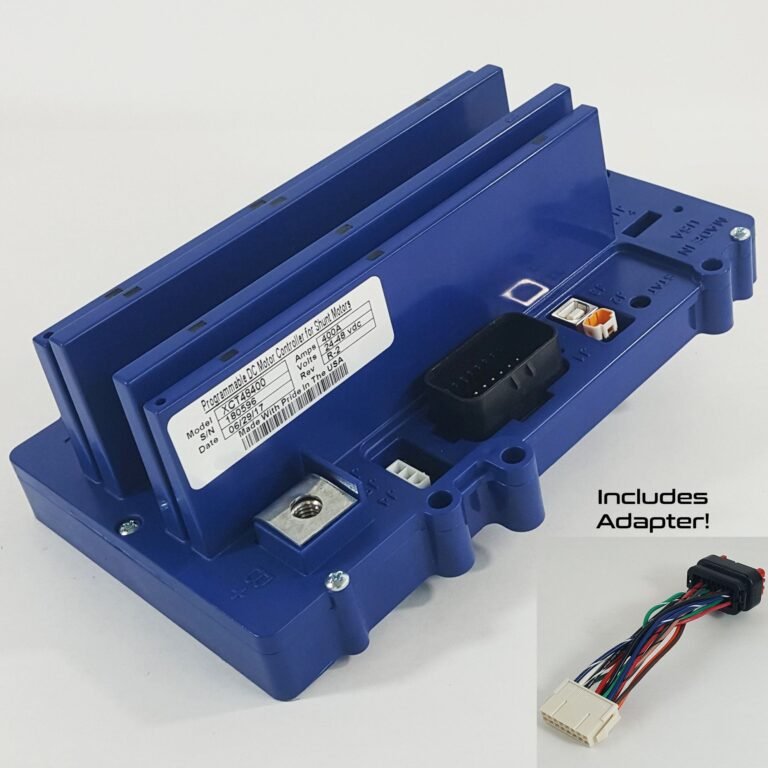
How Long Do Golf Cart Controllers Last?
A golf cart controller is solid-state with no moving parts, so it is one of the longest-lived components on the cart. Here is the realistic lifespan, what quietly shortens it, and how to make yours last.
01 : Typical Controller Lifespan
A golf cart controller is solid-state electronics with no moving parts, so under normal conditions it is one of the longest-lived components on the cart. Eight to fifteen years is a realistic range, and many original controllers are still running well past that.
Because there are no bearings or brushes to wear, a controller does not die from mileage the way a motor does. It dies from electrical and environmental stress, which means lifespan is largely in your control.
02 : What Shortens Controller Life
Controllers rarely die of old age, they die of stress. The main culprits:
- Heat: The number one killer. Poor ventilation or constant heavy loads cook the internal transistors.
- Moisture: Water intrusion corrodes the board and shorts components.
- Voltage spikes: A failing solenoid or loose battery connection sends damaging surges into the controller.
- Overloading: Oversized tires or constant steep hills force sustained high current the controller was not rated for.
03 : Warning Signs of a Failing Controller
A dying controller usually warns you first. Watch for:
- Intermittent loss of power or sudden cut-outs while driving.
- Jerky or hesitant acceleration that was not there before.
- Reduced top speed or weak hill performance.
- Fault codes on carts with diagnostic displays.
Many of these symptoms overlap with solenoid and wiring faults, so diagnose carefully, the repair guides walk through isolating the controller from other causes.
04 : How to Make Yours Last Longer
Keep the controller cool and dry, mount it where air can circulate, and never pressure-wash directly at it. Maintain tight, clean battery connections to prevent voltage spikes, and avoid chronically overloading the cart with oversized tires or constant max-throttle hill climbing. Do those things and a quality controller will likely outlast your batteries several times over.
05 : Controller Lifespan by Brand and Type
Manufacturers publish electrical limits and fault logic, but not a universal calendar-life rating. The ranges below are therefore planning estimates for normal private use, with the official manuals used to identify the stresses that shorten them.
| Controller type | Service-planning range | Dominant failure mode or trigger | How to identify it |
|---|---|---|---|
| Curtis 1204 / 1205 series DC | Often 10-20+ years in stock, dry, lightly loaded carts | Heat from overload, high-resistance terminals, poor mounting, or sustained overtemperature. The Curtis manual documents thermal protection above 75 C and lists overload and mounting causes. | Four heavy power terminals on a series-drive cart; confirm the label and vehicle diagram. |
| Club Car PowerDrive / IQ shunt | Often 10-20+ years with clean wiring and correct charging | MOSFET or connector stress, overvoltage, moisture, and external current paths. An M- short diagnostic means current is bypassing the controller power stage, not that the M- stud has a published age defect. | Identify the drive system through the serial prefix and service manual. Confirm by serial. |
| E-Z-GO RXV AC controller | About 8-15 years as a field planning range | Thermal cycling, moisture, pack overvoltage, contactor or sensor faults, and motor-brake or feedback issues. Current RXV specifications use a 235A AC controller. | AC induction motor and inverter; exact controller generation must match the vehicle. |
| Alltrax / Navitas aftermarket | About 8-15 years when correctly sized and cooled | Overtemperature, undersized power path, wrong configuration, water intrusion, or voltage outside the model limit. Alltrax warnings expressly call out misuse and high-speed competition. | Read the complete model label, software family, voltage, and current limit. |
| Lithium-era OEM AC or PM controller | About 6-12 years as a conservative planning range | BMS or CAN communication, firmware mismatch, thermal protection, contactor faults, or pack-voltage events can stop drive even when the power stage is healthy. | Controller, battery, and display communicate as a system. Diagnose stored codes before replacement. |
The PowerDrive M- quirk, correctly stated: an M- SHORTED diagnostic is evidence that the controller detects an uncontrolled current path from the motor M- circuit to battery negative, bypassing the MOSFETs. Inspect wiring, the motor circuit, and the controller according to the serial-matched Club Car manual. It should not be described as a known M- terminal that simply wears out at a certain age.
06 : Why Heat Is Really the Enemy
Every symptom of a short-lived controller traces back to thermal stress. The power transistors, MOSFETs, inside the unit switch battery current thousands of times a second, and each switch produces a tiny burst of heat. Under normal loads the aluminum case sheds that heat fine, but block the airflow with a seat cushion, cargo, or a poorly placed lithium pack, and internal temperatures climb until the solder joints and semiconductors degrade years early.
This is why two identical carts can have wildly different controller lifespans. The one that hauls heavy loads up hills in Florida summers with a cover blocking the vents will burn a controller in five or six years, while the same model on a flat, shaded course can run the original unit for two decades. Where and how you drive matters more than the badge on the cart.
07 : Repair, Replacement, and Upgrade Choices
Controllers are almost always replaced rather than repaired, because the failed component is usually a potted power stage that is not economically serviceable. When yours does fail, you face a choice: install an OEM-equivalent unit to keep stock behavior, or upgrade to a higher-amp aftermarket controller for more speed and torque. The upgrade path is tempting, but remember that a hotter-running high-amp controller also stresses the motor and cabling, so it can shorten the life of nearby parts if the rest of the system is not upgraded to match. The replacement controller finder lists both routes for your cart: the same part again where we stock it, and the upgrade kits that keep your motor.
Whatever you install, pair it with a healthy solenoid and clean, tight battery cables. A worn solenoid that arcs on every engagement sends voltage spikes straight into the new controller, and that is a fast way to kill an expensive part you just bought.
Parts note: The Navitas TSX 3.0 kits we stock replace the stock controller with the harness and programmer in the box, listed by cart. See controller kits
08 : Getting the Most Years Out of Yours
The practical takeaway is simple: a controller mostly lasts as long as you let it. Keep it mounted where air circulates, never aim a pressure washer at it, seal any cover gaps that let rain reach it, and re-torque the battery and controller lugs once a year to prevent the loose-connection spikes that quietly damage the board. Do that, and there is a good chance the controller outlives several battery packs and stays with the cart for its entire useful life, turning one of the most expensive components into one you rarely think about.
Frequently Asked Questions
How long do golf cart controllers last?
Most golf cart controllers last 8 to 15 years and often longer, because they are solid-state with no moving parts. They die from electrical and environmental stress, not mileage.
What kills a golf cart controller?
Heat is the number one killer, followed by moisture intrusion, voltage spikes from a worn solenoid or loose connections, and chronic overloading from oversized tires or steep hills.
What are the signs of a failing controller?
Watch for intermittent power cut-outs, jerky or hesitant acceleration, reduced top speed, and fault codes on carts with a display. These overlap with solenoid faults, so diagnose carefully.
Can you repair a golf cart controller?
Controllers are almost always replaced rather than repaired, because the failed part is usually a potted power stage that is not economically serviceable.
Lab Verdict: Golf cart controllers last 8 to 15 years on average and often longer, because they have no moving parts. Heat, moisture, voltage spikes, and overloading are what cut that short. Watch for power cut-outs, jerky acceleration, and reduced speed as early failure signs, and keep the unit cool, dry, and fed by clean connections to maximize its life.