How Fast Does a Golf Cart Go? Top Speed by Model + Calculator
Stock top speeds by model and class, what physically limits how fast you can go, a worked speed-formula example, the FMVSS rules that cap street-legal carts, and a free top speed calculator.
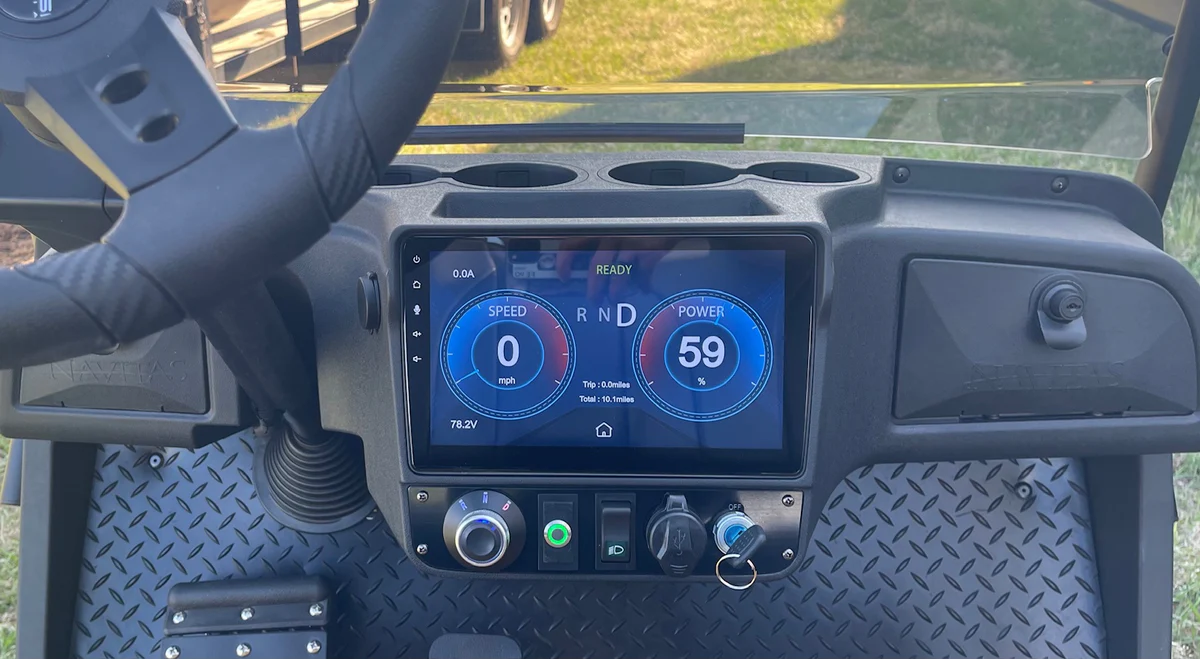
- Stock 36V carts run about 12 to 14 mph and stock 48V carts about 15 to 19 mph, with gas carts near 18 to 24 mph depending on the governor.
- Factory LSV trims (Club Car Onward LSV, E-Z-GO Liberty LSV, ICON i40/i60 LSV) are built to the federal 25 mph cap; many PTV trims like the Yamaha Drive2 PTV and Evolution D5 Maverick top out at 19 mph.
- Top speed = (Motor RPM / Gear Ratio) x (pi x Tire Diameter) x 60 / 63,360, and real road speed always runs below the no-load figure.
- FMVSS 500 caps a low-speed vehicle at not more than 25 mph, so a legitimate factory LSV advertises 25 mph, not 28 or 32.
Whether you are cruising a neighborhood or chasing a little more pace on the course, the first thing every owner wants to know is how fast their cart can actually go. The answer comes down to three numbers, motor RPM, gear ratio, and tire size, and a few simple upgrades can change all of them.
Stock golf cart top speeds by model
From the factory, most carts are deliberately governed. A fleet or PTV cart is usually slower than a factory LSV, even when they look similar. Use the table below as a model-anchored starting point, then confirm your exact trim and tire size.
| Model or class | PTV or LSV | Verified top speed | What it means |
|---|---|---|---|
| Club Car Onward LSV | LSV | 25 mph | Club Car’s LSV material and current specs put it at the federal LSV cap. |
| Club Car Onward or Precedent PTV class | PTV | About 19 mph on current Onward PTV specs; older Precedent examples vary by controller and year. | Do not assume a PTV is the same as the LSV trim. |
| E-Z-GO Liberty LSV | LSV | 25 mph | Use the LSV trim for the 25 mph number, not every Liberty or TXT listing. |
| E-Z-GO TXT or RXV PTV class | PTV | Typically 15-19 mph when stock and healthy. | Controller programming, tire size, and model year decide the exact ceiling. |
| Yamaha Drive2 PTV | PTV | 19 mph on current Yamaha Drive2 PTV specs for several gas and electric variants. | Yamaha’s current PTV page is a clean 19 mph anchor. |
| ICON i40 or i60 LSV trim | LSV | 25 mph in verified fastest-stock-carts data. | Use the LSV configuration. Dealer settings and local rules still matter. |
| Evolution D5 Maverick | PTV in current public spec context | 19 mph on the current Evolution D5 Maverick public page. | Do not list it as a 25 mph cart unless a specific LSV trim or source says so. |
Want the quickest carts off the showroom floor? See our roundup of the fastest stock golf carts.
What determines how fast a golf cart goes
Three drivetrain numbers set your top speed, plus the motor’s load behavior:
- Motor RPM: higher voltage and high-speed motors spin faster, raising the ceiling.
- Gear ratio: a lower (numerically smaller) rear-end ratio trades torque for speed.
- Tire diameter: a taller tire covers more ground per revolution.
How fast does a golf cart go? Calculate your top speed
The formula is MPH = (Motor RPM ÷ Gear Ratio) × (π × Tire Diameter) × 60 ÷ 63,360. The axle turns the wheels at motor RPM divided by the gear ratio, and each wheel turn moves the cart one tire circumference.
Worked example: assume a motor speed of 4,800 rpm, a 12.3:1 rear axle ratio, and an 18-inch tire. Wheel rpm is 4,800 ÷ 12.3 = about 390 rpm. Tire circumference is 3.1416 x 18 = about 56.5 inches. The no-load math is 390 x 56.5 x 60 ÷ 63,360 = about 20.9 mph. Real road speed will be lower if the cart cannot hold that rpm under load.
Instead of doing that by hand, enter your numbers into the top speed calculator. It also shows how much speed you would gain from taller tires and how far off your factory speedometer will read after the change. Just remember that real top speed runs lower than the no-load figure, respect your motor’s safe RPM limits to avoid damage.
How to make a golf cart faster
- Taller tires: the cheapest mod; going from 18-inch to 23-inch tires raises top speed about 28%.
- High-output controller: raises the current limit and removes conservative speed governing.
- Performance motor: a high-speed wind trades some low-end torque for more RPM.
- More voltage: converting 36V to 48V (or adding lithium) spins the motor faster.
There is a tradeoff: taller tires and speed motors reduce low-end torque, which our tire size vs. torque guide explains. If your cart feels slower than it should be stock, start with our slow cart troubleshooting guide. Controller makers like Navitas publish speed gains for their kits. For the full walkthrough, see how to make a golf cart faster.
Parts note: For the controller step, the Navitas TSX 3.0 kits we stock are listed by cart and by the stock controller they replace. See controller kits
Speed limits and staying legal
Federal LSV rules are specific. FMVSS 500 applies to low-speed vehicles and caps the maximum attainable speed at not more than 25 mph when tested over 1 mile. Federal definitions also place LSVs in the above-20-mph and not-more-than-25-mph band. That is why legitimate factory LSVs tend to advertise 25 mph rather than 28 or 32 mph.
A standard non-LSV golf cart is not automatically a federal LSV just because it can be modified to go faster. Street equipment, VIN, mirrors, lighting, glazing, parking brake, belts where required, state registration, and local road rules all matter. Always check local rules before chasing big speed numbers, and balance pace against your driving range, since faster driving drains the pack quicker.
Does going faster hurt your golf cart?
Chasing top speed is fun, but every upgrade has a consequence worth understanding before you commit. Knowing how fast a golf cart goes safely is just as important as knowing how fast it can go.
Heat is the enemy. Pushing more current through a stock motor and controller to gain speed generates extra heat. Without adequate cooling or properly rated components, that heat shortens the life of the motor windings, the controller, and even the solenoid. This is why a balanced upgrade pairs a higher-output controller with a motor rated to handle it, rather than just removing the speed governor.
Braking and stability matter more at speed. A cart that comfortably stops from 15 mph needs noticeably more distance from 25 mph, and the stock suspension and tires were tuned for lower speeds. Many owners who add speed also upgrade brakes, add a lift for larger tires, and check their alignment to keep the cart planted.
Finally, more speed means more energy used per mile, so your driving range drops as your top speed climbs, a tradeoff you can model directly with the range calculator. The smartest builds raise speed and protect reliability at the same time, instead of trading one for the other.
Speed expectations also change a lot by platform. A healthy 36V EZGO TXT from the late 1990s may only run 12 to 14 mph stock, while a 48V Club Car Precedent IQ or Yamaha Drive commonly lands closer to 17 to 19 mph when tires and batteries are healthy. RXV carts can feel faster because the AC drive and regenerative braking hold speed more consistently, but controller limits still decide the real ceiling. If the cart suddenly lost 3 to 5 mph, do not start with upgrades. Check pack voltage under load, brake drag, speed-sensor signal, and whether a programmable controller has fallen into a low-speed mode. A slow cart with hot cables is an electrical fault, not a gearing problem.
Frequently Asked Questions
How fast does a golf cart go?
A stock 36V cart runs about 12 to 14 mph and a stock 48V cart about 15 to 19 mph. Factory low-speed vehicles (LSVs) such as the Club Car Onward LSV, E-Z-GO Liberty LSV, and ICON i40 or i60 LSV trims are built to the federal cap of 25 mph, while many PTV trims like the Yamaha Drive2 PTV and Evolution D5 Maverick top out at 19 mph. Lifted and upgraded carts can reach 25 to 35 mph.
How can I make my golf cart faster?
The most common speed upgrades are taller tires, a higher-output controller, a performance motor, and more battery voltage. Taller tires are the simplest: top speed rises in direct proportion to tire diameter, roughly 28% from an 18-inch to a 23-inch tire.
How do I calculate a golf cart’s top speed?
Use MPH = (Motor RPM / Gear Ratio) x (pi x Tire Diameter) x 60 / 63,360. For example, 4,800 rpm through a 12.3:1 axle on an 18-inch tire is 4,800 / 12.3 = about 390 wheel rpm, times a 56.5-inch circumference, times 60, divided by 63,360, which is about 20.9 mph no-load. Real road speed runs lower under load.
What is the legal top speed for a street-legal golf cart?
Federal FMVSS 500 caps a low-speed vehicle at not more than 25 mph when tested over 1 mile, and places LSVs in the above-20-and-not-more-than-25-mph band. A standard golf cart is not automatically a federal LSV just because it can be modified to go faster; street equipment, VIN, lighting, and state registration also matter, so always check local rules.