
What Are the Fastest Stock Golf Carts? Top Speed Guide
A few factory models leave the showroom genuinely quick. Here is which stock LSVs actually hit 25 MPH, verified against current manufacturer specs.
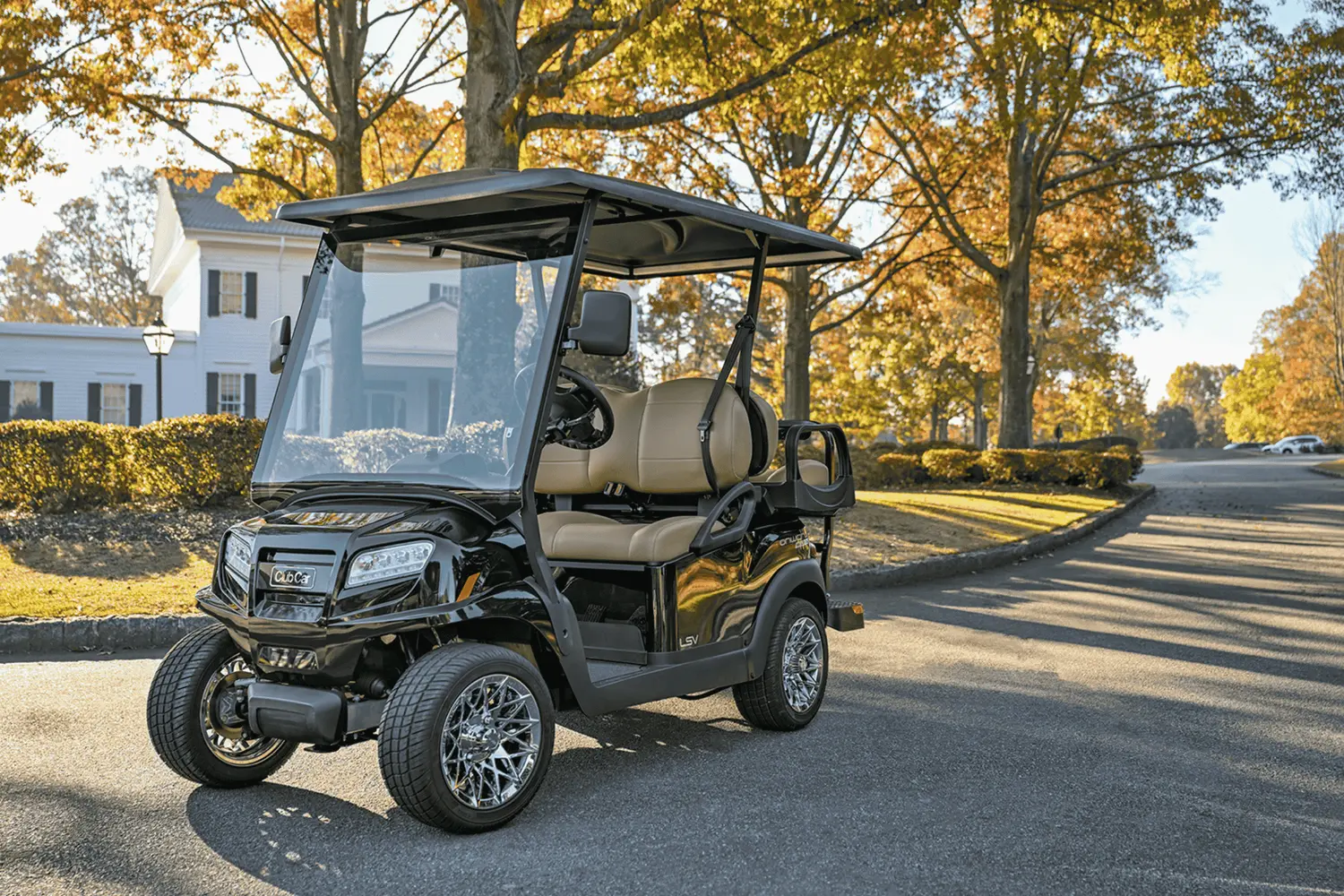
- The fastest stock golf carts are all factory LSVs, a federally defined class (FMVSS 500) capped by law at 25 MPH.
- Verified 25 MPH models: Club Car Onward LSV, E-Z-GO Liberty LSV, GEM e4, and ICON i40/i60.
- Current Yamaha Drive2 PTV and Evolution D5 Maverick pages list 19 MPH, not 25 MPH, despite older internet claims.
- Three things cap stock speed: the controller’s programmed limit, the motor/gear ratio, and tire diameter.
Most factory golf carts are governed to a modest speed for safety and warranty reasons, but a few stock models leave the showroom genuinely quick. If you want speed without immediately voiding a warranty or rewiring a controller, knowing which of the fastest stock golf carts ship hot from the factory saves you a lot of aftermarket spending.
01. Why LSVs Are the Fastest Stock Option
When people ask which stock golf cart is fastest, the honest answer is that a true golf cart (the kind you rent at a course) tops out around 12 to 15 mph, but a Low-Speed Vehicle (LSV) is the fastest thing you can buy without modifying anything. An LSV is a federally defined class (FMVSS 500) that is factory-built to run 20 to 25 mph and comes with seat belts, DOT windshield, turn signals, headlights, mirrors, and a VIN. That 25 mph ceiling is not a mechanical limit, it is the legal cap: to stay street-legal as an LSV the manufacturer electronically governs the cart right at 25 mph.
To wear the LSV badge, the cart must also include DOT safety equipment: seat belts, headlights, turn signals, mirrors, and a windshield. That package is why an LSV trim costs more, but it is also the only way to legally and safely get 25 MPH straight off the lot. The higher speed is engineered together with the braking and safety hardware needed to carry it, which is the real reason a factory LSV stops safely at 25 MPH while a hopped-up standard cart does not.
02. The Fastest Stock Models Ranked
Among factory-built LSVs, the verified 25 MPH group is narrower than the old internet list suggests. Here is the corrected stock-speed stack based on manufacturer sources:
| Model | Verified Top Speed | Source Detail |
|---|---|---|
| Club Car Onward LSV | 25 MPH | Club Car lists 25 mph as high speed on level ground for both non-lifted and lifted Onward 4 Passenger LSV configurations. |
| E-Z-GO Liberty LSV | 25 MPH | E-Z-GO’s MY25 Liberty LSV specification lists a 25 mph speed for the ELiTE lithium LSV. |
| GEM e4 / GEM LSV line | 25 MPH | GEM lists the e4 top speed at 25 mph and confirms GEM vehicles comply with the federal LSV 25 mph standard. |
| ICON i40 / i60 families | 25 MPH | ICON’s owner manual lists 25 MPH maximum speed for i40, i40L, i40F, i40FL, i60, and i60L models. |
| Yamaha Drive2 PTV QuieTech | 19 MPH | Yamaha’s current Drive2 PTV page lists 19.0 mph maximum forward speed, not a verified 25 MPH factory LSV. |
| Evolution D5 Maverick | 19 MPH (current pages) | Evolution’s current D5 Maverick 4 Plus page lists max speed at 19 mph. Treat any 25 MPH Evolution claim as configuration-specific until proven. |
| Standard non-LSV carts | 12 to 19 MPH | Base EZGO TXT, Club Car DS/Precedent, and Yamaha golf trims ship governed below the LSV ceiling. |
03. What Actually Caps Stock Speed
Three things set a stock cart’s top speed: the controller’s programmed speed limit, the motor and gear ratio, and the tire diameter. The controller governor is the big one; nearly every modern cart could physically go faster but is software-limited for safety and legal reasons. The gear ratio (a stock golf ratio is often around 12:1) trades top speed for hill-climbing torque, which is why golf-focused carts feel slow. Tire diameter matters too: a taller tire raises the effective final speed but robs low-end torque and can confuse the speedometer.
The quirk most owners discover: raising speed by only changing tires or unlocking the controller without upgrading the motor leads to overheating and premature wear, because the drivetrain was geared for the original speed. This is why owners chasing more speed start at the controller. Our repair guides library covers controller upgrades and the gearing math behind them.
04. Speed, Safety, and Street Legality
Faster is not automatically better. A cart’s brakes, tires, and suspension are engineered around its rated speed. Pushing a standard golf-trim cart far past its factory limit without upgrading the braking and chassis is genuinely dangerous, and driving an unregistered fast cart on public roads can mean fines. If speed is the goal, buy an LSV that was engineered as a complete fast package rather than over-driving a slow chassis.
It helps to know exactly where the factory speed ceiling comes from on each of these carts. A standard personal-use golf cart is deliberately governed at the controller and, on gas models, by a mechanical governor on the engine, which is why most ship at 12 to 15 MPH regardless of how much motor they have. The LSV trims are not simply ungoverned; to be sold at 20 to 25 MPH they must legally add the DOT glass, three-point seat belts, headlights, turn signals, and a 17-digit VIN discussed above.
The fastest stock golf carts are verified factory LSV or LSV-style models rated up to 25 MPH, including Club Car Onward LSV, E-Z-GO Liberty LSV, GEM e4 and related GEM LSVs, and ICON i40/i60 models listed at 25 MPH in ICON owner documentation. Standard golf carts ship governed lower. Current Yamaha Drive2 PTV and Evolution D5 Maverick pages list 19 MPH, so they should not be treated as verified 25 MPH stock picks.
Frequently Asked Questions
What are the fastest stock golf carts?
The fastest stock golf carts are street-legal LSV trims rated up to 25 MPH, including the Club Car Onward LSV, E-Z-GO Liberty and Express L6, and the Yamaha Drive2 QuieTech LSV. Standard non-LSV golf carts are usually governed to between 12 and 19 MPH from the factory.
How fast can a golf cart go without modifications?
A standard factory golf cart is typically limited to 12 to 19 MPH. A factory LSV (Low-Speed Vehicle) is the fastest stock option at up to 25 MPH, which is the legal maximum for the LSV class before a vehicle is reclassified.