Why Is My 36 Volt Golf Cart So Slow?
A sluggish 36V cart usually traces to tired batteries, low pack voltage, or worn motor brushes, not a dead motor. Work through these causes in order to get your speed back.
- Batteries are the first suspect. As lead-acid batteries age and sulfate, they hold less charge and sag under load, robbing speed and torque.
- Corroded or loose terminals add resistance that chokes current to the motor, mimicking weak batteries.
- Worn motor brushes reduce power and cause sluggishness, while a failing solenoid can intermittently limit current.
- Some carts have a speed setting or limp mode that caps speed, and dragging brakes create constant resistance.
A golf cart that crawls up hills or tops out far below normal is frustrating, but the cause is usually fixable. If your 36 volt golf cart so slow it feels broken, the culprit is most often the battery pack’s health and voltage, with motor and controller issues close behind. Here is how to find it.
The Ordered 36V Slow-Cart Test
Direct answer: start with battery state of charge, then test individual batteries under the same load, cable voltage drop, solenoid path, throttle input, brake drag, tires, and finally controller or motor limits. One weak series battery limits the current of the entire string because the same propulsion current passes through every unit.
| Flooded state of charge | 6V unit | Common 36V pack | Meaning |
|---|---|---|---|
| 100 percent | 6.37V | 38.20V | Fully charged open circuit |
| 80 percent | 6.25V | 37.49V | Continue testing under load |
| 60 percent | 6.12V | 36.72V | Charge before judging performance |
| 50 percent | 6.02V | 36.31V | Materially discharged |
| 20 percent | 5.83V | 34.97V | Deeply discharged |
Trojan requires at least six hours idle, preferably 24, with no charge or discharge before its open-circuit table is used. These values are for the cited flooded-battery guidance at reference conditions, not lithium or every AGM curve.
- Fully charge, rest, and record pack and individual voltages.
- Apply the same controlled load while watching each battery. The unit that drops disproportionately is suspect.
- Measure voltage across each cable, connection, and closed contactor while current flows. Voltage shown across a connection is energy being lost there. Compare like segments and follow the platform manual because there is no universal acceptable value for every traction path.
- With power isolated, check cable heat damage, loose terminals, solenoid contacts, throttle sensor travel, and brake release.
- Verify tire pressure and actual diameter. Larger tires reduce wheel torque in proportion to the stock-to-new diameter ratio.
- Only after inputs and mechanics pass should controller current limiting, brushes, bearings, and motor temperature be evaluated.
Use the existing battery test, voltage-drop guide, and 36V to 48V conversion guide.
Weak Batteries Make a 36 Volt Golf Cart So Slow
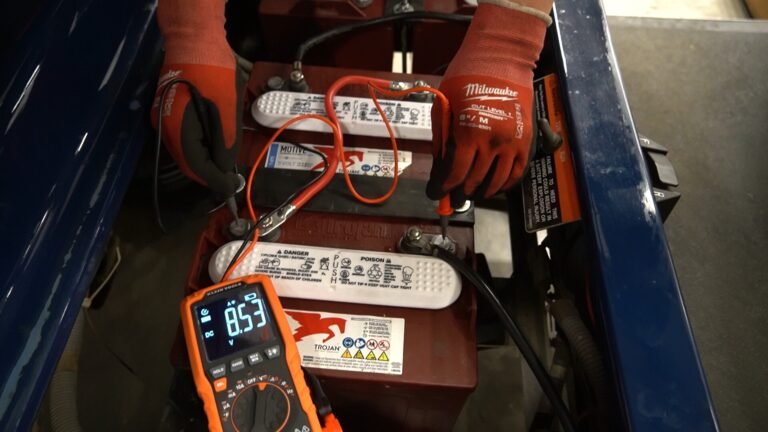
Batteries are the first suspect. As lead-acid batteries age and sulfate, they hold less charge and sag under load, robbing speed and torque. A single weak battery in the series string drags the whole pack down. Fully charge the pack, then load-test each battery; replace any that fail. the voltage bounce test pinpoints a dropped cell.
Corrosion and Connections
Corroded or loose terminals add resistance that chokes current to the motor, mimicking weak batteries. Clean every terminal, check the cables for damage, and verify tight connections. A voltage drop test reveals hidden resistance in the cables.
Motor Brushes and Solenoid
Worn motor brushes reduce power and cause sluggishness, while a failing solenoid can intermittently limit current. If the batteries test fine, inspect the brushes and listen for a clean solenoid click. the motor diagnosis guide covers brush wear in depth.
Speed Limiter and Brakes
Some carts have a speed setting or limp mode that caps speed, and dragging brakes create constant resistance. Confirm the brakes release fully and check for any controller fault. If all else is healthy and you simply want more speed, consider whether converting to 48V is the real fix.
Know Your 36V Voltage Targets
A 36V cart uses six 6V batteries in series, and knowing the numbers turns guesswork into diagnosis. A healthy pack rests near 38.2 volts fully charged, roughly 6.37 volts per battery. Under load, compare every battery at the same instant and follow the exact manufacturer load-test limits; no universal 33V cutoff applies to every battery, temperature, and load. Check each 6V battery individually right after a drive, because one unit reading 5.9 volts while the others read 6.3 is the classic pattern that makes the whole cart crawl. That single bad battery, not the motor, is usually the whole problem.
Platform-Specific Slow Causes
Different 36V platforms use different series motors, controllers, throttle inputs, contactors, chargers, and brake systems. Identify the serial and electrical diagram before testing; do not transfer Club Car OBC or MCOR advice, Yamaha drive-belt advice, or E-Z-GO controller assumptions across platforms.
The Undercharging Trap
A surprising number of slow 36V carts are simply never reaching a full charge. If the charger shuts off early, or the pack is chronically topped only to 34 or 35 volts, the batteries sulfate and lose capacity over a season, and the cart gets slower month by month. Confirm the charger actually completes a full cycle and that resting voltage hits the high 38s the morning after. On carts with a Club Car OBC, a flaky computer can end the charge prematurely, which slowly starves the pack and masquerades as worn-out batteries.
Work the list in order and the fix reveals itself: charge fully, load-test each 6V battery, clean the connections, then inspect brushes, solenoid, brakes, and the throttle sensor. Nine times out of ten a slow 36V cart is a battery or charging problem, and the cheapest fix is finding the one tired battery before you spend money on a motor you did not need.
Tires, Weight, and Cheap Speed
Before assuming something is broken, rule out the mechanical thieves. Underinflated tires add rolling resistance that noticeably slows a 36V cart, so set them to the sidewall spec, using the exact tire and vehicle cold-pressure guidance. Oversized lifted tires also cut top speed and torque because they change the effective gearing; a 36V cart that felt fine on stock 18-inch tires will crawl on 23-inch mud tires without a gear change. And simply hauling four adults up a grade will expose a marginal pack that seems fine when the cart is empty. These are free checks worth doing first.
When Slow Is Just the Limit of 36V
Sometimes the cart is healthy and 36 volts is simply doing all it can. A well-maintained 36V cart tops out around 12 to 15 mph by design, and no amount of tuning changes physics. If you have confirmed strong batteries, clean connections, good brushes, and free brakes but still want more speed and hill power, the honest answer is a 48V conversion or a higher-amp controller and motor, not another round of parts swapping on the 36V system.
One last field tip: keep a written baseline. After you fix a slow cart, note the resting pack voltage and the loaded voltage on your favorite hill. A quick re-check against those numbers a few months later tells you instantly whether a battery is fading again, long before the cart slows enough to strand you.
For federal vehicle and equipment guidance, see the U.S. Department of Transportation.
Frequently Asked Questions
Why is my 36 volt golf cart so slow?
The most common cause is weak, aging, or undercharged batteries that sag under load. Other causes include corroded connections, worn motor brushes, a failing solenoid, dragging brakes, or an active speed limiter.
How can I make my 36V golf cart faster?
Start by restoring battery health and cleaning connections. Replace worn motor brushes and a weak solenoid. For a permanent speed increase, converting the cart from 36V to 48V provides the biggest gain.
Reviewed and updated July 30, 2026 by the Golf Cart Lab team.