EZGO RXV Motor Brake Bypass: Test and Release Procedure
The RXV electronic motor brake holds the cart on hills and locks the drive when power is lost. Releasing it to move a dead cart is a specific procedure, and doing it wrong is how carts roll away.
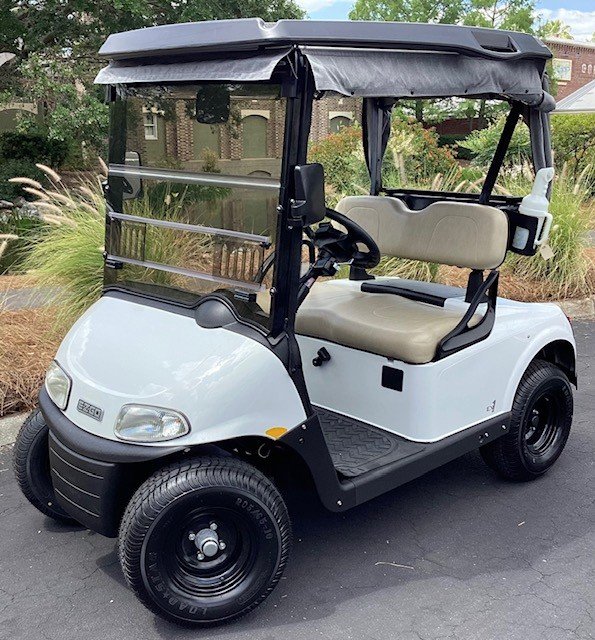
- The RXV motor brake is fail-safe: it engages when power is removed, which is why a dead RXV will not roll freely.
- Releasing the brake to move a cart is a recovery step, not a repair. Chock the wheels first because the cart will roll once it releases.
- A brake that will not release with power applied usually means no voltage reaching the coil, rather than a mechanically seized brake.
- Test for coil voltage before condemning the brake assembly. The fault is often upstream in the controller output or the harness.
- Never leave an RXV parked on a slope with the motor brake bypassed. That protection is the only thing holding it.
The RXV electronic motor brake is a spring-applied, electrically-released mechanism, and understanding that single sentence explains almost every complaint about it. Spring-applied means the default state is locked. Electrically-released means it only frees the driveline while it is being energized. So a cart with a flat pack, a blown fuse or a controller fault does not coast to a stop and sit there rollable; it locks, and it stays locked until something restores power to that coil. This guide covers testing the brake circuit properly and the correct procedure for releasing it to move a disabled cart. For the broader fault picture, the RXV motor brake troubleshooting guide covers roll-away and lock-up symptoms in depth.
How the RXV Motor Brake Works
The motor brake sits at the motor and acts on the driveline rather than on the wheel hubs. Internally, springs clamp the brake closed and an electromagnetic coil pulls it open. When the controller decides the cart should be free to move, it energizes that coil, the brake releases, and the cart drives normally. Cut the power and the springs immediately reassert themselves.
This arrangement is deliberate and it is the safe way round. A brake that required power to hold would release the moment a battery went flat or a wire broke, leaving a cart free to roll away on any slope. By making the locked state the unpowered state, the design ensures a failure results in a stationary cart rather than a moving one. The inconvenience of a dead cart that will not roll is the direct cost of that safety choice.
It also explains why the brake is so often blamed unfairly. When an RXV loses power for any reason, the brake locks as designed, and the owner experiences a seized cart. The brake is usually the messenger rather than the fault, which is why testing the circuit that feeds it comes before touching the brake itself.
What the Symptom Is Actually Telling You
Separate two very different complaints before starting. The first is a cart that will not release when it should, meaning the key is on, the cart is otherwise alive, and the drive is still locked. The second is a cart that is completely dead and will not roll, which is the brake behaving correctly on an unpowered system.
In the second case the brake is not the problem at all. The task is to find why the cart has no power, and the locked driveline is simply a consequence. Diagnosing the brake in that state wastes time. Restore power and the brake usually releases on its own.
The first case is the real brake circuit fault, and it splits again: either the coil is not receiving voltage, or it is receiving voltage and not releasing. Those two point to very different repairs, and a meter distinguishes them in about a minute. Note that a grabbing or intermittently locking brake while driving is a different complaint again, closer to the brakes locking up and reset procedure than to a release failure.
Testing the Brake Circuit
Support the cart with the drive wheels off the ground and chock the front wheels before any test that might release the brake. A cart whose brake frees unexpectedly while a wheel is on the ground will move, and on a slope it will keep moving.
The first measurement is at the brake coil connector, checking for supply voltage with the key on and the cart in a state where the brake should be released. If no voltage arrives, the brake assembly is not the fault and the investigation moves upstream to the controller output, the harness and the connectors between them. If voltage is present and the brake stays locked, the coil or the mechanism itself is the suspect.
The second measurement is the coil itself, checked for continuity with the connector unplugged and the pack isolated. An open coil is conclusively failed. A coil that reads continuous is probably serviceable, though continuity alone does not prove it can develop full clamping force, which is why the voltage test above matters as the companion check.
Inspect the connector while you are there. Corrosion and a partially backed-out pin both produce a circuit that measures acceptably on a static test and fails under vibration, and both are more common than a genuinely failed coil on a cart that has lived outdoors.
Releasing the Brake to Move a Disabled Cart
Sometimes the cart simply has to move: onto a trailer, out of a bay, into a workshop. Before anything else, chock the wheels and understand where the cart will go once the driveline is free. This is the step people skip, and a released RXV on even a gentle slope moves faster than expected and cannot be stopped by hand once it is going.
The correct approach is to restore power to the brake coil so it releases as designed, rather than to defeat the brake mechanically. Applying the proper supply to that circuit frees the driveline in a controlled, reversible way and leaves nothing to reassemble afterwards. Consult the RXV service documentation for the release procedure that matches your model year, because the RXV changed across its production run and the correct method is model specific.
Whatever method is used, treat it as strictly temporary. The cart must not be parked, stored or left unattended with the brake defeated, because the motor brake is the only thing holding an RXV on a gradient once it is stationary. Restore the brake to normal operation the moment the cart is where it needs to be, and use wheel chocks in the interim.
If the cart is being moved because it is dead rather than because the brake has failed, remember that the underlying power fault still needs diagnosis. A cart that locked its brake because of a flat pack, a blown fuse or a failed connection will do it again as soon as it is put back into service.
Two RXV Release Procedures
The RXV motor brake is spring applied and electrically released. Loss of electrical power therefore produces a locked cart by design. The normal tow procedure and the total-power-loss release are not interchangeable. Use the normal procedure whenever the vehicle can power its controls. Use the auxiliary-power procedure only when the pack or control power is unavailable and the TOW position does not release IntelliBrake.
Normal RUN/TOW release
- Park on the flattest available surface, turn the key to neutral, and chock the tires before touching the RUN/TOW switch.
- Move the switch to TOW. On the documented RXV procedure, the electrically released motor brake should now release so the cart can be moved.
- Move the vehicle only as far as required, keep people clear of its path, and chock it again immediately at the destination. A released RXV has no automatic holding brake.
- Return the wiring and switch state to the normal operating configuration before troubleshooting or driving.
Total power loss on current RXV ELiTE documentation
The current E-Z-GO RXV ELiTE owner manual publishes a manual IntelliBrake release beneath the controller splash shield. With the key off and the wheels chocked, remove the three plastic rivets and shield. Locate the capped Auxiliary Power line, remove its weather-pack seal, then disconnect the Primary Power line. Connect Auxiliary Power to Primary Power. The brake releases as soon as the connection supplies the release circuit, so an unchocked cart can move immediately.
After the cart is moved and secured, disconnect Auxiliary Power, reconnect Primary Power, reinstall the weather-pack seal, and refit the splash shield. This is a recovery connection identified by the manufacturer, not permission to feed battery voltage directly into an unknown brake connector. Earlier RXV service families place release instructions in the controller area, but the connector layout can differ. Follow the label and manual that match the cart in front of you.
Coil, Harness, or Controller Output?
A locked cart does not identify the failed part. Divide the system into the brake coil, the two-conductor brake harness and connectors, and the controller command that releases the brake. First inspect the motor-brake connector for water, backed-out terminals, overheated plastic, or a harness pulled tight against the transaxle. Disconnect pack power before unplugging it.
| Check | Published or expected result | Meaning | Scope |
|---|---|---|---|
| Brake coil resistance | 27 plus or minus 3 ohms | Open or far outside the band supports a failed coil or connector. A value in range does not prove the mechanism releases under load. | Published in E-Z-GO service manual 611103 for its mid-2009 RXV family. Do not universalize it to every later brake. |
| Supply at brake connector | Specified release output while the controller commands release | No output directs diagnosis upstream. Output present with a locked brake directs attention to the brake assembly or mechanical drag. | The public manual does not provide one safe universal voltage for every controller generation. |
| Harness continuity | Continuity near lead resistance end to end, with no short to the wrong conductor | A changing reading during a gentle wiggle test exposes an internal break or loose terminal. | Measurement method, not a published E-Z-GO numeric specification. |
| Controller faults | Record before clearing | Motor-brake, throttle, direction, or power faults can prevent a release command even when the coil is sound. | Use the controller and handset procedure that matches the connector generation. |
For a resistance test, isolate the pack, unplug the brake, zero or note meter-lead resistance, and measure on the brake side of the connector. Do not probe a powered controller output in resistance mode. For a command test, reconnect the circuit as the manual directs and back-probe without spreading the sealed terminal. A test lamp is not a substitute unless the service procedure specifies its load, because an incorrect lamp can overload an electronic output.
Connector generations matter
E-Z-GO service literature shows early and later RXV motor and controller connector arrangements, including different main controller connector counts. The available manual does not publish a dependable calendar-year cutoff for every production change. Identify the system by the actual connector, controller label, serial number, and matching schematic rather than assigning it from a guessed model year.
The documented older service family lists the motor brake as an assembly, not as a field-rebuildable coil. Its parts catalog identifies motor brake assembly 605867 for that catalog family. That number is evidence for the covered RXV build range only. Confirm the serial-number fit before ordering because a connector that looks similar does not establish interchangeability.
A Practical No-Release Decision Tree
- Dead cart, brake releases in TOW: secure and move the cart, then diagnose the main power loss. The brake release circuit can still function.
- Powered cart, no release command: read faults and verify key, direction, throttle, brake switch, pack voltage, and controller permissions before replacing the brake.
- Correct command reaches an in-spec coil, but the brake stays locked: inspect mounting, rotor condition, contamination, and mechanical binding. The complete assembly may require replacement.
- Coil is open or outside the serial-matched specification: confirm at the brake pins to exclude the vehicle harness, then replace the correct assembly.
- Brake releases only when the harness is moved: repair the terminal or conductor. Do not cable-tie it into a temporary working position.
After repair, remove every recovery connection, restore the splash shield and seals, and test on level ground. Verify that the brake releases only when commanded, applies when the key is turned off, holds the stationary cart, and produces no related fault. A cart that can roll with the key off should remain out of service until its normal holding function is restored.
Decide first whether the brake is failing or simply doing its job on a dead cart, because those need opposite responses. If the cart has no power at all, fix the power fault and the brake will release itself. If the cart is alive and the brake stays locked, measure for voltage at the coil connector: no voltage sends you upstream to the controller and harness, voltage present sends you to the coil. When you do need to move a disabled cart, chock the wheels before releasing anything, and never leave an RXV parked with the brake defeated.
Frequently Asked Questions
Why will my dead RXV not roll?
The RXV motor brake is spring-applied and electrically released, so its default state without power is locked. A cart with a flat pack, a blown fuse or a controller fault therefore locks its driveline. That is the brake working correctly rather than failing.
How do I release the RXV motor brake to move the cart?
Chock the wheels first, then restore power to the brake coil so it releases as designed rather than defeating it mechanically. The exact release procedure is model-year specific on the RXV, so use the service documentation that matches your cart.
The key is on but the brake still will not release. What now?
Measure for supply voltage at the brake coil connector. No voltage means the fault is upstream in the controller output or harness and the brake itself is fine. Voltage present with the brake still locked points at the coil or the mechanism.
Can I permanently bypass the RXV motor brake?
It should not be left bypassed. The motor brake is what holds an RXV stationary on a slope, so defeating it permanently removes the cart primary parking restraint. Use a release only as a temporary recovery measure and restore normal operation immediately afterwards.
Is a locking motor brake the same as brakes locking up while driving?
No. A brake that will not release is a circuit or coil problem in the release path. A brake that grabs or locks intermittently while driving is a different complaint tied to the electronic brake logic and its reset procedure.