Club Car DS Jerky Acceleration: Causes & Fix
When a Club Car DS jerks or lurches as you accelerate, the controller is getting a stuttering throttle signal or fighting a bad connection. This guide isolates the cause in order, with the real MCOR voltage spec included.
- DS jerky acceleration is a signal-quality or connection problem first, a mechanical one second.
- The MCOR yellow signal wire should read about 0.32V pedal-up, rising smoothly to about 4.65V at full pedal.
- A resistance cross-check runs 1k ohm to 5.67k-7.43k ohms across the MCOR’s two lead pairs, useful for catching a dead spot a quick continuity check misses.
- Clutch sheave wear of 0.060 inch (1.52mm) or more on the belt-contact area is Club Car’s replacement threshold.
A Club Car DS that jerks, bucks, or lurches when you press the pedal, instead of pulling away smoothly, is almost always a signal-quality problem. The controller meters power based on what the throttle sensor tells it; if that signal is noisy, or if a corroded connection chokes current under load, the controller delivers power in stutters and the cart jerks. On older DS carts a worn drive clutch adds a mechanical version of the same complaint. Diagnose the electrical causes first, they’re cheaper and more common.
This is the same lurch-on-takeoff logic traced on other carts; our Yamaha G29 surging and hesitation guide covers the cross-brand version, and the golf cart troubleshooter tool can branch you by symptom.
Why a Club Car DS Jerks Instead of Pulling Smoothly
The DS controller delivers power in proportion to the throttle signal it receives. Smooth acceleration depends on a clean, steadily-rising signal and a low-resistance path for current. Break either one and you get jerking: a noisy throttle signal makes the controller surge and back off; a high-resistance connection makes voltage sag and recover under load. Both feel like the cart is bucking. The fix is to restore clean signal and clean current flow, in that order of likelihood.
The MCOR and Throttle Sensor Behind Club Car DS Jerky Acceleration
On the electric DS, the MCOR (Motor Controller Output Regulator) is the throttle position sensor near the pedal, and it is the prime suspect when acceleration is jerky instead of smooth. Club Car’s DS service procedure gives the number this section was missing: with the meter on the MCOR yellow signal wire, the reading should be about 0.32V with the pedal up, then rise smoothly to about 4.65V at full pedal. If the signal jumps, drops out, or never rises, the MCOR or its wiring is suspect.
| MCOR Test Point | Pedal Up | Full Pedal |
|---|---|---|
| Yellow signal wire (voltage) | ~0.32V | ~4.65V (smooth rise) |
| Resistance, lead pair A | ~1k ohm | 5.67k-7.43k ohms |
| Resistance, lead pair B | 5.67k-7.43k ohms | drops toward ~1k ohm |
Those numbers are useful because a worn MCOR can pass a quick continuity check and still have a dead spot under slow pedal movement. Before replacing it, confirm the pedal group is adjusted correctly: the DS manual uses accelerator pedal adjustment tool CCI P/N 101871001 and lists accelerator pedal height at 5-5/8 inches from the floorboard when set with the tool. If the pedal or park-brake ratchet is misadjusted, the MCOR can be blamed for a mechanical problem. On pre-MCOR DS carts, an ITS or older throttle setup plays the same role, so use the service manual for that exact generation.
Clean the Connections First
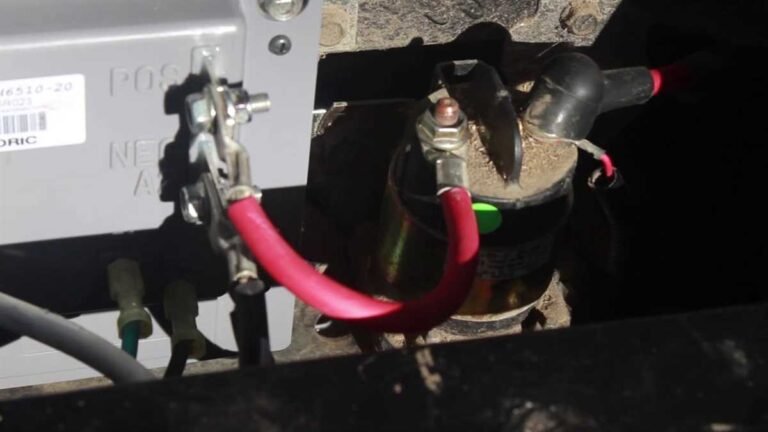
Before condemning any sensor, do the check that fixes a surprising share of jerky DS carts and costs nothing but a wire brush: clean and torque every battery terminal and the motor and controller cable lugs. A single corroded or loose connection adds resistance the controller can’t compensate for, so voltage sags the instant the motor draws current and the cart lurches as it fights through the bad joint. Look for white or green corrosion and tug each cable, nothing should move.
Drive Clutch and Belt
If the electrical side is clean, the DS can still jerk mechanically. On gas DS carts, the service manual points to the torque converter, starter/generator belt, and clutch sheaves rather than a single magic “belt tension” number for the drive belt. It does publish one useful belt figure: starter/generator belt tension should be 75 ft-lb on a new belt or 45 ft-lb on an existing belt when checked with a Krikit gauge or equivalent.
For the drive clutch itself, Club Car says to clean clutch parts with a dry, lint-free cloth, not solvent or lubricant, because dirt and lube interfere with clutch movement. The clutch sheave contact surfaces are the wear spec to know: if any belt-contact area is worn 0.060 inch (1.52mm) or more, the clutch should be replaced. A sticky or worn clutch grabs and releases instead of pulling smoothly, which feels exactly like a low-speed lurch. A clutch clean-and-rebuild often cures a jerk that no amount of MCOR testing would fix.
Batteries and the Step Test
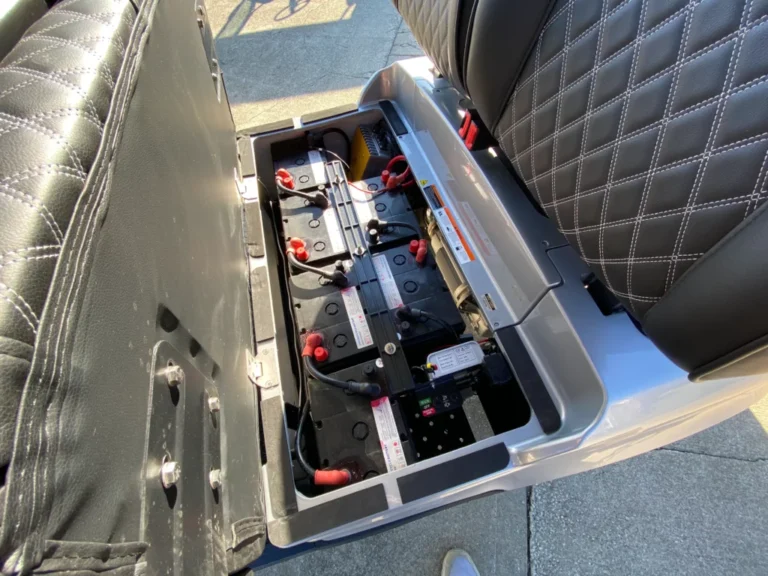
A single weak battery is the great impersonator. The pack reads full at rest, but under the inrush of acceleration one bad battery’s voltage collapses and the controller cuts back, the cart jerks, recovers, jerks again. Load-test each battery individually rather than trusting the pack total; one cell well below its siblings is your culprit. Our companion Club Car DS won’t go forward or reverse guide shares the same drive-circuit map if the jerk ever escalates into a no-drive fault. For DS-specific wiring and component references, Club Car’s official manuals and support library is the authoritative source.
Bottom Line
Club Car DS jerky acceleration is a signal-and-connection problem first, a mechanical one second. Clean every connection (the free win), then check the MCOR/throttle sensor voltage against the 0.32V-4.65V sweep, load-test the batteries, and finally inspect the drive clutch and belt against the 0.060 inch wear limit. Confirm each suspect with a meter or a hands-on check and fix only what’s proven bad.
Because several different faults all produce the same lurch, it pays to verify your repair rather than assume it. After each change, press the pedal slowly from a dead stop to about a third of travel and feel for a smooth, continuous pull. Still steps or bucks at light throttle: recheck the MCOR alignment and connector. Smooth at light throttle but jerks only under hard acceleration or on a hill: revisit the load test. Rhythmic and tied to wheel speed rather than throttle: look at the clutch and belt.
Frequently Asked Questions
Why does my Club Car DS jerk when I accelerate?
A Club Car DS that jerks or lurches on acceleration is almost always a signal-quality problem: a noisy or misaligned MCOR throttle sensor, or a corroded connection that makes voltage sag and recover under load. On older DS carts a worn drive clutch can add a mechanical version of the same symptom.
What voltage should the Club Car DS MCOR read?
Club Car’s DS service procedure specifies about 0.32V on the MCOR yellow signal wire with the pedal up, rising smoothly to about 4.65V at full pedal. A resistance cross-check runs from about 1k ohm at pedal-up to 5.67k-7.43k ohms at full pedal on one pair of leads, the opposite direction on the other pair.
Can a weak battery cause jerky acceleration?
Yes. A single weak battery can read full at rest but collapse under the inrush of acceleration, causing the controller to cut back power in a jerk-recover-jerk pattern. Load-test each battery individually rather than trusting the pack total voltage.
How worn can the DS clutch sheaves be before they need replacing?
Club Car specifies that if any belt-contact area on the clutch sheaves is worn 0.060 inch (1.52mm) or more, the clutch should be replaced. Clean clutch parts with a dry, lint-free cloth only, never solvent or lubricant, since both interfere with clutch movement.
Updated July 2026: added Club Car DS MCOR voltage and resistance sweep specs plus clutch and belt service limits.