Best Golf Cart Brands: How to Choose the Right Maker
There is no single best golf cart brand, only the best brand for your use case, your local dealer network, and the kind of cart you are buying. Here is how the major makers actually stack up by buyer type, with real specs and market-typical prices.
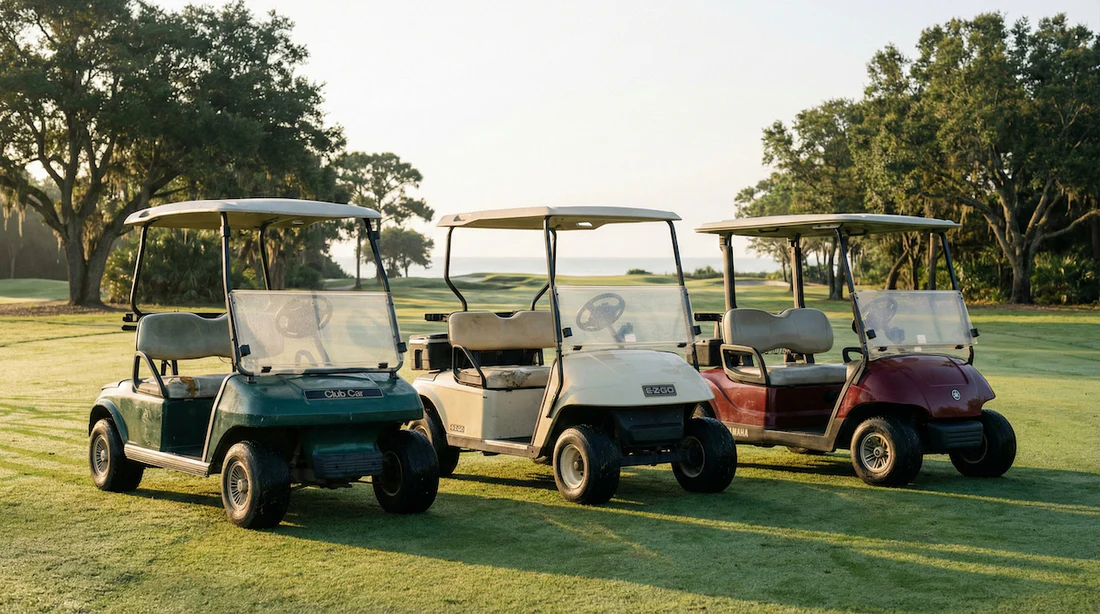
- For serviceability and cheap parts, start with E-Z-GO (TXT/RXV/Liberty) or Club Car (DS/Precedent/Onward). Their dealer networks and parts availability are the deepest.
- For a refined new personal cart, Club Car Onward and Yamaha Drive2 lead. Yamaha QuieTech gas is still the gas-comfort benchmark.
- For loaded lithium-LSV value, compare ICON and Evolution first, then Bintelli, Advanced EV, and Star EV where local dealer support is strong.
- For utility hauling, Cushman Hauler (401cc, 13.5hp, starter/generator) and gas Yamaha are built for torque and all-day fueling.
- LSV claims deserve their own check. FMVSS 500 defines low-speed vehicles around a 20 to 25 mph window with required lighting, mirrors, VIN, and braking. A fast private-road cart is not automatically a legal LSV.
There is no single best golf cart brand. There is the best brand for your use case, your local dealer network, and the kind of cart you are buying. A private-course golfer, a beach-town LSV buyer, and a maintenance crew hauling tools all need different answers, which is why this guide stays categorical instead of pretending a numeric score can rank every maker fairly. Use the table as a shortcut, then read the notes before you buy.
01: Best Golf Cart Brands in 2026
Use the table below as a shortcut, then read the notes before you buy. For speed limits by exact model, cross-check the golf cart top speed by brand reference, because a 19 mph PTV and a 25 mph LSV can wear the same badge but follow different equipment rules. Treat every price as a market-typical band, not a fixed MSRP.
| Buyer Type | Best Fit | Why It Fits | Market-Typical New Price |
|---|---|---|---|
| Proven fleet and parts support | E-Z-GO, Club Car | Deep dealer networks, long-running TXT/RXV/DS/Precedent ecosystems, strong parts availability. | About $9,000 to $18,000 by seats, lithium, and LSV trim. |
| Premium personal cart | Club Car, Yamaha | Club Car leans on aluminum frames and polished Onward trims. Yamaha is the gas-comfort benchmark. | About $10,000 to $20,000 plus options. |
| Loaded lithium LSV value | ICON, Evolution | Feature-rich lithium carts, strong standard equipment, aggressive street-ready pricing. | About $9,000 to $16,000 in many local markets. |
| Dealer-dependent emerging value | Bintelli, Advanced EV, Star EV | Good feature lists and LSV packaging, but local service quality matters more than the brochure. | About $9,000 to $17,000 by battery and seating. |
| Gas and utility work | Cushman, Yamaha gas | Cushman Hauler models are purpose-built utility carts. Yamaha gas is quiet, proven, and fuels all day. | About $10,000 to $15,000 for many gas builds. |
02: How We Rank These Brands
Golf Cart Lab ranks brands by buyer outcome, not by sponsorship or a made-up score. The factors that matter are parts support, dealer coverage, drivetrain reliability, battery warranty, LSV equipment, brake package, frame construction, and resale. A brand with a great spec sheet but no nearby dealer can be a worse buy than a plainer brand with a strong service shop ten minutes away.
LSV claims deserve a separate check. Federal FMVSS 500 defines low-speed vehicles around a 20 to 25 mph speed window and required safety equipment. A cart advertised as street-ready should have the right lighting, mirrors, windshield, VIN, seat belts where applicable, and braking package for your state. Do not assume a fast private-road cart is legally the same as an LSV.
03: What Each Tier Actually Gets You
E-Z-GO is the safest legacy answer for owners who want serviceability. The current Liberty family shows why: E-Z-GO publishes 19 mph PTV versions and 25 mph Liberty LSV material, with ELiTE lithium and an automatic electromagnetic parking brake on electric models. The value is not always the lowest purchase price; it is that most shops know the platform and parts are easy to find.
Club Car is the premium legacy pick. The Onward line is highly configurable, current Onward lithium pages publish modern battery options and range matrices, and the LSV pages emphasize aluminum-frame construction plus street-legal equipment. Club Car makes the most sense for buyers who care about corrosion resistance, refinement, and long-term resale.
Yamaha wins the gas-refinement lane. The Drive2 PTV page lists gas and electric choices and a 19 mph speed, and Yamaha’s QuieTech gas reputation is why many golf communities still choose it. Pick Yamaha when you want gas convenience without the harsh, loud feel of older utility carts.
ICON and Evolution are the value-feature disruptors. ICON’s warranty material shows lithium battery coverage that can run 8 to 10 years depending on the pack, and ICON is widely shopped for loaded street-style carts. Evolution’s D5 Maverick pages publish a 48V lithium battery, a 6.3 kW motor, a 400A AC controller, an onboard charger, and a 19 mph max speed for current PTV-style pages, with separate LSV or dealer configurations varying by market. These brands are strong when you want screens, sound, lighting, lithium, and style for less than many legacy builds.
Bintelli, Advanced EV, and Star EV sit in the same value-LSV conversation but are more dealer-dependent. Bintelli Beyond pages advertise a four-year limited warranty and street-legal packaging. Advanced EV highlights a five-year warranty on current Advent listings. Star EV’s Capella page publishes 48V AC platforms, lithium options, 350A to 450A controllers, a 19.5 mph standard max speed, and 25 mph configured as an LSV. These can be excellent buys where the local dealer stocks parts and honors warranty work quickly.
Cushman is not trying to be a luxury cruiser. Current Hauler pages publish gas utility specs such as 401 cc, 13.5 hp on Hauler 800 and 1200 models, starter/generator electrical systems, payload ratings, and tow ratings. If your cart hauls tools, landscaping supplies, range balls, or maintenance equipment, Cushman belongs on the list even if it is less glamorous.
04: How to Pick the Right Brand for You
Start with the job. If you want a cheap used cart that every shop can repair, shop the E-Z-GO TXT/RXV or Club Car DS/Precedent first. If you want a refined new personal cart and can pay more, start with the Club Car Onward or Yamaha Drive2. If you want a lithium cart loaded with screens, sound, lights, and LSV hardware, compare ICON, Evolution, Bintelli, Advanced EV, and Star EV dealer by dealer.
Then check three local realities. First, who will service it within 50 miles? Second, does that dealer stock controller, charger, brake, and body parts, or do they order everything after a failure? Third, is the cart a PTV, an LSV, or a private-road cart being loosely called street legal? Those answers matter more than a spec-sheet brag.
Parts note: Already own an E-Z-GO TXT or RXV, or a Club Car DS or Precedent? Our buying guides pick the right controller, battery pack and charger for it, cart by cart. See the buying guides
05: Buying Used Changes the Math
On the used market, condition and battery health outrank the badge. A neglected premium cart with a weak pack is a worse buy than a well-kept mainstream cart. Lead-acid battery age, lithium pack age, charger condition, tire wear, brake condition, controller codes, and frame corrosion decide the real cost. Use the value calculator for fair pricing and inspect the batteries, charger, brakes, and tires before you commit.
Used value also depends on parts access. A fifteen-year-old Club Car or E-Z-GO can be easier to own than a three-year-old value LSV if the newer brand has no local support. The exception is when the selling dealer is strong, documents the warranty transfer clearly, and can show service records.
Match the brand to the job, then to your local dealer. Legacy E-Z-GO or Club Car for serviceability, Club Car Onward or Yamaha for refinement, ICON or Evolution for value lithium LSVs, and Cushman for utility. Confirm who services it within 50 miles, whether they stock parts, and whether the cart is a true LSV under FMVSS 500 before you sign.
Parts note: Looking at a used electric cart with a tired pack? The lithium battery finder matches a replacement bundle to it, so you can price the swap before you buy. Find a lithium bundle
Frequently Asked Questions
What is the most reliable golf cart brand?
E-Z-GO and Club Car have the longest proven parts and service ecosystems, which is a large part of real-world reliability because almost any shop can repair a TXT, RXV, DS, or Precedent. Yamaha is also extremely reliable, especially its QuieTech gas engine. Reliability in practice is as much about local parts access as it is about the drivetrain itself.
What is the best value street-legal cart?
ICON and Evolution are usually the first value-LSV brands to compare: they pack lithium, lighting, screens, and street-legal hardware in at aggressive prices. Bintelli, Advanced EV, and Star EV are close behind where dealer support is strong. Confirm the exact trim is a certified LSV under FMVSS 500 for your state, not just a fast private-road cart.
Does brand or condition matter more when buying used?
Condition and battery health matter more than the badge on the used market. A neglected premium cart with a dying pack is a worse buy than a well-kept mainstream cart. Inspect the battery pack age, charger, brakes, tires, controller behavior, and frame corrosion, and weigh whether parts for that brand are available locally before you buy.
How much does a new golf cart cost by brand?
Treat these as market-typical bands, not fixed prices. Legacy E-Z-GO and Club Car builds commonly run about $9,000 to $18,000 depending on seats, lithium, and LSV trim; premium Club Car Onward and Yamaha personal carts about $10,000 to $20,000; value lithium LSVs from ICON and Evolution about $9,000 to $16,000; and gas utility Cushman and Yamaha builds about $10,000 to $15,000. Options, lithium, and LSV certification move the number.