Yamaha 48V Golf Cart Rapid Voltage Drop Under Load: Voltage Sag Fixes
- Every lead-acid battery has internal resistance.
- A static voltmeter reading is useless for diagnosing a the sag you are seeing.
- Sometimes the batteries are healthy, but the the voltage dip is happening in the wiring.
- The solenoid is the heavy-duty switch that connects the 48V pack to the controller.
A Yamaha 48V golf cart rapid voltage drop under load is the primary diagnostic indicator of a breakdown in chemical energy storage or electrical conductivity. When your cart shows 50V at rest but plummets to 38V the moment you hit the accelerator, your power logic is failing. This guide covers the practical ways to troubleshoot and eliminate the "sag" that turns your 48V Yamaha into a slow-moving liability.
The Physics of Voltage Sag vs. Capacity
Every lead-acid battery has internal resistance. As batteries age or sulfate, this internal resistance increases. When you experience a this power loss under load, you are witnessing Ohm’s Law in action (V = I x R). The massive current draw (I) of the Yamaha motor interacts with the high internal resistance (R) of the battery, causing a dramatic voltage drop (V). If your 48V pack drops below 42V under load, the controller will automatically limit speed to protect the electronics. This explains why your cart feels powerful for 10 feet and then suddenly crawls.
The Real-Time Individual Battery Load Test
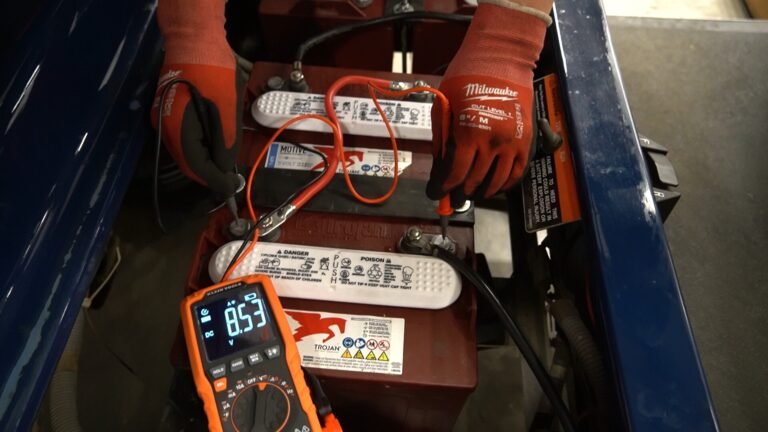
A static voltmeter reading is useless for diagnosing a the sag you are seeing. You need to see the telemetry while the motor is pulling 200+ amps. This is the most reliable way to find the “bad apple” in your pack.
-
The Action: Connect a digital multimeter to one 12V (or 8V) battery. Drive up a steep incline. Repeat for every battery in the pack.
-
The Logic: In a healthy Yamaha 48V system, all batteries should sag equally. If three batteries stay at 10.5V but one drops to 7V, that specific battery has high internal resistance. This single failure is the cause of your this drop under acceleration.
High-Resistance Cable “Hot Spots”
Sometimes the batteries are healthy, but the the voltage dip is happening in the wiring. 4-gauge cables can corrode internally, especially near the battery terminals. This corrosion acts like a restrictor plate, blocking the flow of electricity. Under heavy load, this resistance creates heat. If your battery cables feel hot to the touch after a hill climb, they are the best reason for your power loss. Upgrading to high-strand 2-gauge cables is a mandatory fix for consistent power logic.
Solenoid Contact Pitting
The solenoid is the heavy-duty switch that connects the 48V pack to the controller. Over thousands of cycles, the internal copper contacts become pitted and carbon-scored. This creates a high-resistance bridge. When you have a this symptom, measure the voltage on the “battery side” vs. the “controller side” of the large solenoid terminals while driving. A drop of more than 1V across the solenoid indicates it is failing and choking your power telemetry.
Specific Gravity and Sulfation Recovery
If your this sudden voltage sag is affecting the whole pack equally, your batteries may be heavily sulfated. Use a hydrometer to check the specific gravity of the electrolyte in every cell. If the readings are in the “fair” or “red” zone even after a full charge, the best attempt at a fix is a 24-hour “equalization” charge. This high-voltage pulse helps break down lead-sulfate crystals, restoring the chemical depth needed to prevent a the voltage collapse under throttle.
Tired of lead-acid voltage sag? Upgrade to a Lithium-ion conversion that maintains 50V+ until the moment it’s empty. Browse verified kits in our Guides.
On Yamaha 48V G19, G22, G29 Drive, and Drive2 electric carts, a rapid voltage drop under load usually points to resistance or weak capacity rather than a mysterious controller fault. The pack may show 50.9V after charging, then collapse into the low 40s the moment the pedal is pressed. Test the whole pack first, then test each 8V battery while climbing a small grade. A single battery dropping far below the others is enough to make the controller cut power. Yamaha trays also hide corrosion around the rear hold-downs and cable ends, especially on course fleet carts washed every day. Remove the cable, clean the lug face, and inspect for blackened copper under the insulation. If the voltage drop improves after cable service, the batteries may not be perfect, but the main fault was heat and resistance in the current path.
Once the pack, cables and solenoid test healthy, a Drive that still slows on grades has reached the limit of its stock drive. The Yamaha Drive speed upgrade guide covers the next step for 26 pin G29 and Drive2 DC carts.
Lab Summary
A this power loss under load is a sign that your electrical system cannot meet the amperage demands of the motor. By performing a real-time load test on individual batteries and inspecting your high-current cables for resistance, you can pinpoint the bottleneck in your drive logic. Restoring consistent voltage telemetry is the most reliable way to ensure your Yamaha Drive maintains its torque on every terrain.
For official Yamaha 48V wiring schematics and battery torque specifications, visit the Yamaha Golf Car Manuals (Dofollow) or cross-reference battery safety standards at the NHTSA LSV Safety Portal (Dofollow).
Reviewed and updated August 5, 2026 by the Golf Cart Lab team.