
What Is the Most Common Problem With Electric Golf Carts?
Nine times out of ten it comes back to the batteries: age, sulfation, or neglect. Here are the top electric-cart problems in order, the numbers that confirm each one, and the simple habits that prevent most of them.
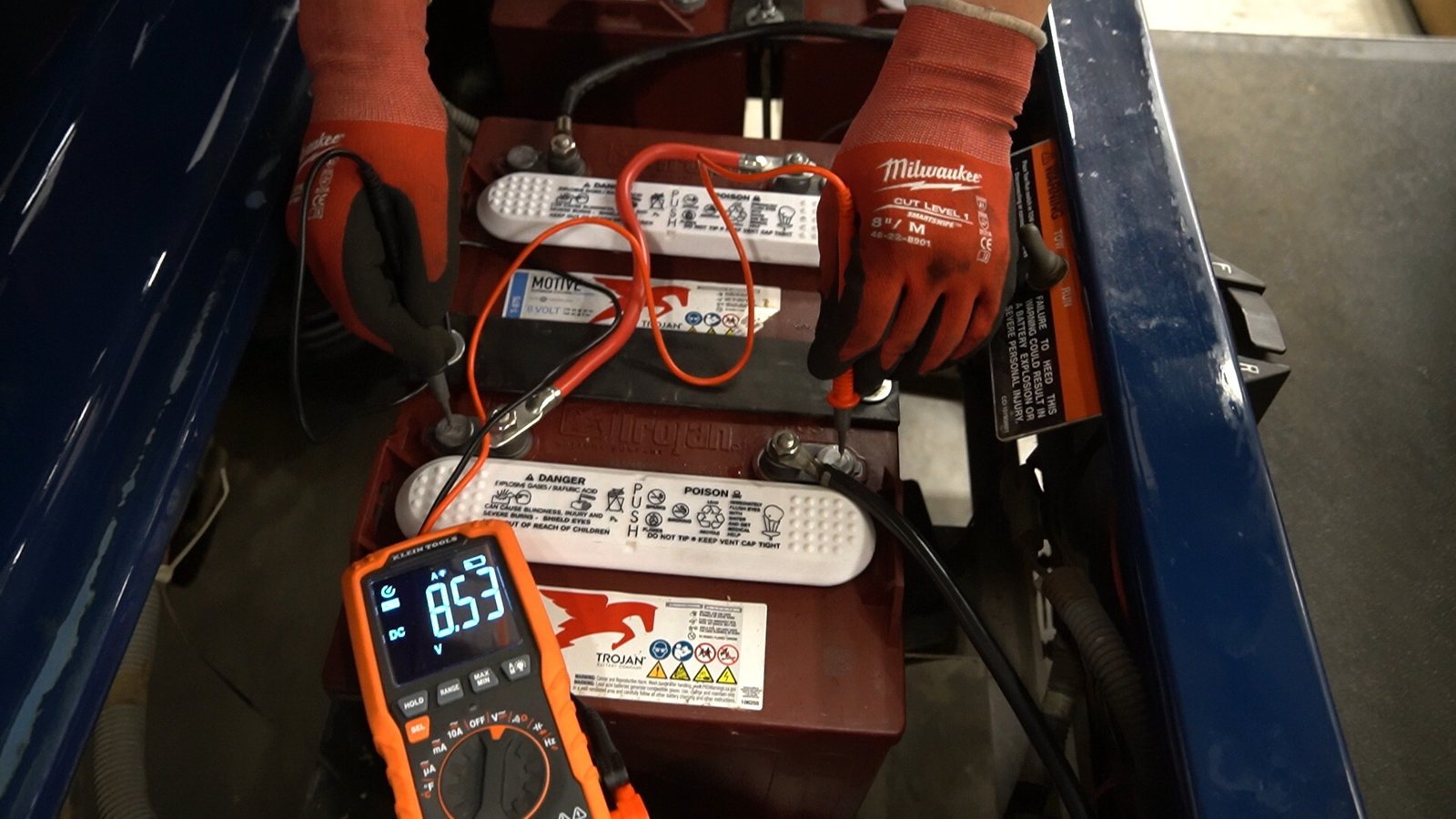
- The battery pack is the most common problem by a wide margin; it powers everything, so weak batteries masquerade as power, speed, and range complaints.
- Resting voltage is a state-of-charge screen, not a health test. A 48V pack reads about 50.93V full and 48.41V at 50% after a proper rest.
- Prove health with a loaded or capacity test and a voltage-drop check across every cable, lug, and closed solenoid contact.
- Diagnose in order (battery, connections, solenoid, charger, controller) to avoid replacing a healthy part.
Electric golf carts are remarkably reliable, but when they do act up the same handful of issues appear again and again. The most common problem, by a wide margin, is the battery pack, followed by the connections, the solenoid, the charger, and the controller. Knowing that order is what lets you diagnose fast instead of throwing parts at the cart, because a voltage number only means something when the battery is rested and the test method is defined.
Diagnostic order: charge the pack, let it rest, record every battery and the full pack, test under a controlled load, inspect voltage drop across connections, then move to the solenoid, charger interlock, throttle input, controller faults, and motor. This sequence separates an energy-storage problem from a control problem before any parts are bought.
Battery Failure: The Number-One Cause
Lead-acid batteries lose usable capacity through sulfation, plate shedding, electrolyte loss, and cell imbalance. A pack can show a respectable voltage with no load and collapse as soon as the controller asks for current, which is exactly why resting voltage is a state-of-charge screen and not a complete health test. Charge the pack fully, disconnect charge and load, and let it sit at least 6 hours, and preferably 24, before reading it against Trojan’s open-circuit table.
| State of charge | 6V | 8V | 12V | 48V pack | Specific gravity at 80F |
|---|---|---|---|---|---|
| 100% | 6.37V | 8.49V | 12.73V | 50.93V | 1.277 |
| 80% | 6.25V | 8.33V | 12.50V | 49.99V | 1.238 |
| 70% | 6.19V | 8.25V | 12.37V | 49.49V | 1.217 |
| 50% | 6.02V | 8.07V | 12.10V | 48.41V | 1.172 |
Specific gravity is measured with a temperature-compensating hydrometer on flooded batteries only. Trojan specifies 1.277 plus or minus 0.007 as full for most of its batteries and a correction of 0.004 for each 10F away from 80F. A reading near 1.225 falls between the 70% and 80% rows, so it is roughly three-quarters charged, not full. A cell spread greater than 0.030 calls for the maker’s equalization procedure and a retest. Do not equalize AGM or lithium batteries.
Load and Capacity Tests That Mean Something
A carbon-pile test has no universal golf-cart pass voltage unless test current, duration, battery type, temperature, and rating are specified. Starter-battery instructions commonly use half the CCA rating for 15 seconds and 9.6V at 70F for a 12V battery, but most deep-cycle golf-cart batteries do not publish CCA, so applying that rule to an unlabeled deep-cycle battery produces a confident but meaningless result.
| Deep-cycle capacity test at 80F | 6V | 8V | 12V | 48V pack |
|---|---|---|---|---|
| Published end voltage, 1.75V per cell | 5.25V | 7.00V | 10.50V | 42.00V |
| Serviceable | At the maker’s stated discharge current, U.S. Battery treats total runtime above 50% of the published specification as generally serviceable. | |||
| Fail or investigate | One battery reaches the end voltage early, runtime is 50% or less, or a cell stays low after a full charge and the approved equalization process. | |||
A shop capacity tester is the cleanest test. At home, record each battery at rest, then back-probe each one while the cart climbs the same short hill with the same passenger load. The module that drops much farther than its peers is the suspect. The battery voltage bounce test explains how the recovery pattern helps identify a dropped cell.
Corroded or Loose Connections
Resistance turns current into heat. A cable can look clean and still have corrosion inside the crimp or poor contact beneath a lug. With the cart safely raised or during a controlled loaded test, measure directly across each connection, one probe on the battery post and one on the cable lug. A good connection approaches zero voltage drop. Compare every jumper under the same load and inspect the outlier, and shut down immediately if a terminal smokes, softens, or becomes too hot to touch.
After repair, torque the terminal to the battery maker’s value, route the cable without strain, and protect the joint. The battery terminal melting guide covers damaged posts and cables.
Solenoid, Charger, and Interlock Tests
The solenoid is a high-current switch. A click proves that the coil moved something, not that the main contacts can carry current. With the key on and pedal pressed, measure the voltage across the two large solenoid posts; a high reading across closed contacts means the contacts are dropping voltage. No click at all requires checks of pack voltage, key input, pedal switch, direction switch, tow/run circuit, and coil command before the solenoid is replaced.
A charger complaint begins with battery voltage, AC supply, charge-port condition, interlock wiring, and the charger’s minimum start requirement. Club Car systems with an OBC or connected charger can block operation or charging for reasons that resemble a dead pack, so use the charger minimum-voltage guide before bypassing any circuit.
How to Prevent Most Problems
- Charge flooded batteries after use and never store them partly discharged.
- Add distilled water at the interval and level in the manual, usually after charging unless plates are exposed.
- Record monthly resting voltage and specific gravity so a trend appears before range collapses.
- Keep tray drains clear, tops clean and dry, and terminal hardware at specified torque.
- Maintain tire pressure, because low pressure raises current draw and masks itself as a battery complaint.
Battery age is only one ownership variable. The golf cart lifespan guide covers the chassis and powertrain around the pack.
Controller, Charger Platform, and Lithium Notes
Move to the controls only after pack voltage stays stable under load and the main power path passes voltage-drop checks. Read stored controller faults before disconnecting batteries, because some systems erase active evidence. Verify that throttle input changes smoothly, the charger interlock releases, and a motor speed sensor produces pulses. A slow cart with a healthy pack may have a programmed speed limit, a speed-sensor fault, a dragging brake, or a controller thermal cutback, and a generic dash blink should never be pinned on one component without the model’s service table.
Charging systems also differ by platform. Club Car DS and early Precedent 48V carts can put an onboard computer in the charging circuit, while E-Z-GO PowerWise, Delta-Q, and later connected systems use different ports and start logic, and an E-Z-GO RXV does not use the Club Car OBC architecture. On a lithium cart, watering, sulfation, and hydrometer testing go away, but BMS current, temperature, cell-voltage, and communication limits arrive. When a lithium cart shuts off on a hill, record pack voltage, BMS fault history, controller current setting, and battery temperature. If the pack wakes once the load is removed, the demand likely crossed a protection threshold, and repeated resets are not a repair.
The single most common problem is the battery pack, but the money-saving move is the order of the checks: charge and rest, then a maker-defined or comparative loaded test, then voltage-drop across every connection, then the charger, and only then the controller, interlock, throttle, speed feedback, and motor. That sequence turns vague symptoms into measurements and keeps you from replacing a healthy part.
Frequently Asked Questions
What is the most common problem with electric golf carts?
A weak or poorly connected battery pack, by a wide margin. Range loss, slow acceleration, charger complaints, and intermittent no-move faults usually trace back to the same place, because the pack powers everything. A resting voltage reading only means something once the pack has rested and the test method is defined.
How do I prevent electric golf cart problems?
Charge flooded batteries fully after each use and never store them discharged, water them on the manual’s schedule, keep the terminals clean and torqued, keep the tray dry, and hold tire pressure so the cart does not draw extra current. Recording monthly resting voltage and specific gravity lets a trend show up before range collapses.
Why does my golf cart show good voltage but still run slow?
A lead-acid pack can read a respectable voltage at rest and collapse the instant the controller asks for current, which is why resting voltage is a state-of-charge screen, not a health test. Back-probe each battery while the cart climbs the same short hill under the same load; the module that drops much farther than its peers is the suspect.
What voltage means a golf cart battery is fully charged?
After a full charge and at least 6 to 24 hours of rest, Trojan’s open-circuit table shows roughly 6.37V for a 6V battery, 8.49V for an 8V, 12.73V for a 12V, and about 50.93V for a 48V pack. A flooded cell reads about 1.277 specific gravity at 80F when full. Anything materially lower is partially discharged or failing.