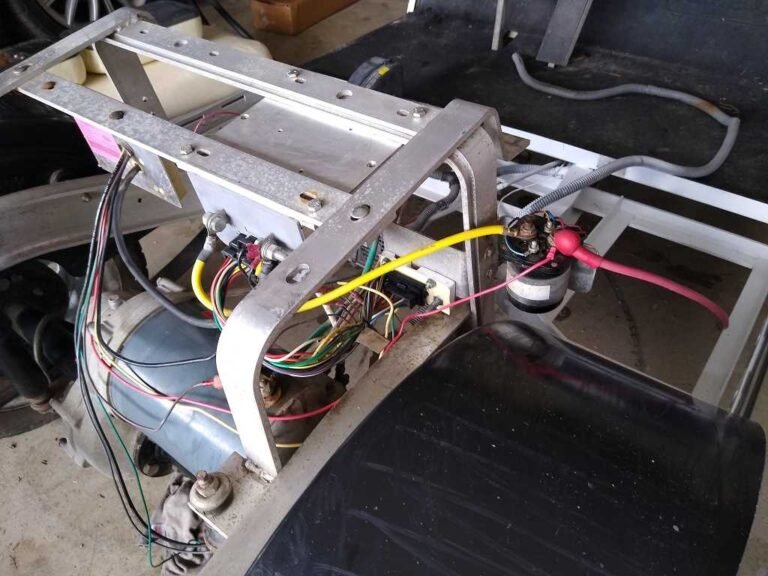
How to Diagnose a Stuck Starter Solenoid
When your golf cart refuses to respond or behaves unpredictably, the solenoid is one of the first components to investigate. Knowing how to properly diagnose a stuck starter solenoid saves you from blindly replacing parts that may not be the problem. This protocol covers the three definitive multimeter tests, the audible click test, and a controlled bypass procedure that confirms whether the solenoid is the actual point of failure.
Already confirmed the solenoid is bad? Jump to our click of death fix guide or our step-by-step welded contacts repair guide.
01 : Recognizing the Symptoms
Before reaching for a multimeter, narrow down the symptoms. The solenoid can fail in ways that mimic other component failures, so correctly identifying the symptom pattern is critical.
- Cart does nothing (no click, no movement): Could be a dead solenoid coil, a failed microswitch, a blown fuse, or a broken key switch. You need to test all four.
- Solenoid clicks but cart does not move: The coil is working and pulling the plunger, but the main contacts may be burnt, or the problem is downstream (controller, motor, cables). Our click-of-death guide covers this scenario in depth.
- Rapid chattering / buzzing from solenoid: The coil is partially energizing but cannot hold the plunger down. This usually indicates low battery voltage (the pack cannot sustain the coil current) or a coil with shorted windings that has reduced its magnetic pull strength.
- Cart moves with key on and no pedal input: The solenoid contacts are welded shut. This is a dangerous runaway condition. Turn the key off immediately. If the cart still moves, disconnect the main battery cable.
02 : Test 1: Continuity Across the Main Contacts
This test determines whether the solenoid is stuck closed. Turn the key off, select neutral, set Run/Tow to Tow when fitted, disconnect pack negative, and isolate at least one large cable plus any precharge resistor. Never use the ohms setting on a powered circuit.
- Short the meter probes together and note their resistance, commonly about 0.1 to 0.4Ω on basic leads.
- Probe the two isolated large terminals with the solenoid de-energized.
- Expected: OL/open circuit. That is the correct resting state.
- Bad: continuity or approximately 0Ω after lead resistance is removed. The contacts are welded; replace the solenoid. A reading in the hundreds of ohms usually means the precharge resistor or another parallel path was not disconnected, so isolate the terminals and repeat.
03 : Test 2: Coil Resistance
Keep the pack disconnected and remove the control wires from the two small terminals so the harness does not alter the reading. Measure directly across the coil.
- Expected: a stable, finite low-ohms reading for that part. There is no universal number: 36V and 48V continuous-duty cart contactors commonly measure from a few dozen to a few hundred ohms. For example, known 48V Club Car Precedent service parts are roughly 180 to 250Ω, while other designs can be much lower. Use the stamped part number or service manual as the deciding specification.
- Bad: OL/infinite. The winding is open and cannot pull the plunger in.
- Bad: approximately 0Ω, or far below the specified range. The winding is shorted and can overheat the control circuit. Replace the solenoid.
04 : Test 3: Activation Voltage
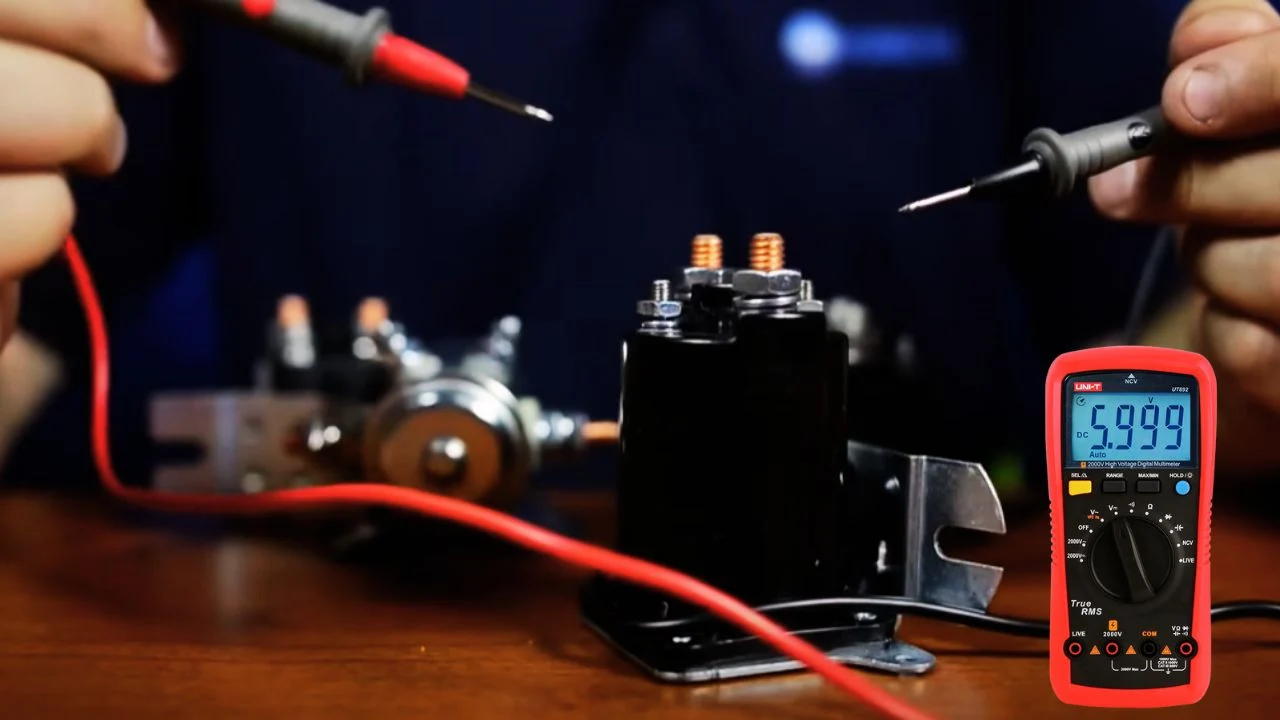
Reconnect the circuit for a live test, chock the cart, keep clear of the drive wheels, and set the meter to DC volts. Back-probe across the two small terminals while the key is on, a direction is selected, and the pedal is pressed.
- Expected: approximately the solenoid’s rated coil voltage while commanded. On a conventional 36V or 48V cart this is usually near pack voltage, although controller-driven systems can use a different stamped coil voltage or pulse-width-modulated hold voltage.
- Bad: 0V means the command path is open. A reading several volts below the specified pull-in voltage points to a weak pack, corroded connector, key/pedal switch, interlock, or control-side voltage drop.
- Conclusion: correct activation voltage plus no click condemns the coil or a seized plunger. No activation voltage means diagnose upstream before buying a solenoid.
05 : Test 4: Voltage Drop Under Load
This is safer and more useful than bridging the large terminals. Leave the solenoid installed, set the meter to DC volts, place one probe on each large post, and command the cart while it is loaded. The meter is measuring only the voltage lost inside the closed contacts.
- De-energized: the reading may be close to pack voltage because the contacts are open.
- Energized and carrying current: a healthy contactor should fall close to 0V; roughly 0.1 to 0.3V is a practical field target when connections and current are normal.
- Bad: about 0.5 to 1V or more deserves investigation, and a steady 2V or more across the clicked-in contacts is strong evidence of burned, high-resistance contacts. Readings depend on load and meter placement, so test at the studs and repeat at the cable lugs to separate internal contact loss from a loose terminal.
Do not bridge the high-current posts with a screwdriver. The arc can weld metal, damage a controller, or make the cart move unexpectedly.
06 : Common Misdiagnoses to Avoid
Before condemning the solenoid, rule out these frequently misdiagnosed conditions:
- Dead batteries mimicking a stuck solenoid: If your pack voltage is below the controller’s minimum threshold, the solenoid may click but the controller will not engage the motor. Test your pack voltage and individual battery voltages. Read our voltage bounce test guide to find a weak cell.
- Failed F/R switch: If the Forward/Reverse switch has burned contacts, it can interrupt the solenoid activation circuit. Check our F/R switch burnout guide to rule this out.
- Speed sensor limp mode: On EZGO RXV and some Club Car Precedent models, a failed speed sensor puts the controller into limp mode, severely limiting power output. This can feel like the solenoid is “not working right” when in reality it is engaging normally. See our speed sensor limp mode fix.
Frequently Asked Questions
How do you diagnose a stuck starter solenoid?
Disconnect the pack, then run four checks: continuity across the large contacts, coil resistance across the small terminals, activation voltage at the coil, and voltage drop under load. Compare each reading to the expected value to isolate the fault.
What should the solenoid coil read on a multimeter?
Compare across the two small terminals to the part or service-manual spec. It is a low-ohms reading that varies by coil voltage and design; OL means an open (dead) coil and near zero means a shorted coil.
What does continuity across the large posts tell you?
With the coil de-energized the large posts should read open (OL). A stable near-zero-ohm reading means the contacts are welded and the solenoid is stuck closed.
Can a bad connection mimic a stuck solenoid?
Yes. Corroded terminals, a weak battery pack, a failed microswitch, or an OBC fault can all mimic solenoid failure, which is why voltage-drop testing under load is part of the diagnosis.