
Cart Won’t Stop? Welded Contacts
Does your golf cart keep driving after you release the pedal? The solenoid contacts have welded shut, a critical safety failure. This guide proves the weld with a meter and sizes the right replacement contactor.
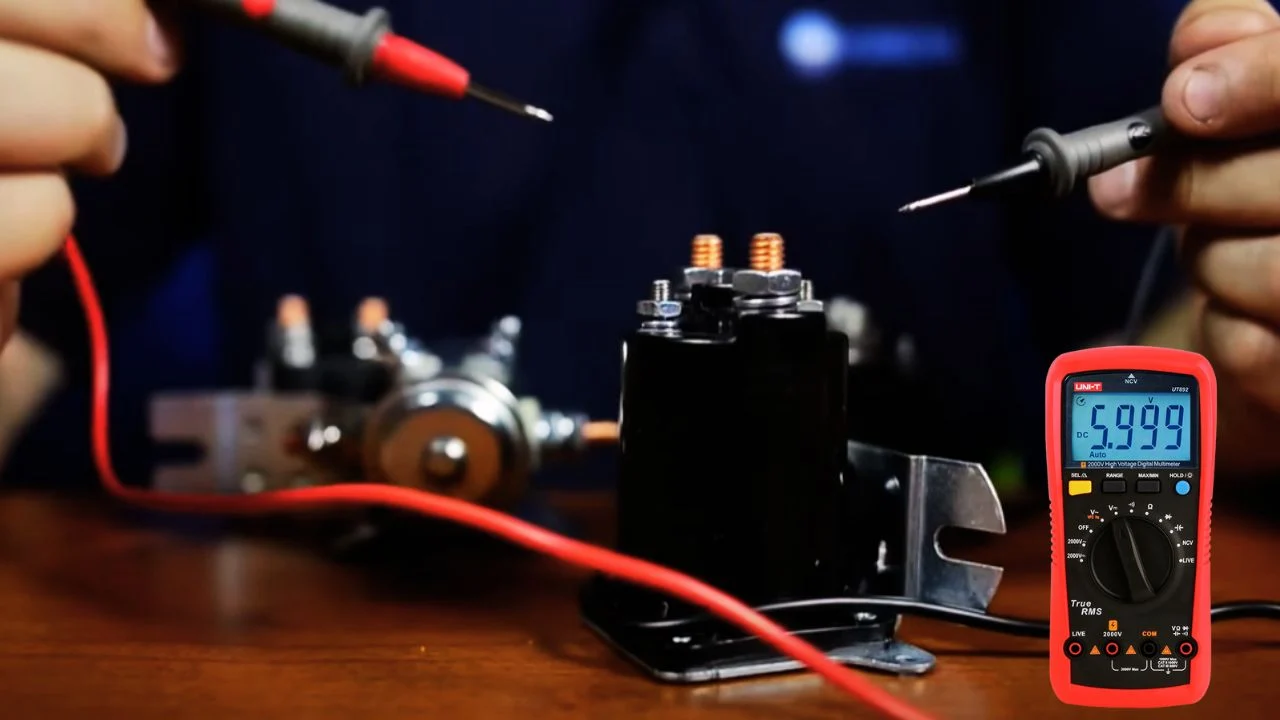
- A cart that creeps after you release the pedal has a welded solenoid, the opposite of the click of death. Treat it as an emergency.
- Prove it with the cables removed: OL (open) at rest is safe; a dead-zero beep with no coil power means welded.
- Never trust the screwdriver tap: it breaks a thin weld temporarily but the pitted faces re-weld at the next hard pull.
- Size the replacement above stock: Albright SW200 (250A interrupted/400A uninterrupted) or Sayoon MZJ-400A on modified carts, coil voltage matched.
You pull into the garage, let off the pedal, and the cart keeps creeping forward. This is the runaway cart, and it is the exact opposite of the click of death: your solenoid has melted shut. A welded solenoid may keep the controller connected to pack voltage even when the pedal is released, which can create runaway movement, heat damage, or a cart that will not shut down normally. Get the key off and the tow switch pulled before you diagnose anything.
Why the Contacts Fuse Shut
A solenoid is a heavy DC contactor. Each time it closes, the contacts carry motor-controller current. If the cart has high cable resistance, a weak pack, oversized tires, a high-current controller, a heavy rear-seat load, or repeated hill starts, the arc at the contact face gets hotter, and eventually the contact face can weld closed. This failure is far more common on hard-driven fleet carts and lifted four-seaters than on stock personal carts. The physics is simple: current equals torque, and every amp of extra torque you demand at the wheels flows straight through those two little copper faces. Sizing the contactor to the job is the real fix:
| Contactor | Published Rating Clue | Use Case |
|---|---|---|
| Stock 200A replacement style | Many OEM-style golf-cart solenoids are sold around the 200A class. | Fine for a stock cart with stock controller, tires, and payload when cables and batteries are healthy. |
| Albright SW200 | Data sheet lists 250A interrupted and 400A uninterrupted by configuration. | Common upgrade path when the controller and duty cycle exceed stock-style contactor comfort. |
| Sayoon MZJ-400A | Data sheet lists 400A rated load current and continuous work specification. | Another heavy-duty contactor family, with coil voltage chosen by exact model number. |
Do not buy a 400-amp contactor without matching the coil voltage, mounting, duty rating, diode or resistor setup, and controller wiring. A 48V coil belongs on a 48V control circuit; a 36V coil belongs on a 36V control circuit. Our 400 amp solenoid upgrade guide walks through choosing the right part for 36V and 48V systems.
Proving the Weld With Ohms
Warning: jack up the rear wheels. If the solenoid is welded, the wheels will spin at full speed instantly upon reconnection.
- Isolate the solenoid. Turn the key off, switch Tow/Run to Tow, disconnect the main positive, and remove the heavy cables from the two large solenoid posts.
- Why remove the cables? You cannot test continuity accurately while the solenoid is connected to the controller loop; the motor windings and precharge resistor give a false low reading.
- Run the ohm test. Set the meter to continuity and touch the two large posts.
A good solenoid at rest reads OL, or open, across the large posts; it should only close when the coil is energized. If your meter beeps a dead zero with no coil power applied, the disk is fused to the studs and no amount of cleaning will save it. Do not bother measuring a specific ohm value here, since a welded contact and a healthy closed contact can both read near zero; the diagnostic that matters is whether it is closed when it should be open.
| Reading | Sound | Diagnosis |
|---|---|---|
| OL (Open Loop) | Silent | Safe (open) |
| 0.00 ohms | Continuous beep | Welded (bad) |
The Screwdriver Tap Trap
Take the handle of a screwdriver and give the solenoid body a sharp tap. Did you hear a clunk? That was the spring finally breaking the weld. Do not think you fixed it. The reason the tap trick is so seductive is that the cart will drive normally for a day or two afterward, convincing the owner the problem cured itself. What actually happened is the return spring finally overcame a thin weld, but the mating surfaces are now cratered and out of round, so they arc worse than before and re-weld at the next hard pull. On fleet carts this cycle can repeat every few days until it welds during braking on a hill, which is the failure mode that hurts people. Once a solenoid has welded even once, its service life is over. Order the replacement the same day and do not rely on the tap as anything but a way to safely stop the cart creeping across your garage.
Root Causes and Prevention
Replacing a welded solenoid without finding the cause can make the new one fail the same way. The single biggest killer is chronic undervoltage: when the pack sags, the controller pulls more amperage to make the same power, and that extra current turns a normal switching arc into a welding arc. Regen and plug braking on RXV and lithium-converted carts push high current backward through the same contacts, and a lazy old return spring lets the faces linger in the arc zone a few milliseconds too long. Clean every battery cable, inspect the controller B+ and B- lugs, load-test the pack, and check whether the cart has been upgraded beyond the stock contactor’s job.
| Platform Reference | Common Stock-Style Part Clue | Upgrade Trigger |
|---|---|---|
| E-Z-GO 36V TXT/Medalist | 27855G01 36V solenoid catalog reference. | Upgrade for a high-current controller, larger tires, heavy payload, or repeated contact welding. |
| E-Z-GO 48V TXT | 612711, 606971, 609428 48V TXT catalog references. | Upgrade if voltage drop or heat appears on a modified 48V cart. |
| Club Car DS/Precedent | 101908701, 102774701, 1014947 common 48V references. | A lifted Precedent with more controller current can outgrow a stock 200A solenoid. |
| Late Precedent/Tempo | 102865901 48V slot-mount reference (Club Car Tempo parts data). | Confirm controller rating and duty cycle before replacing like-for-like on a modified cart. |
| Yamaha G19/G22 | JR1-H1950-00 48V solenoid catalog reference. | Use serial-specific parts and upgrade if the controller or motor package asks for more current. |
Stock 200A parts are undersized when the controller can command far more than stock current, the cart spends time on steep hills, the tires are oversized, the pack is lithium with high current capability, or the same contactor has welded more than once. Size the contactor above the controller’s current and duty cycle, and keep the diode or suppression resistor arrangement matched to the controller. Never file a pitted contact: filing removes the plating and the part will simply weld again.
A cart that will not stop has a welded solenoid until proven otherwise. Kill the key, prove the weld with a continuity test across the disconnected large posts, and replace the solenoid, never file it or rely on the tap. Then fix the root cause, weak pack, high current, or an undersized contactor, so the new one does not weld too.
Frequently Asked Questions
Why does my golf cart keep moving when I let off the pedal?
This is caused by welded contacts inside the main solenoid. High electrical current has melted the copper contact faces and fused them together in the closed position, so power flows to the controller and motor even when the pedal is released. A welded solenoid is a safety failure and must be replaced, not tapped free.
How do I test for a welded solenoid?
Turn the key off, switch Tow/Run to Tow, disconnect the main positive, and remove the heavy cables from the two large solenoid posts. Set a multimeter to continuity and touch the two large posts. A good solenoid reads OL (open) at rest with no coil power. A dead-zero beep with no coil power means the contacts are welded shut.
What amp solenoid do I need for a golf cart?
Stock-style golf-cart solenoids are often sold around the 200A class, which is fine for a stock cart with healthy cables and batteries. The Albright SW200 data sheet lists 250A interrupted and 400A uninterrupted; the Sayoon MZJ-400A lists 400A rated load current. Size the contactor above the controller’s current and duty cycle on lifted, oversized-tire, high-current, or lithium carts, and match the coil voltage.
Can I fix a welded solenoid by tapping it?
No. Tapping may let the return spring break a thin weld so the cart stops creeping, but the contact faces are now cratered and out of round, so they arc worse and re-weld at the next hard pull. Once a solenoid has welded even once its service life is over; use the tap only to safely stop the cart and order a replacement the same day.
