
Golf Cart Limp Mode Fix: Speed Sensor Diagnosis
Is your golf cart suddenly stuck at 8 MPH? It’s likely in "Limp Mode." Learn how to perform the "Roll-Away Test" and replace the sensor.
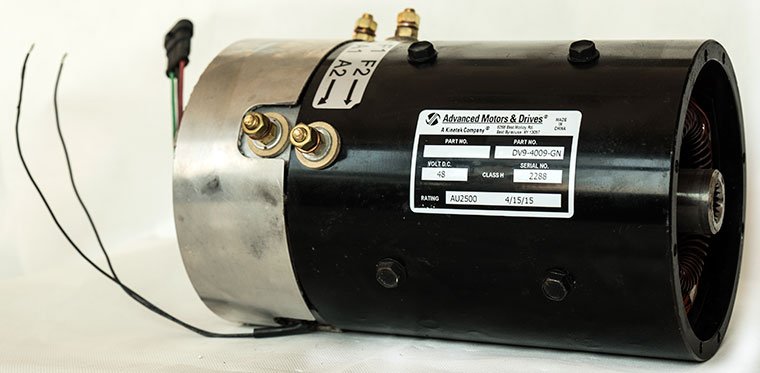
01 : Why The Cart Caps At 8 MPH
Modern electric carts use a closed-loop system. The Speed Sensor counts the RPMs of the motor magnet. If the controller sends power but receives no speed signal, it assumes a lock-up and triggers safety mode.
This logic is most visible on the EZGO PDS and DCS carts (1994 through 2009) and the Club Car IQ system Precedent (2004 and newer). Both watch a small Hall-effect sensor that sits a few thousandths of an inch from a ring of magnets on the back of the motor. The controller is not measuring how fast you are going down the road, it is counting magnet passes. Lose those pulses and the controller cannot tell the difference between a stalled motor and a snapped sensor wire, so it defaults to the safe assumption and pulls you back to a crawl.
On the EZGO PDS this shows up as a hard 8 to 9 MPH cap with the cart still drivable. Club Car carts behave similarly but will sometimes throw a slow fault blink on the OBC light. Knowing which platform you are on tells you exactly which connector and wire colors to chase.
02 : The No-Tools Roll-Away Test
You don’t need tools to diagnose this. You just need a slight incline or a strong pair of legs.
The Procedure
Turn Key ON, F/R in Forward. Do NOT touch the pedal. Push the cart manually to 2-3 MPH.
- Result A (Healthy): Cart beeps rapidly and motor brake engages (resistance).
- Result B (Dead): Cart rolls freely with zero resistance and no beeping. Sensor Failure Confirmed.
03 : Confirming It With A Multimeter
For scientific proof, use a multimeter to back-probe the sensor while it is still plugged in.
Back-probing matters here because unplugging the sensor to test it tells you almost nothing. These Hall sensors only output a signal when the magnet ring is moving past them, so the wheel has to spin while the connector is still seated and powered. A common mistake is testing a stationary sensor, seeing a flat 5V, and condemning a perfectly good part. Always spin the wheel slowly by hand and watch for the toggle.
- Setup: Multimeter to 20V DC. Black probe to Main Negative. Red probe to Green/Signal wire.
- Action: Jack up one rear wheel and spin it slowly by hand.
- Healthy Reading: Voltage toggles between ~5V and 0V four times per revolution (Pulse… Pulse…).
- Dead Reading: Steady 0V or 5V with no change.
04 : Is It The Sensor Or The Magnet?
It’s not always the sensor. On older Club Car ADC motors, the magnet is held on by a screw. Heat expansion often cracks this magnet.
One more clue separates a bad sensor from a bad magnet: if the roll-away test gives you zero motor braking and zero beep, but a brand-new sensor changes nothing, the magnet is almost always the real fault. A good sensor on a broken magnet still produces no usable pulse, so the symptom never clears. Pulling the sensor and feeling for a loose, gritty, or wobbling magnet takes thirty seconds and saves you from buying a second sensor you do not need.
Wiring is the third suspect. The sensor harness runs along the motor and gets baked, vibrated, and sometimes chewed by rodents on carts stored outdoors. Before condemning the sensor, wiggle the connector and inspect the three wires for cracked insulation or green corrosion on the pins. A single broken signal wire produces the exact same limp-mode symptom as a dead sensor, and it is a free fix with a crimp and some heat-shrink.
The Club Car ADC (Advanced DC) series motor is the classic offender. The trigger magnet is a small ceramic ring or button pressed onto the armature shaft behind the sensor. Years of heat cycling expand and contract that magnet until it crazes and crumbles. When it breaks apart, the pieces still spin but no longer make a clean magnetic pulse, so the brand-new sensor you just bolted in reads garbage and the cart stays in limp mode. EZGO motors mount the magnet ring differently, but the same heat-cracking failure happens on high-mileage carts that live in hot southern climates.
05 : Sensor Replacement Step By Step
Applies to Club Car IQ/Precedent and EZGO PDS.
One platform note before you start: the Precedent uses a top-hat style sensor with two small screws, while many EZGO PDS motors use a flatter GE-style sensor that snaps into a slot. They are not interchangeable, so confirm the body shape against your old part before ordering. Buying the wrong style is the number one reason a sensor swap stalls halfway through.
- Safety: Tow/Run switch to TOW. Disconnect Main Negative.
- Remove: Top Hat style uses two 8mm screws. Flat GE style snaps out with a screwdriver.
- Inspect: Check the internal magnet for cracks.
- Install: Tighten screws gently (plastic cracks easily).
- Reboot: Reconnect battery, switch to RUN, and push the cart to verify the “Beep.”
Summary Checklist
- Limp Mode = 8 MPH. If you go 12 MPH, check batteries instead.
- No Regen: If the cart coasts forever, the sensor is likely bad.
- Magnet Check: A cracked magnet kills a new sensor.
- Buy OEM: Cheap $15 sensors fail in heat. Stick to OEM/Red Hawk.
06 : Speed-sensor signals are controller specific
A fixed 8 mph claim is not universal. A speed-feedback fault typically produces a model-specific reduced-speed or protective behavior. Identify the installed controller and use its diagnostic path.
| Documented sensor example | Published test value | Scope |
|---|---|---|
| Club Car DS IQ three-pin sensor supply | Black/white 48 to 50V; red about 15 to 16V; light green 4.60 to 4.90V | DS IQ procedure only. |
| DS IQ output while wheel turns | Green wire switches from 0 to about 4.85V, four cycles per armature revolution | DS IQ procedure only. |
| Curtis, Alltrax, GE families | No universal resistance or magnet-air-gap figure in the sources used | Use exact controller and sensor manual. |
A Hall sensor commonly needs supply, ground, and switching output. An inductive sensor can use an AC signal or resistance test. If no gap is published, measure old mounting depth and target gap before removal, then follow the replacement maker’s instructions.
FAQ
Will a bad sensor always limit a cart to 8 mph?
No. The reduced-speed behavior depends on controller programming and the exact fault.
Can I test a speed sensor with an ohmmeter?
Only when the sensor documentation specifies resistance. Three-wire Hall sensors are normally tested for supply and switching output.
What air gap should a sensor have?
Use the exact sensor documentation. There is no safe universal number across Hall and inductive designs.
Can a bad magnet cause limp mode?
Yes. A cracked, missing, contaminated, or misplaced target can prevent valid speed feedback.
