
F/R Switch Burnout: Signs & Upgrades
On a series cart the full motor current runs through the mechanical forward/reverse switch, and resistance there means heat. Here is how to prove burnout with a voltage-drop test, the real contactor amp ratings for an upgrade, and why big tires push the current higher.
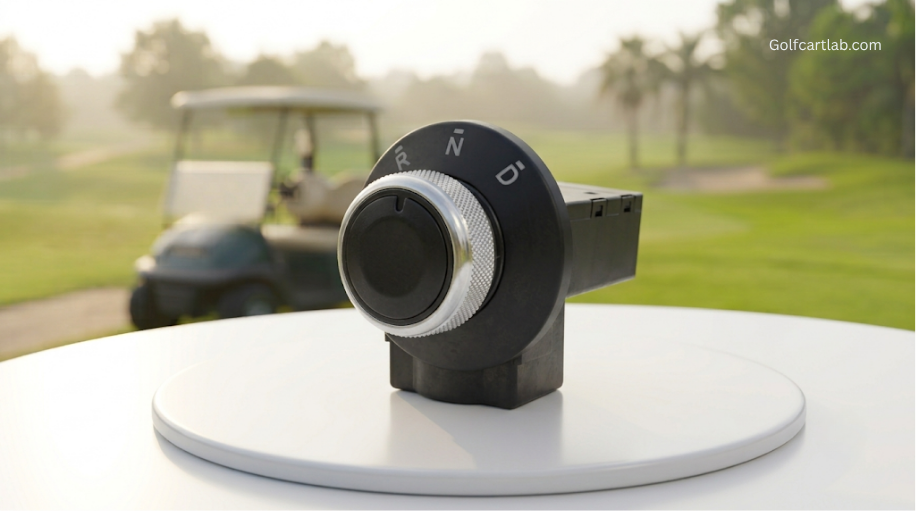
- Heat is resistance. On a series cart the full motor current runs through the mechanical F/R contacts, so worn or loose contacts build heat that melts the switch and nearby wires.
- There is no universal stock amp rating. The honest specification is a measured voltage drop across the switch path at a known current; over 0.20V at 100A is a service trigger.
- Upgrade ratings are real and specific: Albright SW80 is 100A interrupted / 125A uninterrupted, SU280 is 250A / 350A (450A / 640A at 30% duty), and Trombetta Bear lists 225A continuous / 400A for 30 seconds.
- Bigger tires raise the load. Going 18 to 23 inch needs about 27.8% more axle torque, and at low speed torque tracks current, so starts and hills draw materially more amps through that switch.
A mechanical forward/reverse switch carries motor current through copper contacts selected by a cam. Controller upgrades, larger tires, steep grades, loose pivots, and poor cable joints all raise the heat at those contacts, and on an older series cart that heat can melt the switch and its wiring. The service manuals do not publish one universal amp rating for every stock rotary switch or every aftermarket heavy-duty switch, so where a rating is missing, the honest specification is a measured voltage drop at a known current.
Why the Switch Burns
On a series-wound cart the full armature current flows through the mechanical switch. Clean, tight contacts pass that current with almost no loss, but dirty, worn, or loose contacts add resistance, and resistance at hundreds of amps turns into concentrated heat. That heat softens the contacts further, which raises resistance again, a runaway loop that ends in a melted switch. The same physics is why a lifted cart pulling 400 to 500 amps destroys a switch that a stock cart never bothered.
Switching Approaches and Real Ratings
| Switching approach | Published current data | Coil / control | Fitment limit |
|---|---|---|---|
| Stock rotary / cam F/R switch | No universal current rating is published across Club Car, E-Z-GO, and Yamaha manuals | Mechanical cable or lever, by platform | Use the OEM part confirmed by serial and stock controller/motor, or measure the actual path. |
| Aftermarket heavy-duty rotary switch | Use only a datasheet stating continuous, intermittent, and make/break current; “heavy duty” without test conditions is not a spec | Mechanical | Confirm terminal layout, enclosure, cable size, controller, and motor current. |
| Albright SW80 contactor | 100A interrupted thermal, 125A uninterrupted, 185A at 30% duty; about 40mV new-contact drop at 100A | 6 to 240V coils; continuous coil 7 to 13W | Engineering reference for a conversion, not a universal drop-in. |
| Albright SU280 contactor | 250A interrupted, 350A uninterrupted, 450A interrupted and 640A uninterrupted at 30% duty; about 40mV new-contact drop at 250A | 6 to 240V coils | Higher-current conversion. Confirm suppression, duty, enclosure, controller logic, fault protection. |
| Trombetta Bear family | 225A continuous and 400A for 30 seconds for applicable models | 12, 24, 36, and 48V coil options | Select the exact contact form and coil code by serial and system design. |
Interrupted and uninterrupted thermal ratings are not the same as make/break capacity. A reversing system may switch direction only after current has fallen, so never command a direction reversal while moving unless the manufacturer designs for it, and a contactor conversion also needs electrical interlocking so forward and reverse contactors cannot close together.
Voltage-Drop Proof of Burnout
| Drop across the selected path | Resistance at 100A | Heat at 100A | Workshop action |
|---|---|---|---|
| At or below 0.10V | At or below 1 milliohm | At or below 10W | Low-drop result. Compare forward with reverse at the same current. |
| 0.10 to 0.20V | 1 to 2 milliohms | 10 to 20W | Inspect contacts, pivot pressure, lugs, and cables. Retest. |
| Above 0.20V | Above 2 milliohms | Above 20W | Service or replace the proven high-resistance path. |
| 0.50V | 5 milliohms | 50W | Severe concentrated heating at 100A. Stop high-load use until repaired. |
Put the voltmeter across the complete selected switch path, not stud to chassis, and record motor current with a DC clamp at the same instant. Test forward and reverse against the same grade, then divide a high result into contact-to-contact, lug-to-stud, and cable segments. A burned-looking switch with low drop may not be the present fault, while a clean-looking crimp with high drop is. Albright’s roughly 40mV new-contact figures show what a purpose-built contactor achieves at its rated current; they do not mean every stock rotary switch must read 40mV.
Why Larger Tires Raise Stress
Tractive force at the ground equals axle torque divided by tire radius. Holding the same ground force after changing from an 18 inch tire to a 23 inch tire needs a radius and torque ratio of 23 divided by 18, which is 1.278, or about 27.8% more axle torque. At low motor speed, motor torque is closely tied to current, so starts, hills, soft ground, and stalled wheels can demand materially more current through the F/R switch. This is a geometry calculation, not a promise that every cart draws exactly 27.8% more battery current. Alltrax recommends a 400A or higher controller for a large-tire cart in hilly terrain and describes stock 6 AWG motor cable as good for about 300A, with 4 AWG for a 400A controller or non-stock motor.
A hot or melted F/R switch is a resistance problem you can prove with a meter: measure the voltage drop across the whole switch path under a known current, and anything over about 0.20V at 100A earns service or replacement. If your cart is lifted or has a bigger controller, a stock rotary switch is outmatched, so step up to a rated heavy-duty switch or a properly interlocked reversing contactor sized to your real current, not to a vague “heavy duty” label. Pair any upgrade with cable heavy enough to carry the load without becoming the next hot spot.
Where the switch has not yet burned out but one direction has stopped working, the full terminal by terminal procedure is set out in the forward and reverse switch test guide.
Frequently Asked Questions
Why does my golf cart Forward/Reverse switch get hot?
Heat comes from electrical resistance. On older series carts the full motor current flows through the mechanical F/R switch, so dirty, worn, or loose internal contacts build resistance that generates intense heat, enough to melt the switch and the surrounding wires. Prove it with a voltage-drop test across the switch path under load, since a drop over about 0.20V at 100 amps means the contacts are the problem.
Do I need a Heavy Duty F/R switch for my lifted golf cart?
Usually yes. Lifted carts with larger tires need more torque and therefore more current to move: a stock switch is outmatched once the cart pulls well past its stock draw. Rather than trust a vague heavy-duty label, pick a switch or reversing contactor with a published amp rating that exceeds your measured current, and back it with heavier cable so the load is handled everywhere in the path.
What is a Reversing Contactor for a golf cart?
A reversing contactor replaces the mechanical F/R lever with a heavy-duty solenoid system that switches direction electrically instead of through sliding copper contacts. That eliminates the melting-contact failure mode and can allow push-button shifting. It must include electrical interlocking so the forward and reverse contactors can never close at once, and you should switch direction only when the vehicle is designed to allow it.
How many amps does a golf cart F/R switch handle?
There is no single published figure for stock switches, which is why a measured voltage drop is the honest test. For upgrades the numbers are documented: an Albright SW80 handles 100A interrupted and 125A uninterrupted (185A and 230A at 30% duty), an SU280 handles 250A interrupted and 350A uninterrupted (450A and 640A at 30% duty), and a Trombetta Bear lists 225A continuous with 400A for 30 seconds. Match the rating to the real current your cart draws under load.
