Golf Cart Backup Camera Worth It?
A golf cart backup camera fixes a real rear blind spot on bigger carts. Here is the honest verdict and who should skip.

- a camera earns its cost on carts with rear seats, cargo boxes, enclosures, trailers, or frequent pedestrian exposure.
- A manual-view setup is often the simplest safe option on a cart without reverse lamps.
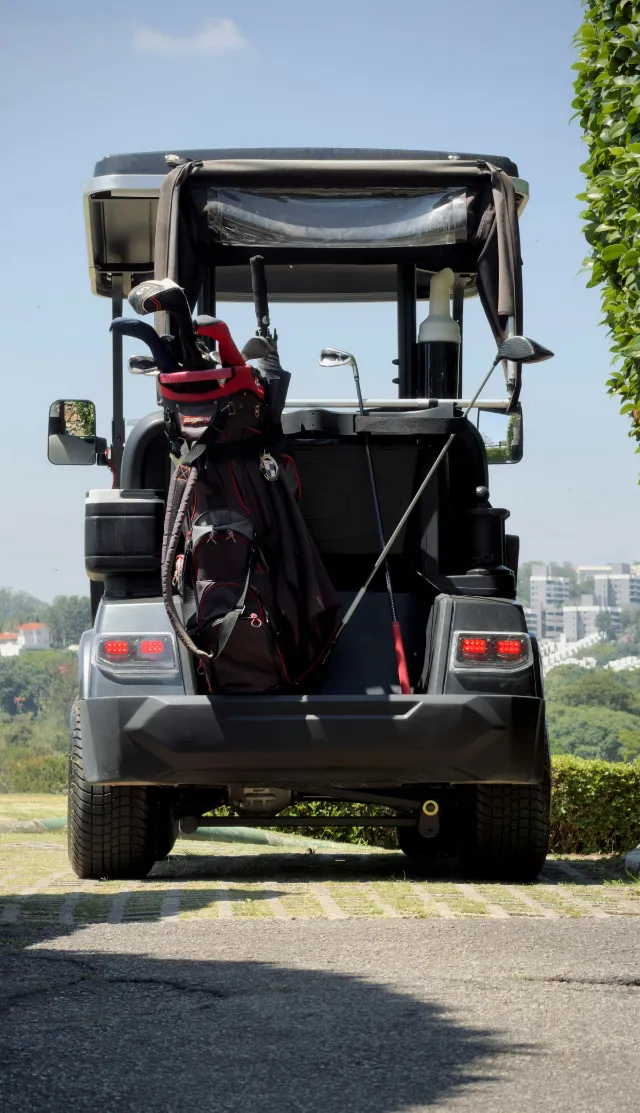
- Rear-facing seats and cargo boxes create blind zones close to the bumper.
- Buy for visibility, not screen size alone.
A backup camera is essential on some carts and pointless on others. This verdict covers when a golf cart backup camera is worth it, wired vs wireless, and how to install it.
Wired Versus Wireless With Current Specs
Direct answer: a camera earns its cost on carts with rear seats, cargo boxes, enclosures, trailers, or frequent pedestrian exposure. It is convenience rather than necessity on an open two-seater with a clear shoulder view, and it never replaces turning to check the path.
| Current example | Image and view | Power and protection | Connection tradeoff |
|---|---|---|---|
| Garmin BC 50 | 720p, 160 degrees, 30 fps | 12/24V family; camera module 9 to 28V, 1A at 12V, 2A fuse, IPX67 | Wireless, up to 50 ft published range |
| Haloview BT6 Touch Plus | 1920 by 1080 camera; 1280 by 720 5.5-inch display | 10 to 32V; IP69K camera; 4.5W monitor | Wireless, 120ms published latency |
| Haloview BT7 Plus | 1080p with 7-inch display | 10 to 32V; IP69K camera; 8W monitor | Larger screen and the same 120ms class latency |
| Generic wired kit | Model dependent | Verify voltage, fuse, and camera ingress rating | No radio interference, but a full-length signal cable |
Wireless means wireless video, not wireless power. Garmin documents reverse-light power for automatic display and constant power for manual viewing. Many golf carts do not provide a clean automotive reverse-lamp trigger, so use a switched 12V supply or a model-specific isolated trigger. Never probe or tap motor, solenoid, speed-sensor, or controller wiring as a shortcut.
Wired systems offer the most predictable picture but require protected cable routing through the cart. Wireless systems simplify the signal run, yet metal roofs, battery compartments, and distance can reduce link quality. Mount the camera high enough to see hazards, low enough to judge the bumper, and centered when possible. Test latency, night view, field of view, and the driver’s normal seating position before drilling.
Installation Decision
- Choose a regulated voltage source that matches both camera and display.
- Decide whether the image should appear automatically in reverse or manually from a switch.
- Use a model-specific trigger or an isolated relay when the cart lacks a clean reverse signal.
- Fuse at the source and route power and video wiring away from motor cables, moving suspension, heat, and sharp edges.
- Bench-test the field of view, wireless link, latency, and night image before drilling.
A manual-view setup is often the simplest safe option on a cart without reverse lamps. A wired kit is preferable where reliability matters more than installation time. A wireless kit is useful when running a signal cable is difficult, but the transmitter and camera still require power.
Who Benefits Most
Rear-facing seats and cargo boxes create blind zones close to the bumper. Enclosures narrow the shoulder view, and trailers make alignment harder. Those carts gain the most. A camera also helps on property with children, pets, equipment, or tight storage. Compare the cost with other priorities in the best golf cart accessories guide and the light bar review.
Bottom Line
Buy for visibility, not screen size alone. A protected camera with a usable field of view, a stable power source, and a deliberate trigger method is more valuable than an advertised high resolution connected through improvised cart wiring. Keep a direct visual check as the final step before moving.
For the broader upgrade order, see golf cart upgrades worth it.
What Actually Matters When Choosing One
Most golf cart camera kits are rebadged automotive or marine units, and the spec sheet rarely tells you how it will behave clamped to a cart roof in direct sun. A few things separate a kit you keep from one you take off after a season.
- Weather sealing. Look for an IP rating of at least IP67 on the camera body. A cart lives outdoors, gets hosed down, and sits through rain in a way a car camera behind glass never does. An unrated camera will fog or fail.
- Operating voltage. Most kits expect 12V. A 48V or 72V cart needs a proper voltage converter, not a tap off part of the pack. Pulling 12V across a subset of series batteries unbalances the pack and shortens its life, which is the single most common wiring mistake on this job.
- Monitor brightness. A screen rated around 400 nits or less is hard to read in direct sunlight, which is exactly when you are driving. This matters more on a cart than in a car because there is no roof pillar shading the display.
- Vibration tolerance. Carts transmit far more chassis vibration than a car. Cheap connectors back out over time, so kits with locking connectors and a strain-relieved cable run last considerably longer.
- Field of view. Somewhere around 120 to 150 degrees suits a cart. Much wider adds distortion that makes judging distance harder, which defeats the purpose.
Installation Notes Worth Knowing First
The camera itself is usually the easy part. The wiring is where installs go wrong. Take your 12V feed from a proper DC to DC converter fed from the full pack, not from one or two batteries in the string. Fuse the feed close to the source. Run the camera cable along an existing harness path where possible, secured every foot or so, and keep it away from motor and controller cables to reduce interference on the video signal.
Decide early whether you want the camera live all the time or only in reverse. On a cart without a conventional reverse circuit to trigger from, a simple switched feed is often more practical than trying to find a reverse signal, and many owners prefer leaving the display on permanently anyway.
Frequently Asked Questions
Is a golf cart backup camera worth it?
For rear-seat, cargo, enclosed, or trailer-towing carts with poor rear visibility, yes, it removes a real blind spot for little money. On an open two-seater where you can simply turn and look, it is more convenience than necessity.
Wired or wireless backup camera for a golf cart?
Wired kits are more reliable with no signal lag, but require running a cable the length of the cart. Wireless kits simplify installation at the cost of occasional lag or signal drops; mount the receiver close to the monitor to minimize issues.
How do I power a 12V camera on a 48V golf cart?
Use a DC to DC converter rated for your pack voltage, fed from the full pack and fused at the source. Do not tap 12V across two of the six batteries in a 48V string. That draws unevenly from part of the pack, leaves those batteries chronically undercharged, and will shorten the life of the whole set. A converter costs little and is the only correct way to do this.
Will a backup camera drain my batteries when parked?
It can if it is wired to a permanently live feed, though the draw is small. The safer approach is to switch the camera and monitor with the key so nothing is powered when the cart is parked. If you do wire it permanently live, a cart left for weeks will see measurable drain, so add an isolation switch if the cart sits over winter.
Can I fit a camera to a cart with a rear seat kit?
Yes, and this is one of the situations where a camera genuinely earns its place, because a rear seat and its occupants block the over-the-shoulder view almost completely. Mount the camera high enough to see past the seat back, usually on the roof edge or the top of the cargo frame rather than low on the bumper.
Do wireless kits work reliably on a golf cart?
Generally yes over the short distance involved, but expect a fraction of a second of lag and occasional dropout, particularly if the receiver sits far from the transmitter or the cart carries other electronics. Mount the receiver as close to the monitor as practical. If you are towing or the camera is on a trailer, a wired run is worth the extra effort.
Is a camera legal to use on a street-legal cart?
A backup camera is an addition rather than a replacement for required equipment, so it does not usually create a compliance problem. Local rules for low-speed vehicles still require the mirrors specified for street use, so fit the camera in addition to the mirrors rather than removing them.
Reviewed and updated July 30, 2026 by the Golf Cart Lab team.