
EZGO vs Club Car vs Yamaha: Which Golf Cart to Buy
A head-to-head buyer comparison of the big three golf cart brands with real cited specs: frame, drive system, speed, battery, and warranty, so you can choose with confidence.
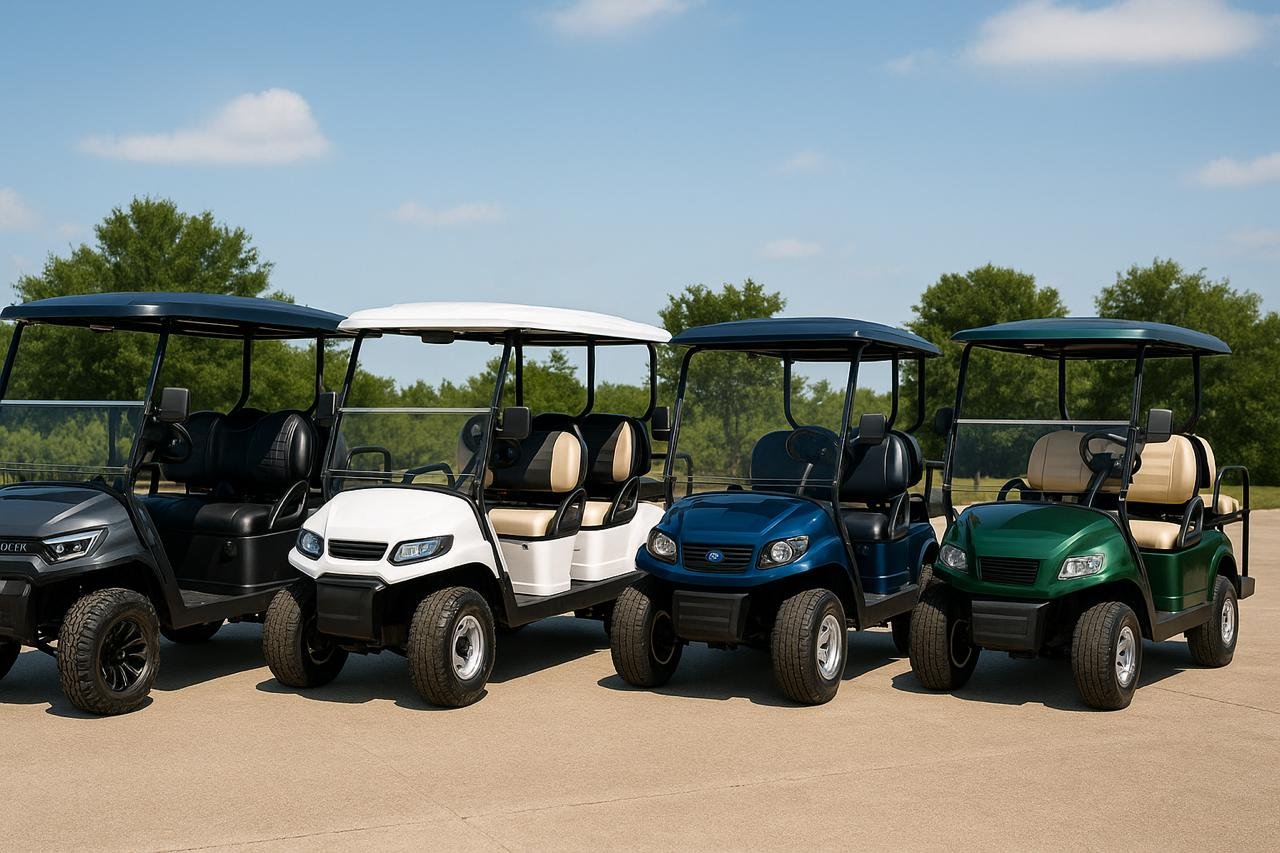
- Club Car’s Onward uses a rustproof aluminum frame; E-Z-GO’s current RXV dealer spec lists welded steel with Durashield powder-coat; Yamaha’s Drive2 uses a HybriCore robotic-welded steel chassis.
- Published top speeds are close across all three current models: up to 19 mph on the Onward, 19 mph plus or minus 0.5 mph on the RXV ELiTE, and 19.0 mph on the Drive2 PTV.
- Warranty terms differ meaningfully: Club Car lists lithium coverage up to 6-8 years, E-Z-GO lists an 8-year lithium cell warranty, and Yamaha’s Drive2 PTV carries a 4-year limited warranty.
- E-Z-GO has the deepest, cheapest aftermarket; Club Car’s aluminum frame is the strongest resale/durability edge; Yamaha wins on drivetrain refinement and quiet operation.
Club Car, E-Z-GO, and Yamaha build the carts most people end up choosing between, and each has a genuine personality. Knowing what each brand does best is the fastest way to narrow your search and avoid buyer’s remorse.
EZGO vs Club Car vs Yamaha at a glance
These three makers dominate the market, and you cannot really go wrong with any of them. They differ in character more than in quality. Here is the quick comparison before we break down each brand:
| Brand | Known for | Frame | Best for |
|---|---|---|---|
| Club Car | Durability, resale value | Rust-proof aluminum | Long-term owners |
| E-Z-GO | Aftermarket, customization | Steel with powder-coat protection on the cited RXV dealer spec | Modders and tinkerers |
| Yamaha | Smooth, quiet, reliable | HybriCore steel chassis | Refined daily driving |
The useful version of an EZGO vs Club Car vs Yamaha comparison needs more than brand personality, so this table uses current or recently published model-level specs. Always confirm the exact model year and package, because warranties, battery packs, speed settings, and street-legal limits vary.
| Spec row | Club Car Onward 4 Passenger | E-Z-GO RXV 4 Touring S ELiTE Lithium | Yamaha Drive2 PTV |
|---|---|---|---|
| Frame material | Club Car describes the Onward with a rustproof aluminum frame | A 2026 RXV dealer spec lists welded steel with Durashield powder-coat protection | Yamaha lists a HybriCore robotic-welded ladder-style steel frame with phosphate, epoxy, and powder-coat protection |
| Drive system | Current Onward specs list gas, 250A DC electric, and 375A AC lithium configurations | Dealer spec lists direct-drive AC induction motor, 235A AC controller, and IntelliBrake electromagnetic parking brake behavior | Yamaha Drive2 PTV page lists QuieTech EFI gas and electric PTV options; speed varies by configuration |
| Published speed | Up to 19 mph on the standard Onward 4 Passenger | 19 mph plus or minus 0.5 mph on the cited 2026 RXV 4 Touring S ELiTE listing | 19.0 mph maximum forward speed on the Drive2 PTV page for the faster PTV configuration |
| Battery or power options | 12V gas starting battery, six 8V flooded batteries, or 4.0 kWh and 7.0 kWh lithium options | Single ELiTE 2.2 lithium battery, 56.7V max, on the cited 2026 RXV dealer spec | Yamaha publishes gas EFI and electric Drive2 PTV variants; confirm the battery package by serial and dealer build sheet |
| Warranty anchor | Club Car warranty page lists limited lifetime frame coverage, 2 to 3 years on many vehicle groups, and lithium battery terms up to 6 or 8 years depending on base or extended range package | E-Z-GO lithium warranty materials list lifetime frame workmanship, 8 years for lithium battery pack cells, and 3 years for Freedom-model parts on the cited non-fleet lithium warranty statement | Yamaha Drive2 PTV manual includes a limited 4-year warranty for Drive2 personal transportation vehicles |
Club Car: built to last
Club Car’s signature claim is now easy to anchor: its Onward page describes the cart as using a rustproof aluminum frame. That is the fact behind the usual durability and resale-value reputation, especially in wet, coastal, humid, or fertilizer-heavy environments where steel-frame rust can become a long-term cost.
The current Onward 4 Passenger specifications also show why Club Car spans more than one buyer type. The same model family can be gas, flooded electric, base lithium, or XR lithium, with 4.0 kWh and 7.0 kWh lithium options on the spec page and a top speed up to 19 mph for the PTV version. Warranty terms vary by component, but Club Car’s current warranty page lists limited lifetime frame coverage and lithium battery warranty terms that can run to 6 or 8 years depending on base or extended range lithium coverage.
The trade-off is that Club Car’s proprietary systems, including older Excel and IQ electronics, can be less hobbyist-friendly than an EZGO TXT or RXV with a deep aftermarket. If you want a cart that you buy, maintain simply, and sell years later with strong buyer confidence, Club Car is the classic choice. Learn to identify any model with our Club Car serial number lookup.
E-Z-GO: the customizer’s favorite
E-Z-GO has the broadest modification culture of the three, which makes it the go-to brand for owners who want lifts, lights, tires, speed controllers, rear seats, and DIY-friendly parts support. The sourced technical anchor is the RXV platform: a current 2026 RXV 4 Touring S ELiTE dealer spec lists a direct-drive AC induction motor, 235A solid-state AC controller, 19 mph plus or minus 0.5 mph top speed, welded steel frame with Durashield powder-coat protection, and an ELiTE 2.2 lithium battery.
The RXV’s AC drive and IntelliBrake reputation is not just brand folklore. E-Z-GO’s own launch material for ELiTE pointed to RXV technology, Samsung SDI lithium packs, and maintenance-free battery operation, while current warranty materials for non-fleet lithium vehicles list an 8-year battery-cell warranty. That gives E-Z-GO a strong technical story even if the steel frame means rust inspection matters more near salt water.
For owners who enjoy modifying their cart or want the widest, most affordable parts selection, EZGO is hard to beat. It is also a strong pick if you expect to do your own maintenance, since how-to information and aftermarket support are abundant. The buyer check is simple: inspect the frame coating, confirm the controller and battery package by label, and verify whether any lithium warranty transfers.
Yamaha: smooth and reliable
Yamaha tends to win on refinement, and the current Drive2 PTV page gives that claim some hard edges. Yamaha lists a HybriCore chassis built from a robotic-welded automotive ladder-style steel frame, with phosphate treatment, epoxy-based coating, and powder topcoat. It also lists maximum forward speed at 19.0 mph for the faster PTV configuration and a tight turning radius, depending on configuration.
The Drive2 gas reputation is also more than a vibe. Yamaha’s PTV material highlights QuieTech EFI, and the owner’s manual backs the ownership side with a limited 4-year warranty for Drive2 personal transportation vehicles. Compared with E-Z-GO, the aftermarket can be smaller, and some Yamaha-specific parts cost more, but the platform is a strong fit for owners who want a quiet gas cart or a polished daily driver.
If you want the smoothest, least fussy stock-feeling cart in the big three, Yamaha belongs high on the list. If you want maximum customization, E-Z-GO usually wins. If you want aluminum-frame corrosion resistance and resale value, Club Car has the clearest fact-based edge.
Which brand should you buy?
Pick based on what you value most:
- Club Car for the longest life, rust resistance, and best resale, ideal in humid or coastal areas.
- E-Z-GO for the biggest, cheapest aftermarket and easy customization and DIY repair.
- Yamaha for the smoothest, quietest, most reliable daily driving, especially in gas.
For deeper context, see our overview of the big three golf cart brands, our pick for which golf cart brand is best, and the fastest stock carts. You can research current lineups directly at E-Z-GO.
The bottom line
There is no single winner in the EZGO vs Club Car vs Yamaha matchup, because each brand is genuinely best at something different. If we had to generalize: buy a Club Car if you plan to keep the cart a long time or live somewhere humid; buy an EZGO if you love to customize or want the cheapest, most available parts; and buy a Yamaha if a quiet, refined, trouble-free ride is your priority.
Condition matters more than badge, though. A neglected example of any of these brands will frustrate you, while a well-maintained one will serve you for a decade. Whatever you choose, decode the serial to confirm the exact year and model before you buy, and inspect it carefully, brand reputation is a starting point, not a substitute for checking the actual cart in front of you.
Parts, service, and long-term cost
For most owners, the practical difference between these brands shows up in parts and service rather than driving feel. E-Z-GO has the deepest and most affordable aftermarket, so common parts, tires, lift kits, light kits, controllers, and body accessories, are easy to find and usually the cheapest of the three. That keeps both repairs and customization budget-friendly, and it is a big reason EZGO is so popular with hands-on owners.
Club Car and Yamaha parts are readily available too, but specialty and OEM components can cost a little more, and some Club Car electronics are more proprietary. Against that, Club Car’s aluminum frame means you are far less likely to face the expensive structural rust that can eventually total an older steel-framed cart in a wet climate, a real long-term cost advantage that does not show up on a spec sheet.
Yamaha sits in the middle: a smaller aftermarket than EZGO, but a drivetrain reputation that means fewer surprise repairs over the years. When you weigh total cost of ownership, factor in your climate, how much you plan to modify the cart, and whether you will do your own work. Those three questions usually point clearly to one brand.
Club Car for durability and resale (aluminum frame, 6-8yr lithium warranty), E-Z-GO for customization and parts (deepest aftermarket, 8yr battery-cell warranty), Yamaha for smooth reliability (HybriCore chassis, 4yr Drive2 warranty). Confirm any cart’s year with our serial decoder.
Frequently Asked Questions
Which golf cart brand is the most reliable?
All three major brands are reliable when well maintained, but they differ in where that reliability shows. Club Car’s aluminum frame resists the structural rust that can eventually total an older steel-framed cart in a wet climate. Yamaha has a strong reputation for drivetrains that go years without drama, especially its gas models. E-Z-GO’s steel frame needs more rust vigilance near salt water, but its RXV AC drive and IntelliBrake system are a genuine technical strength.
Which golf cart brand has the best resale value?
Club Car generally holds resale value best, largely because its rustproof aluminum frame avoids the structural corrosion that can tank a used cart’s value in humid or coastal regions. Club Car’s current warranty page also lists lithium battery coverage up to 6 to 8 years depending on the package, which supports resale confidence on newer models.
Which golf cart brand is easiest to customize?
E-Z-GO has the largest and most affordable aftermarket of the three, making it the go-to brand for lift kits, lighting, tires, speed controllers, and other bolt-on parts. The TXT and RXV platforms are especially well supported, and E-Z-GO’s parts availability keeps both repair and customization costs down for hands-on owners.
Do Club Car, E-Z-GO, and Yamaha have different warranties?
Yes. Club Car’s current warranty page lists limited lifetime frame coverage, 2 to 3 years on many vehicle groups, and lithium battery terms up to 6 or 8 years depending on the package. E-Z-GO’s non-fleet lithium warranty statement lists lifetime frame workmanship coverage and 8 years for lithium battery cells. Yamaha’s Drive2 PTV owner’s manual includes a limited 4-year warranty for personal transportation vehicles. Always confirm the exact terms for your specific model and year.

Will a custom body on a 2004 EZgo electric fit on a 2001 Yamaha gas 2 seater?
Hi Josie, good question. Short answer: no, not as a bolt-on swap.
Golf cart bodies are made for one specific frame. A 2004 E-Z-GO electric is a TXT, and any body built for it is shaped around the TXT frame, seat base, steering column position and wheel openings. A 2001 Yamaha gas 2 seater is most likely a G16, which has a different frame, different mounting points and a seat pod built around the engine and fuel tank, so the mounting holes and body lines will not match up.
It can be made to work, but only as a custom fabrication job: new brackets, trimming around the cowl and rear body, and keeping access to the engine. For most people that costs more time and money than it saves.
The easier route is a body made for your Yamaha. If you are not sure exactly which model you have, our free Yamaha serial number lookup tool will tell you the model and year, and then you can shop for a body listed for that model.
Thank you for your help.