Club Car Serial Number Lookup: Decode Year, Model & Voltage
Decode any Club Car serial to find the model year, model line, and voltage, with real DS-vs-Precedent worked examples, a prefix table, and a free instant decoder tool.
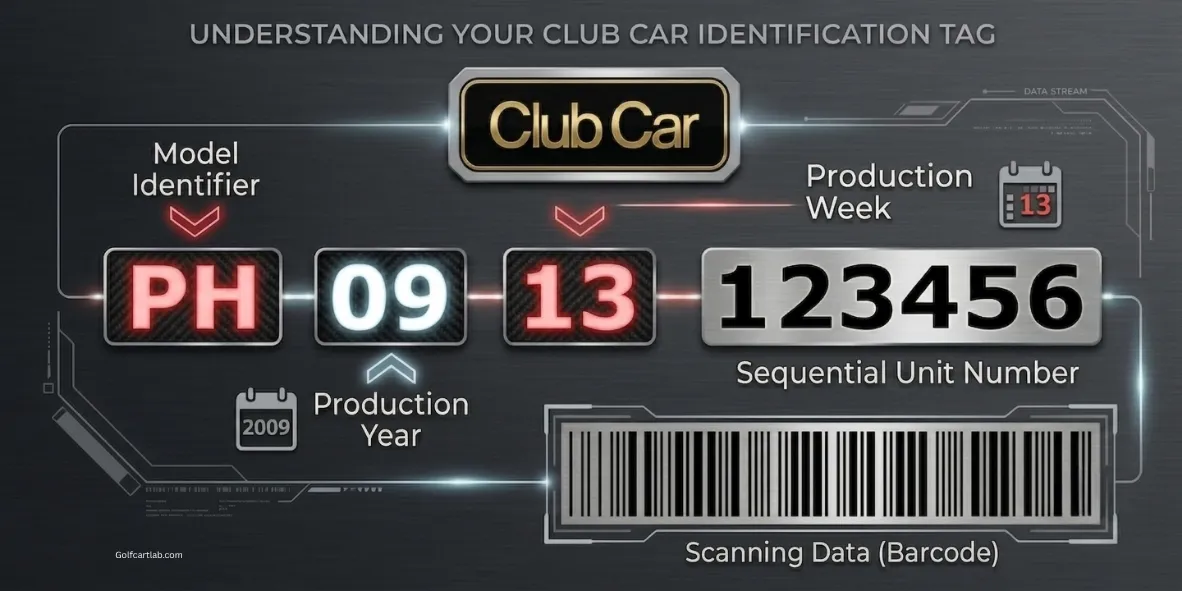
- On a Precedent, Onward, or Tempo, the two digits after the model letters are the year and the next two are the production week (PH0913 = 2009, week 13).
- The older DS (1981-2003) uses a shorter code with no modern week digits, so a DS serial looks nothing like a Precedent one; read them with different rules.
- The serial gives model and year, not always voltage: count batteries to confirm 36V versus 48V, since packs and controllers get swapped over a cart’s life.
- If a decode lands on an impossible week above 52, you are almost certainly reading a DS-format plate with Precedent rules by mistake.
Club Car makes the year of your cart easy to find once you know where the digits live. Whether you own a classic DS or a modern Precedent, Onward, or Tempo, the serial number plate holds the model and year you need before ordering a single part.
Where to find your Club Car serial number
Before you can decode it, you have to find the plate. Club Car put it in different places depending on the body style:
- Precedent, Onward, Tempo: on the passenger-side dash or inside the glovebox, as a metal plate or sticker.
- DS models: under the driver-side seat, or stamped on the frame below the dash.
You may see two numbers: the serial number and a matching manufacturer code. For a Club Car, the serial number is the one that tells you the year, unlike E-Z-GO where you read a separate manufacturer’s code.
How to do a Club Car serial number lookup
Modern Club Cars use a 12-character serial. Reading it left to right:
- First two letters: the model and trim (for example PH = Precedent i2).
- Next two digits: the model year (09 = 2009).
- Next two digits: the production week of that year (13 = the 13th week).
- Final six digits: the unique build number.
So a serial beginning PG09 is a 2009 Precedent-style decode, and RG18 points to a 2018 Onward or Tempo-family prefix. On DS carts, public Club Car prefix sources and dealer examples show a shorter DS-era pattern: one or two prefix letters identify the model and powertrain, followed by year digits, then the build sequence. Examples include AG8414-53441 as a 1984 gas DS-style example and A9451-534223 as a 1994 electric DS-style example.
| Example serial | Format | How to read it |
|---|---|---|
| AG8414-53441 | DS-era gas example | AG is the gas DS-style prefix; 84 is the model year; the remaining digits are production details and sequence. |
| A9451-534223 | DS-era electric example | A is the electric DS-style prefix; 94 is the model year; the rest is not a Precedent-style week-plus-six decode. |
| PH0913123456 | Precedent-style modern format | PH is the model prefix; 09 is 2009; 13 is production week 13; 123456 is the unit sequence. |
| RG1819123456 | Onward or Tempo-family modern format | RG is the model prefix; 18 is 2018; 19 is production week 19; 123456 is the sequence. |
One detail that trips up DS owners: Club Car built the DS through the 2003 model year, and the earliest 1981-1984 carts can have plate stamping that does not look like later Precedent examples. There is no reliable public DS letter-to-every-year progression table from Club Car itself in the same way Yamaha publishes PID sheets. If a DS plate does not line up cleanly, use the confirmed era, prefix, and two year digits as your starting point, then use the decoder or a Club Car dealer lookup for exact parts matching.
That DS caveat is not a dead end. It keeps the lookup honest. The body style, brake pedal layout on very early cars, charger receptacle, battery count, and prefix can usually narrow the cart to a small era even when the plate is worn. Use that era to avoid obvious parts mistakes, then let the serial decoder or dealer record settle the exact year before you buy a controller, charger, body panel, or harness.
Club Car model prefix codes
The first one or two letters identify the model and drive system. These are the prefixes you will see most often:
| Prefix | Model | Era |
|---|---|---|
| PD | Precedent i2L / Excel | 2004+ |
| PH | Precedent i2 / Excel | 2004+ |
| PG / PR / PQ | Precedent (various trims) | 2004+ |
| RG / RH | Onward / Tempo | 2017+ |
| Single letter + digits | DS | 1981-2003 |
If your serial decodes to a year before 2004 but the prefix says Precedent, double-check the reading, the Precedent did not replace the DS until the 2004 model year.
Finding your Club Car’s voltage
The serial number tells you the model and year but not always the installed voltage, because batteries and controllers can be changed over the cart’s life. The quickest way to confirm is to open the battery compartment and count:
- Six 6-volt batteries: 36V, common on many older DS carts.
- Six 8-volt or four 12-volt batteries: 48V, common on Precedent and newer carts.
As a dating cross-check, Precedent electric manuals and parts references are built around 48V electric systems, while many earlier DS carts in the used market are 36V resistor, V-Glide, or early controller carts unless converted. A 48V Precedent is normal; a 36V Precedent claim needs a closer look. A 48V DS is also possible, especially after conversion or on later DS variants, so count batteries and read the controller label before buying electrical parts.
If you are weighing a voltage swap, our guide to the best voltage for a golf cart explains how 36V and 48V compare for speed and range.
Why a Club Car serial number lookup matters
Knowing the exact year saves you money and headaches in three common situations:
- Ordering parts: body panels, controllers, and chargers changed between Precedent years, so ordering by year avoids returns.
- Buying used: decoding the serial confirms a seller’s claim about the cart’s age.
- Service and recalls: the year and serial are needed to look up wiring diagrams and any recall notices.
For the other brands, see our full guide on what year your golf cart is, or compare makers in the big three golf cart brands breakdown. If your plate is missing entirely, Club Car can often look up a vehicle by VIN through a dealer.
Identifying a Club Car when the plate is gone
Plates fade, get painted over, or fall off. When you cannot read the serial at all, Club Car’s body-style changes are reliable reference points for narrowing the year, because the three generations look distinctly different:
- DS (1981-2003): rounded, narrow front body with a single-piece hood and exposed front struts. The classic “old Club Car” look.
- Precedent (2004-present): wider, squared-off body with a flatter hood, integrated headlights on later trims, and a more modern dash.
- Onward / Tempo (2017-present): the newest styling with sculpted bodywork, color options, and a contemporary instrument panel.
The charger receptacle is another clue. Older 36V DS carts often use a round three-pin plug, while newer 48V carts moved to different connector styles. Combined with the body style, that usually gets you within a few years even with no plate at all.
Still, the serial number is always the definitive answer. If yours is even partially readable, decode it with the tool rather than guessing, a single wrong year can mean ordering the wrong controller or charger. When the plate is genuinely gone, a Club Car dealer can often pull the original build record from the vehicle identification number.
One Club Car-specific detail catches a lot of buyers: on the Precedent, Onward, and Tempo the two characters after the model letters are a two-digit calendar year followed by a two-digit production week, so a plate reading PH1130 decodes to the 30th week of 2011, not the 11th cart of 1130. The older DS uses a shorter code with no modern week digits, which is why a DS serial looks nothing like a Precedent one. If your decode lands on an impossible week above 52, you are almost certainly reading a DS-format plate with the Precedent rules by mistake.
Frequently Asked Questions
How do I tell what year my Club Car is?
On a Precedent, Onward, or Tempo, read the two digits after the model letters as the model year, so PH09 is a 2009 and the next two digits are the production week. On a DS, the shorter prefix pattern uses one or two letters for the model and powertrain followed by the year digits, so AG84 is a 1984 gas DS-style example.
Is my Club Car 36V or 48V?
The serial number does not always encode the installed voltage, because batteries and controllers can be changed. Count the batteries: six 6-volt batteries is 36V, while six 8-volt or four 12-volt batteries is 48V. Precedent electric systems are built around 48V, while many older DS carts in the used market are 36V unless converted.
Where is the serial number on a Club Car?
On a Precedent, Onward, or Tempo the plate or sticker is on the passenger-side dash or inside the glovebox. On a DS it is usually under the driver-side seat or stamped on the frame below the dash.
Why does my Club Car serial look different from the standard format?
The Precedent, Onward, and Tempo use a modern format of model letters, a two-digit year, a two-digit week, and a six-digit sequence. The older DS (1981-2003) uses a shorter code with no modern week digits, so a DS serial looks nothing like a Precedent one. If a decode lands on an impossible week above 52, you are likely reading a DS-format plate with Precedent rules by mistake.