Why Is My Resistor Getting Hot? Golf Cart Precharge Resistor Guide
A hot precharge resistor is a warning sign, not a random failure. Here is the real math, the most common causes, and how to test the solenoid and controller behind it.
- A precharge resistor is supposed to run slightly warm, it is only a problem when it is too hot to touch, discolored, or smells burnt.
- Welded solenoid contacts are the most common and most dangerous cause, test for them with the key off and pack disconnected.
- Resistor value matters: 250 ohm is a verified factory Club Car Curtis 48V value, while Alltrax specifies 470 ohm for 48V and 1000 ohm for 72V.
- Match the wattage to the controller documentation, a 5W resistor in a 10W application will overheat even at the correct resistance.
That small ceramic resistor bolted across your golf cart solenoid is supposed to be slightly warm during operation. But when it becomes scorching hot, glowing, or discolored, something in the circuit has gone wrong. A resistor getting hot beyond its rated wattage is almost always a symptom of a deeper electrical problem, not a standalone failure. This guide walks through exactly why it happens and how to fix the root cause.
This issue is closely related to solenoid health. If you suspect the solenoid itself is failing, start with our solenoid resistor diagnostics protocol for the complete cross-diagnosis workflow.
01. What the Precharge Resistor Does
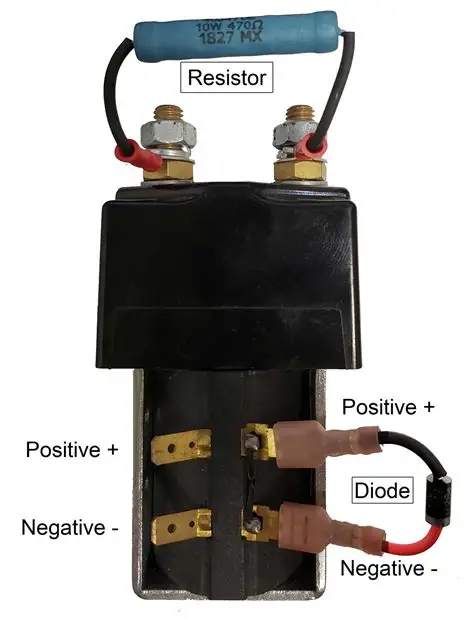
The precharge resistor is wired across the two large posts of your solenoid (the high-amperage main contacts). Its job is to keep the motor controller’s internal capacitors topped off at near-pack voltage while the solenoid is in the open (off) position. When you press the accelerator and the solenoid closes, the capacitors are already charged, so there is no violent inrush arc across the contacts.
Under normal conditions, a 250 ohm resistor on a 48V system passes 0.192 amps (48V divided by 250 ohm) and dissipates 9.2 watts (48V times 0.192A). That is why the resistor can feel warm even when everything is working. It also leaves little margin on a 10 watt part, so do not treat 250 ohm as a universal 48V answer. A factory Club Car Curtis listing verifies a 250 ohm 48V precharge resistor, while Alltrax documentation specifies 470 ohm 10W for 48V Alltrax setups and 1000 ohm 10W for 72V systems. If you need a refresher on how to select and install this resistor, our precharge resistor sizing guide covers the math in detail.
02. Why the Resistor Overheats
Cause 1: Welded Solenoid Contacts
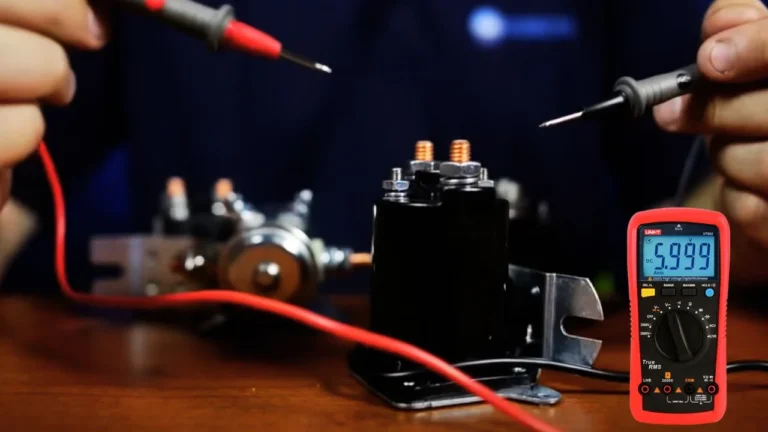
This is the most common and most dangerous cause. When the solenoid’s internal copper contacts weld together, the main circuit is permanently closed. The resistor is now in parallel with the welded contacts and the motor controller. Because the controller presents a very low impedance load when energized, the resistor effectively sees the full pack voltage across a much lower combined resistance, dramatically increasing current flow and heat. You can verify this by turning the key OFF and testing continuity across the solenoid’s large posts. If you read near zero ohms with the key off, the contacts are welded. Read our welded contacts diagnosis guide for the full repair protocol.
Cause 2: Wrong Resistor Value
If someone installed a resistor with too low of a resistance value for that controller package, the continuous trickle current increases significantly. A 100 ohm resistor on a 48V system draws 0.48A and dissipates 23 watts, which will overheat a standard 10W ceramic resistor within minutes. Always verify the resistance value printed on the resistor body against the controller or OEM parts documentation. Alltrax publishes 220 to 250 ohm at 12 to 36V, 470 ohm 10W at 48V, and 1000 ohm 10W at 72V for its precharge resistor guidance, while a Club Car OEM replacement listing confirms that some factory Curtis 48V Club Car systems used a 250 ohm resistor.
Cause 3: Insufficient Wattage Rating
Even with the correct resistance value, a resistor with too low of a wattage rating will overheat. Some generic resistor kits include 5 watt resistors that cannot handle a near 10 watt 48V OEM case. TE Connectivity also notes that wire wound resistor power ratings must be derated when ambient temperature rises above 70C, so a hot battery bay reduces practical margin. Use the wattage specified by the controller or OEM source, and step up only when the controller maker allows the same resistance value at a higher wattage.
Cause 4: Controller Capacitor Failure
In rare cases, a shorted capacitor or internal controller fault can create a low resistance path that pulls excessive current through the precharge resistor. Curtis tells technicians that with a precharge resistor in parallel with the main contactor, controller B+ to B- should rise to about 90% of pack voltage before the main contactor closes. If you have replaced the solenoid, verified the resistor value, and the controller bus voltage test still does not behave normally, suspect wiring or controller trouble. For controller diagnostics, see our controller comparison and diagnostics guide.
03. The Power Dissipation Math
Understanding the math behind resistor heating is critical for selecting the right component. Power dissipated by a resistor equals voltage squared divided by resistance (P = V² / R).
| System & Resistor | Calculation | Verdict |
|---|---|---|
| 36V, 250 ohm | 36² / 250 = 5.2 watts | A 10W resistor handles this easily with 48% headroom. |
| 48V, 250 ohm | 48² / 250 = 9.2 watts | Verified for some factory Club Car Curtis applications, but close to a 10W rating and not the Alltrax aftermarket 48V spec. |
| 48V, 470 ohm | 48² / 470 = 4.9 watts | Matches Alltrax 48V precharge guidance with much more thermal headroom. |
| 48V, 100 ohm (wrong value) | 48² / 100 = 23 watts | Exceeds a 10W rating by 130%, will overheat and eventually crack or burn open. |
| 72V, 1000 ohm | 72² / 1000 = 5.2 watts | Alltrax lists 1000 ohm 10W for 72V, not 470 ohm, use 470 ohm at 72V only if your controller documentation specifically calls for it. |
04. Diagnostic Steps
- Turn off the key and disconnect the battery pack. Allow the resistor to cool before handling.
- Inspect the resistor body. Look for cracks, discoloration (white ceramic turning brown or black), or a burnt electrical smell. Any of these indicate the resistor has been overstressed and should be replaced.
- Measure the resistor value with a multimeter on the Ohms setting. It should read within 10% of its labeled value, such as 225 to 275 ohm for a 250 ohm resistor or 423 to 517 ohm for a 470 ohm resistor. If it reads significantly lower, the resistor has been heat-damaged and its internal wire element has partially shorted.
- Test the solenoid for welded contacts. With the key OFF and batteries disconnected, measure continuity across the two large solenoid posts. OL (open) is normal. Near-zero ohms means the solenoid is stuck closed and must be replaced.
- Verify the controller documentation matches the resistor selection. Treat 250 ohm at 48V as a factory-Curtis Club Car case, not a universal rule. Alltrax lists 470 ohm 10W for 48V and 1000 ohm 10W for 60 to 72V precharge kits.
05. Replacement and Prevention
If the resistor is damaged, replace it with the exact resistor value called out by the controller maker or the OEM parts listing. Use a power wire wound or cement-encased resistor with an appropriate wattage rating. Do not substitute a small carbon composition or low-power metal film resistor just because the resistance number matches.
- Use ceramic wire-wound construction. These resistors dissipate heat through the ceramic body and are designed for continuous high-wattage applications.
- Mount with airflow. Do not bury the resistor inside an enclosed battery compartment. Mount it where air can circulate around the ceramic body to carry heat away.
- Always install a flyback diode across the solenoid’s small activation posts. The diode protects the coil circuit and extends the overall lifespan of the entire solenoid assembly. For sizing guidance, see our diode sizing protocol.
- Inspect the solenoid contacts before installing a new resistor. Replacing a burnt resistor without fixing a welded solenoid will just destroy the new resistor within days.
If you are building a high-output system with a lithium pack and aftermarket controller, ensure your voltage reducer is also properly matched to prevent uneven battery drain. Our universal voltage reducer guide covers the complete accessory power architecture.
A resistor getting hot on your golf cart almost always points to a welded solenoid, an incorrectly sized component, or a controller bus problem. Test the solenoid for welded contacts first. Then match the resistor to real documentation: 250 ohm can be correct on certain factory Club Car Curtis 48V systems, while Alltrax lists 470 ohm 10W for 48V and 1000 ohm 10W for 72V. Replace with a power wire wound unit and mount with adequate airflow.
Frequently Asked Questions
Why is my precharge resistor getting hot on my golf cart?
A precharge resistor gets hot when it is carrying more current than designed. This typically happens when the solenoid contacts have welded shut, forcing continuous current through the resistor even when the cart is at rest. It can also occur if the resistor wattage rating is too low for the system voltage.
Should a precharge resistor be warm during normal operation?
Yes. A precharge resistor will be slightly warm during normal driving because it continuously trickles a small amount of current to keep the controller capacitors charged. However, it should never be too hot to touch. If it is burning hot, the solenoid contacts are likely stuck closed.
What wattage resistor do I need for a 48V golf cart solenoid?
For a factory Club Car 48V Curtis setup, a 250 Ohm, 10 Watt precharge resistor is a verified OEM-style value. For many Alltrax aftermarket controllers, Alltrax specifies 470 Ohm, 10 Watt at 48V and 1000 Ohm, 10 Watt at 72V. Match the resistor to the controller documentation, not just pack voltage.