
Solenoid Resistor Diagnostics: Why a Hot Resistor Means a Stuck Solenoid
A hot precharge resistor is a messenger, not the enemy. Here is how to tell whether it is a welded solenoid, burnt contacts, or the wrong part.
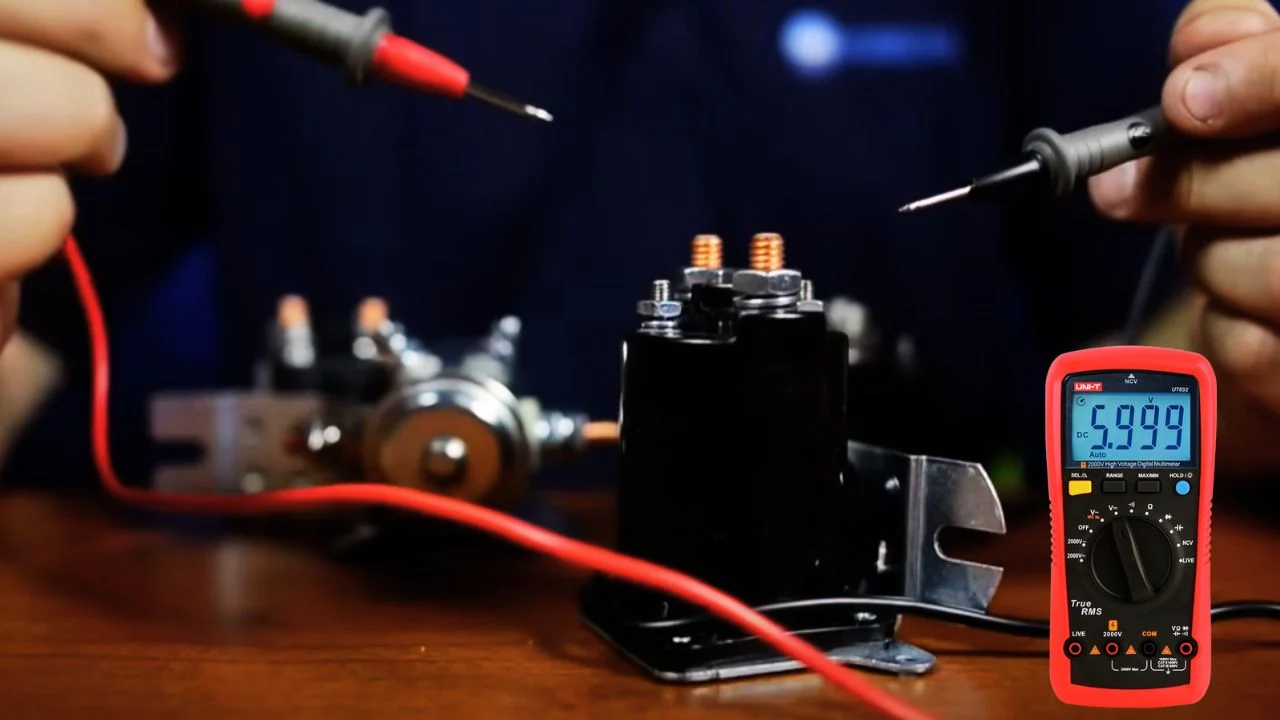
- A hot precharge resistor by itself does not prove a welded solenoid, test before you replace anything.
- Alltrax’s published values are 220 to 250 ohm 10W for 12 to 36V, 470 ohm 10W for 48V, and 1000 ohm 10W for 60 to 72V.
- With the solenoid engaged, voltage across the large posts should be close to 0V, several volts means resistive contacts.
- Test welded contacts only with the pack disabled, then check continuity across the large posts.
If you open your golf cart’s electronics bay and smell something burning, or if your cart won’t move and you notice the small ceramic resistor on your solenoid is glowing red or hot to the touch, you have a critical diagnostic lead. A hot resistor isn’t a “bad resistor,” it is a resistor doing its job under impossible conditions. It is almost always a sign that your solenoid has failed.
01. The Job of the Pre-Charge Resistor
The small resistor spans the two large terminals of the solenoid or contactor. Alltrax documents this as a pre-charge resistor: it lets a small current charge the controller’s filter capacitors before the main contacts close. For Alltrax systems, the published values are 220 to 250 ohm 10W for 12 to 36V, 470 ohm 10W for 48V, and 1000 ohm 10W for 60 to 72V. Some OEM Curtis and Club Car 48V setups use different values, so match the resistor to the controller and vehicle rather than copying a universal number.
Without that precharge path, the capacitors are empty when the solenoid closes, and the first hit of current can arc the contacts. Alltrax says the resistor keeps the capacitors topped off, reducing surge current, contact arcing, and controller stress.
02. Why Heat Is Your Best Clue
A precharge resistor can be warm during normal use, but it should not be the main drive path. Once the solenoid closes, high current should flow through the heavy copper contacts. If the resistor is too hot to touch, discolored, or smells cooked, current is flowing through it longer than intended.
That usually points to one of four faults: the contactor did not close, the contacts closed but are burnt and resistive, the controller precharge path is abnormal, or the wrong resistor is installed. Stop driving when you smell that cooked ceramic odor. The resistor is cheap, but the controller capacitors and contactor contacts it is protecting are not.
03. The Ways a Solenoid Circuit Fails
Scenario A: The Solenoid Won’t Click
If you press the pedal and hear no click, but the resistor is hot, the controller side may be trying to precharge or draw through the only available path. The missing click can come from a dead coil, bad pedal microswitch, key or forward/reverse feed problem, interlock problem, failed coil ground, or a broken wire.
Scenario B: It Clicks, But the Contacts Do Not Carry Current
A contactor can make an audible click and still fail electrically. Burnt or pitted contacts create resistance across the large posts, so the precharge resistor keeps doing work after the contacts should have taken over. This is the pattern that cooks resistors while the cart feels weak, jerky, or completely dead.
Scenario C: The Welded Solenoid
A welded solenoid is serious, but heat alone does not prove it. When contacts are welded shut, the big posts are already connected, so the resistor is often bypassed. Diagnose welded contacts by disabling the pack, isolating the resistor if needed, and checking continuity across the large posts. Near-zero resistance with the circuit safely isolated means the contacts are stuck closed. A welded contactor can leave the controller energized with the key off, so do not keep testing with the rear wheels on the ground.
04. The Lab Test: Identifying the Failure
You can confirm the failure with a digital multimeter. Lift the rear wheels safely, keep the cart in tow or maintenance mode when the service manual requires it, and remove jewelry before touching high-current cables.
- Photograph the wiring first. Note which side of the coil has the diode band, where the resistor lands, and which large post feeds the controller.
- Check controller precharge voltage. Curtis’ M Series manual says that with a precharge resistor in parallel with the main contactor, voltage between controller B+ and B- should rise to about 90% of full battery voltage. If that never happens, inspect the resistor, controller feed, and wiring before blaming the controller.
- Check voltage across the large solenoid posts while engaged. Press the pedal until the solenoid clicks. Across the two large posts you should see close to 0V because closed contacts are now carrying the load. Several volts means resistive contacts. Full pack voltage with the pedal pressed means the contacts are not closing electrically.
- Check for welded contacts only with power disabled. Disconnect or disable the pack, isolate the resistor if it can give a parallel reading, and measure resistance across the large posts. Near-zero resistance with no coil power means the solenoid contacts are welded shut.
- Ohm-check the resistor. Remove at least one leg from the circuit and compare it to the expected value. For Alltrax systems, that means 220 to 250 ohm on many 12 to 36V applications, 470 ohm on 48V, and 1000 ohm on 60 to 72V. An open, charred, or wrong-value resistor should be replaced with the controller maker’s recommended part.
05. Replace the Circuit, Not Just the Burnt Part
If the resistor has been hot enough to discolor, crack, or smell, do not just throw another ceramic block on the same terminals and hope. Inspect the solenoid contacts, the precharge resistor, and the coil suppression diode as one circuit.
The Solenoid
Opens and closes the high-current path. Burnt contacts can click but still drop voltage.
The Resistor
Precharges the controller capacitors and reduces closing surge. Match ohms and wattage to the controller documentation.
The Diode
Suppresses the coil’s voltage spike when the solenoid opens. Alltrax lists diode sizing by solenoid amperage and marks the banded end toward the positive coil side.
TE Connectivity and Littelfuse both describe the same principle: when an inductive relay coil is switched off, the collapsing magnetic field can create a high-voltage spike, and suppression protects the switching electronics. TE also notes that a plain diode can slow relay release, so follow the controller or contactor maker’s diode recommendation rather than installing a random part.
06. Solenoid Quirks By Platform
Solenoid behavior varies enough between brands that it pays to know your platform before swapping parts. On Club Car DS and Precedent carts, onboard computer, charger receptacle, interlock, and harness details vary by generation. A no-click cart with a hot resistor is not automatically an OBC failure or automatically a bad solenoid. Confirm voltage at the small solenoid terminals and use the wiring diagram for your serial range.
EZGO TXT carts are often easier to follow because many pedal circuits route through a key, forward/reverse, and accelerator microswitch chain before the solenoid coil. If you have a hot resistor with no click, start at the coil feed and coil ground before ordering a controller. Yamaha G29 and Drive carts can still weld or burn contactor contacts, but use the same tests above: voltage drop across engaged contacts for burnt contacts, isolated continuity for welded contacts.
Modified carts need extra caution. Lift kits, larger tires, high-torque motors, and upgraded controllers can push a stock contactor outside its comfort zone. A 400A heavy-duty contactor can be the right move on a modified build, but only when the coil voltage, continuous rating, mounting, and controller precharge requirements match the cart.
A hot precharge resistor is a messenger, not the enemy. It tells you the precharge path is being asked to carry current too long, the contactor is not carrying the load cleanly, or the wrong resistor is installed. It does not, by itself, prove a welded solenoid. Use the Curtis-style precharge check, verify near-0V across engaged posts, and test welded contacts only with the pack disabled.
Frequently Asked Questions
Why is the resistor on my solenoid hot?
A hot resistor usually means the solenoid is failing to close its internal contacts. This forces the motor controller to pull all of its operational current through the tiny resistor, which generates extreme heat. It is often a sign of a dead solenoid or a failed activation circuit.
Can I run my golf cart without the solenoid resistor?
Technically, the cart will run, but it is highly discouraged. Without the resistor, every time the solenoid clicks, a massive electrical arc occurs. This will rapidly pit the contacts and eventually weld the solenoid shut, potentially damaging your controller’s internal capacitors.
How do I know if my solenoid resistor is blown?
Use a multimeter set to Ohms. A standard 48V resistor should read approximately 470 ohms. If the meter shows OL (Open Loop) or infinite resistance, the resistor has burned out and must be replaced.