Gas vs Electric Golf Cart: Which Should You Buy?
A clear, honest comparison of cost, range, maintenance, and performance, with a real dated cost-of-ownership example, so you can match the right golf cart to how you actually drive.
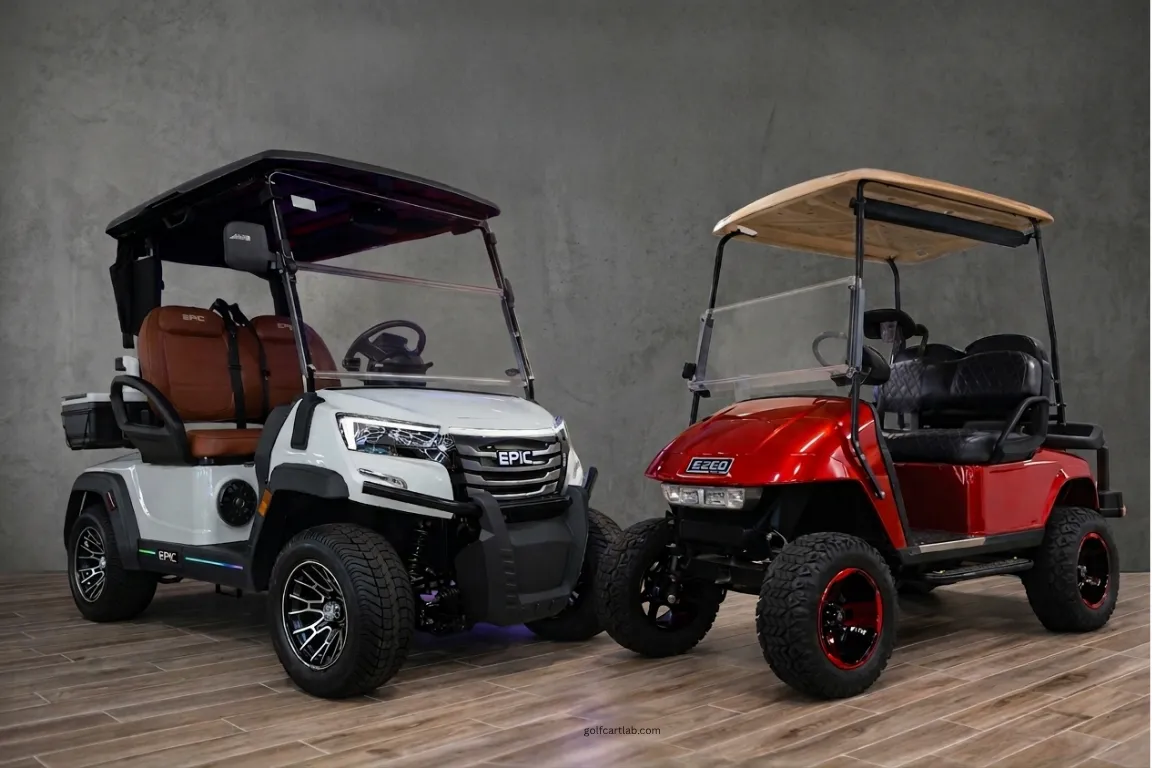
- Electric running cost is about $0.75 per full 4.0 kWh charge at the April 2026 U.S. residential average rate; gas costs about $21.59 per 5.6 gallon tank at the July 2026 EIA price.
- A worked 1,300-mile-a-year example runs about $165 in electricity over 5 years versus about $1,405 in gas, before maintenance and battery replacement.
- Electric travels 25-50 miles per charge and needs 4-8 hours to recharge; gas covers 100+ miles per tank and refuels in seconds.
- Electric wins for typical neighborhood and course driving; gas wins for long distances, heavy towing, and off-grid use.
Choosing between a gas and an electric golf cart is the first big decision every buyer faces, and the wrong call can cost you for years. The good news is that the answer is usually clear once you weigh how far you drive, where you charge, and what you tow.
Gas vs electric golf cart: the short version
Both types do the same job, but they feel and cost very different over time. Electric carts have surged in popularity because the running costs are low and the driving experience is smooth and silent. Gas carts remain popular with owners who cover big distances or work the cart hard, because refueling takes seconds and range is effectively unlimited.
Here is how the two stack up at a glance, with the running-cost cells tied to a dated real-world example from the cost section below:
| Factor | Electric | Gas |
|---|---|---|
| Running cost | About $0.75 per full 4.0 kWh charge at the April 2026 U.S. residential average of 18.83 cents/kWh | About $21.59 to fill a 5.6 gal tank at the July 13, 2026 EIA regular gasoline price of $3.855/gal |
| Range | 25-50 miles per charge, model and battery dependent | 100+ miles per tank is realistic on many gas carts, but terrain and load matter |
| Refuel / recharge | 4-8 hours to charge | Seconds to refuel |
| Noise | Near silent | Loud engine |
| Maintenance | Battery care, tires, brakes, cables, charger | Fuel plus annual oil/filter service, spark plug, air/fuel filters, and belt checks |
| Torque / towing | Strong off the line | Better for heavy, sustained loads |
| Emissions | Zero at point of use | Exhaust fumes |
Cost of ownership
Up front, gas and electric carts of similar age and condition can be close. The difference shows up after you put real fuel, electricity, and maintenance numbers into the same example. The example below uses 25 miles per week, or about 1,300 miles per year, with purchase price treated as equal so the comparison isolates operating cost. You can change the assumptions in our charge vs gas cost calculator, and if you are still deciding on a model, try the cart finder quiz.
For the electric side, Club Car publishes 4.0 kWh and 7.0 kWh lithium options on current Onward specs. EIA’s Electric Power Monthly lists the April 2026 U.S. average residential price at 18.83 cents per kWh. A full 4.0 kWh charge therefore costs 4.0 x $0.1883 = $0.75 before charger losses, and a full 7.0 kWh charge costs about $1.32. If a 4.0 kWh cart is treated as a 30-mile example, 1,300 miles needs about 43 full-charge equivalents, or about $33 per year in electricity before local taxes and charging losses.
For the gas side, Club Car’s Onward 4 Passenger specs list a 5.6 gallon fuel tank. EIA’s latest weekly U.S. regular gasoline figure available during this update was $3.855 per gallon for July 13, 2026, so a tank fill is 5.6 x $3.855 = $21.59. If the cart gets about 100 miles per tank, the same 1,300-mile year needs about 13 tanks, or about $281 in fuel. If your local gas price is higher or the cart is lifted, loaded, or driven on hills, that line rises quickly.
| 5-year ownership line, same purchase price assumed | Electric cart example | Gas cart example |
|---|---|---|
| Energy or fuel | About $33/year, about $165 over 5 years, using a 4.0 kWh pack and EIA 18.83 cents/kWh | About $281/year, about $1,405 over 5 years, using 5.6 gal x $3.855 and 100 miles per tank |
| Routine annual service | Usually no oil, plug, air filter, or fuel filter; still budget for tires, brakes, cables, and charger checks | Club Car says oil and filter after the first 100 hours, then every 200 hours or annually; Golf Car Ranch listed common oil-filter and drive-belt parts around $9.74 and $47.12, before oil, plug, filters, labor, and model fitment |
| Battery replacement risk | Flooded lead-acid can be the big 5-year cost if the bank ages out; lithium may avoid that within this window but costs more up front | Gas avoids a traction battery bank, but still has a starter battery and engine-service parts |
| Illustrative 5-year operating total | Roughly $165 in electricity before battery replacement, charger losses, and normal wear items | Roughly $1,405 in fuel before annual service parts/labor and normal wear items |
That is why electric usually wins for low-to-moderate annual mileage. The energy line is tiny when a full lithium charge costs less than a dollar at the national average rate. The honest caveat is the battery line: if a used electric cart needs a $1,000-plus lead-acid bank during your ownership window, the short-term advantage can shrink or disappear.
A gas cart avoids the traction-battery replacement event but trades it for fuel and recurring engine maintenance. Gas can still make sense for owners who need fast refueling, long workdays, remote use, or heavy sustained loads. For normal neighborhood driving, the worked example is the reason electric almost always looks cheaper per year once the battery condition is known.
Range, refueling, and daily use
This is where the two genuinely diverge. An electric cart travels roughly 25 to 50 miles per charge depending on battery type and terrain, then needs several hours plugged in to recharge. For the vast majority of owners, who drive a few miles a day around a neighborhood or course, that is more than enough, and charging overnight is effortless.
A gas cart, by contrast, goes 100+ miles on a tank and refuels in seconds, which matters on a large property, a ranch, or a hunting lease where there may be no outlet for miles. If you regularly drive all day far from power, gas removes the range anxiety entirely. To see how far an electric cart will actually take you, run your pack through our range calculator, or read how far a golf cart can go.
Performance, noise, and feel
Electric motors deliver instant torque, so an electric cart launches smoothly and climbs hills quietly. There is no engine vibration, no fumes, and no warm-up, you press the pedal and go. That refinement is a big reason electric dominates residential communities, resorts, and golf courses where noise rules apply.
Gas carts sound and feel like a small engine vehicle, which some owners actually prefer for the familiarity and the sustained power under heavy load. They tow and haul confidently all day without worrying about state of charge, but they are noticeably louder and produce exhaust you will notice in an enclosed garage.
Which golf cart should you buy?
Match the cart to how you will actually use it:
- Choose electric if you drive in a neighborhood, on a course, or around a resort; want low running costs and quiet operation; and can charge overnight.
- Choose gas if you cover long distances daily, tow or haul heavy loads, or use the cart far from any outlet on a farm or hunting property.
Still deciding on a brand? Our comparison of the big three golf cart brands and the fastest stock carts are good next reads, or browse every guide in our repair library. For emissions and efficiency context, the U.S. Department of Energy publishes electric-vehicle running-cost data that broadly applies to small EVs like carts.
The bottom line for buyers
If you are buying a cart for a typical residential or recreational use case, getting around a neighborhood, cruising the course, running to a community pool or clubhouse, an electric cart is almost always the smarter long-term purchase. The combination of near-silent operation, low running costs, zero fumes, and minimal maintenance fits that lifestyle perfectly, and modern lithium options have erased much of the old range disadvantage.
Reserve a gas cart for the genuinely demanding jobs: large acreage, daily long-distance driving, heavy and sustained towing, or any situation where charging simply is not practical. Buy for the way you will actually use the cart ninety percent of the time, not the rare edge case, and you will be happy with the choice for years. When in doubt, electric is the safer default for the average buyer, and you can always add range later with a lithium upgrade.
Electric wins for most buyers on cost, quiet, and maintenance, about $165 versus $1,405 in a worked 5-year fuel/energy example. Gas wins for long range, heavy towing, and off-grid use. Decide by your daily distance and whether you can charge, then estimate electric range with our range calculator.
Frequently Asked Questions
Is a gas or electric golf cart cheaper to run?
Electric is nearly always cheaper to run. Using the EIA’s April 2026 U.S. average residential rate of 18.83 cents per kWh, a full 4.0 kWh charge costs about $0.75. Using the EIA’s July 2026 regular gasoline price of $3.855 per gallon, filling a 5.6 gallon tank costs about $21.59. Over 1,300 miles a year that works out to roughly $165 in electricity versus $1,405 in fuel over five years, before maintenance and battery replacement.
How far can an electric golf cart go on one charge?
Roughly 25 to 50 miles per charge depending on battery type, terrain, and load, then it needs 4 to 8 hours plugged in to recharge. A gas cart typically covers 100 or more miles per tank and refuels in seconds, so gas has the range and refueling-speed advantage.
Which is better for towing, gas or electric?
Electric motors deliver strong torque off the line for short bursts, but gas carts are generally better for heavy, sustained loads and towing all day without worrying about state of charge. If you tow or haul constantly on a large property, gas removes range anxiety entirely.
Is electric or gas better for a neighborhood or golf course?
Electric is almost always the better choice for neighborhood, resort, or golf course use. It is near silent, produces zero fumes at the point of use, and the 25 to 50 mile range is more than enough for typical daily distances, with effortless overnight charging.