
OBC vs. External Charger: Why Your Club Car Won’t Recognize a New Charger
You plugged in a new charger and nothing happened. On a Club Car the problem is usually the control path, not the battery. Here is how to tell whether the OBC, the receptacle, or the charger algorithm is refusing the handshake, and which external chargers are actually documented to work.
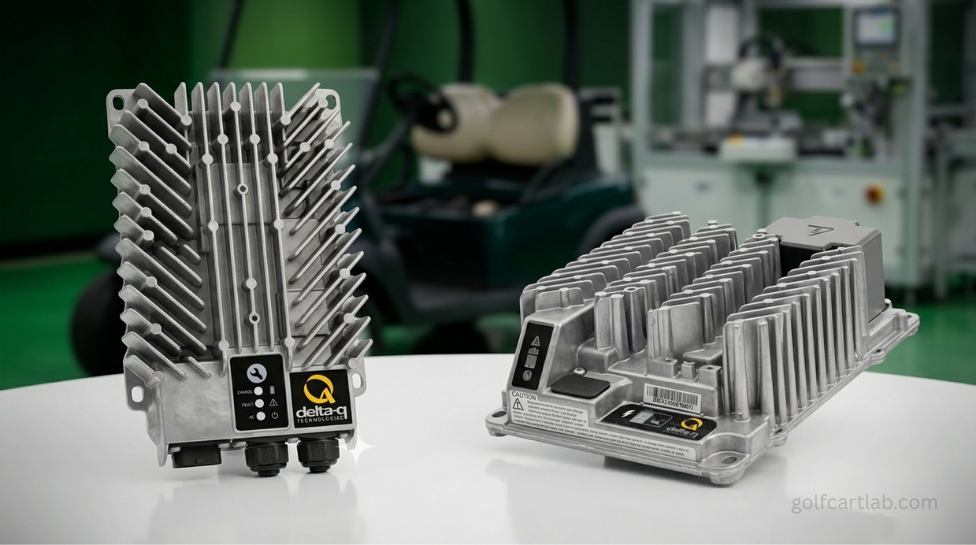
- A Club Car can have pack voltage at the receptacle and still not charge, because the fault is in the control path: a legacy OBC issues the charge command that a plain smart charger never receives.
- The first diagnostic question is architecture, not wiring. Legacy PowerDrive carts use an OBC; Precedents built after September 2013, plus Tempo and Onward, use ERIC and have no separate OBC to bypass.
- Match the charger to the state: Lester 26610-21 works with a live OBC, Lester Links 29840-21 or Summit II suits a bypassed OBC, and ERIC uses the Delta-Q 940-0008 with a battery-approved profile.
- A reset clears latched logic but cannot repair an open fuse, burned receptacle, broken sense lead, failed relay, wrong algorithm, or shorted cell. Verify the hardware before you assume a computer fault.
You bought a modern charger, plugged it in, and got silence. On a Club Car that does not automatically mean the battery is dead or the charger is bad. Legacy PowerDrive systems put an On-Board Computer between the receptacle and the pack: it senses that a charger has been inserted, commands the charger relay, tracks the charge, and enforces the drive lockout. A stand-alone smart charger has its own brain and does not wait for that command, which is exactly why a fresh charger can look ignored on a cart that still expects the OBC to run the show. So the first question is never which wire to jump. It is which charging architecture your serial-numbered cart actually has.
What the Club Car OBC Actually Does
The OBC handles four jobs on legacy PowerDrive carts: it senses charger insertion, commands the charger to run, keeps a running count of charge, and locks out driving while the cart is plugged in. ERIC systems, introduced on electric Precedents built after September 2013 and used on Tempo and Onward, replace that module with a high-frequency charger and controller-based logic. There is no separate legacy OBC on an ERIC cart, so applying OBC diagnostics to one sends you chasing a part that is not there.
Reading the Symptom
What the cart and charger do at the moment of plug-in narrows the fault faster than any single measurement.
| Observed behavior | Most likely paths to test | Discriminating check |
|---|---|---|
| No relay click and no charge current | No AC power, open receptacle fuse or lead, deeply discharged pack, failed control cable, or a legacy OBC not issuing the command | Verify the outlet, pack and receptacle voltage, then run the factory sense-lead test for the identified model. |
| Relay clicks, then the charger shuts off at once | Open battery connection, high pack voltage, wrong battery profile, OBC data fault, or charger output fault | Measure pack voltage at charger start, check every interconnect, and read the charger status code. |
| Charger flashes an algorithm or battery error | Selected profile does not match the battery, or the pack is outside the profile’s start window | Identify battery maker, chemistry, nominal voltage, charger model, and active algorithm before changing anything. |
| Cart drives with the charger plug inserted | Drive lockout circuit is defeated, miswired, or not recognized | Stop using the cart until the model-specific interlock is restored and verified. |
| Cart will not drive after charger removal | Legacy OBC lockout stuck active, sense circuit stuck, missing controller input, or a separate run-circuit fault | Confirm plug removal and receptacle switch state, reset only by the documented procedure, then test controller inputs. |
| ERIC vehicle treated as an OBC cart | Wrong diagnostic architecture | Precedents after September 2013 shipped with ERIC; Tempo and Onward ERIC systems have no legacy OBC to bypass. |
Which External Charger Paths Are Documented
A plug that physically fits does not establish compatibility. Confirm nominal pack voltage, chemistry, battery model, maximum charge current, connector polarity, interlock behavior, and charge algorithm. Delta-Q warns that the wrong algorithm can undercharge, overcharge, or damage a battery, and a lithium pack needs a supported BMS-to-charger arrangement. Never select a profile just because its displayed voltage is close.
| Vehicle configuration | Documented charger option | Recognition and profile note |
|---|---|---|
| Legacy OBC remains active | Lester 26610-21 | Lester identifies this as the aftermarket charger that works with an active OBC, which still commands charging. |
| Factory charger replaced and OBC bypassed | Lester 29840-21 Links or a compatible Summit Series II install | Summit may require harnesses that disable the OBC. Confirm connector, pack voltage, and battery profile. |
| Club Car ERIC 940-0008 / IC0650-024-CC | The matching Club Car ERIC charger | Delta-Q documents profile 31 for OE flooded batteries and profile 188 for Trojan T-875. USB scripts switch only between the profiles loaded for that OEM charger. |
| Generic Delta-Q QuiQ proposal | Only a QuiQ model and algorithm approved for the vehicle and battery | The algorithm must match the battery. OEM-custom units are not automatically interchangeable with a generic QuiQ. |
Parts note: For a 48V Club Car with the 3-pin charge receptacle and the OBC bypassed, the TORO720 15A multi-chemistry smart charger we stock plugs straight in, no adapter needed. View charger
Reset Versus Handshake Test
Use the factory procedure for the exact model. Club Car legacy service material calls for key off, Tow/Run in Tow where fitted, battery disconnection, and at least a 90-second wait for controller capacitors before reconnecting in the manual’s sequence, torquing the actual terminal to its specified value. A reset can clear latched logic, but it cannot repair an open fuse, burned receptacle, broken sense lead, failed relay, wrong algorithm, or shorted cell.
For a legacy DS gray-wire check, the 2008 factory test starts near pack voltage before plug insertion. With the charger plugged in, the gray sense lead drops to about 4V before the relay clicks, then returns to about pack voltage after closure. That is a model-specific OBC handshake test, not a universal ERIC procedure, and it distinguishes a missing sense signal from a charger that receives the command but cannot deliver output.
Diagnostic Sequence
- Read the serial number and charger label. Confirm legacy OBC, ERIC, or another configuration in the Club Car manual.
- Measure every battery and the pack at rest. Repair open interconnects and correct a severely discharged or imbalanced pack before judging recognition.
- Verify receptacle polarity, voltage, fuse, pins, and strain relief. Heat-darkened plastic or a loose terminal is a resistance fault, not a computer-reset problem.
- Observe the charger: AC indicator, relay sound, DC current, status flashes, and the exact time to shutdown. Record the code before cycling power.
- Perform only the architecture-specific sense or interlock check. Do not apply the DS gray-wire values to a Precedent ERIC system.
When a Club Car will not recognize a new charger, prove the architecture first, then the hardware, then the algorithm. If you have a live legacy OBC and want a stand-alone smart or lithium charger, plan to bypass the OBC and pair it with a charger whose profile matches your battery. If you have an ERIC cart, stop looking for an OBC and diagnose the receptacle, controller interlock, and charger profile instead. The full OBC bypass procedure is covered in our dedicated Club Car OBC bypass guide.
Frequently Asked Questions
How do I know if my Club Car OBC is bad?
Signs of a failing OBC include a charger that will not turn on, a cart that will not move because the lockout circuit is stuck, or batteries being overcharged and boiled. A quick test on a legacy cart is to jumper the receptacle negative directly to the battery negative; if the charger then starts, the OBC is the fault. Confirm you have a legacy OBC and not an ERIC system first.
Do I need the OBC if I buy a smart charger?
No. Modern smart chargers carry their own control electronics that are more advanced than the aging Club Car OBC, and it is usually better to bypass the OBC when switching to a stand-alone smart charger to avoid a communication conflict. You still have to match the charger’s algorithm, connector, and voltage to your battery, because bypassing changes only the control path.
Does bypassing the OBC affect the cart’s performance?
No. The OBC only manages the charge cycle and provides the drive lockout, so bypassing it does not change top speed or torque. The cart drives exactly the same afterward. What changes is that charge control now lives in your external charger, so that charger must be right for the battery.
Why does my charger click on then shut off immediately?
An immediate shutoff after the relay clicks usually means an open battery connection, a pack voltage outside the charger’s start window, a wrong battery profile, or a charger output fault, rather than a simple OBC problem. Measure pack voltage at the instant the charger starts, check every cable interconnect, and read the charger status code before assuming the computer failed.