Golf Cart Motor Overheating? Diagnosis: Bearings vs. Brushes vs. Voltage
Is your motor too hot to touch? Learn the safe temperature limits and how to diagnose the root cause: failed bearings, worn brushes, or low voltage.
01 : The 3-Second Rule
If you can hold your hand on the case for 3-5 seconds (130°F), it is safe. If you must pull away instantly (180°F+), or if water sizzles on it, you are in the critical zone where internal copper windings melt.
02 : The Big Three Culprits
1. The Electrical Killer: Low Voltage
This is the #1 cause of motor heat. Your motor requires a specific amount of Power (Watts) to move the cart.
If your batteries are old and Voltage drops, the motor must pull More Amps to compensate. Heat is generated by Amperage. A voltage drop from 48V to 42V can cause a massive heat spike.
2. Worn Brushes (DC Motors)
Carbon brushes wear down over time. Poor contact creates internal arcing (tiny lightning bolts) inside the case, generating massive localized heat.
3. Bad Bearings
A seized bearing forces the motor to fight against itself. Symptom: A growling “coffee grinder” noise. The case will be hottest near the bearing cap.
03 : Isolation Tests
Follow this sequence to pinpoint the failure without guessing.
Test 1: The “Roll Test”
Park on flat concrete in TOW mode with Brake OFF.
- Result A: Rolls smoothly with one hand = Mechanicals OK.
- Result B: Feels like pushing a truck = Brake Drag or Bearing Seize.
Test 2: Voltage Drop Test
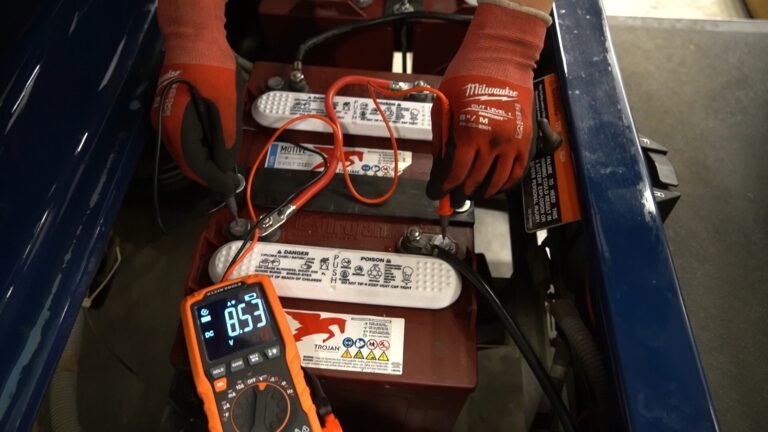
Connect a multimeter to the main pack. Drive up a steep hill. If voltage drops below 42V (48V system) or 31V (36V system), your batteries are collapsing, causing the motor to starve and overheat.
04 : Temperature Danger Zones
Use an Infrared (IR) Thermometer gun for accuracy.
| Component | Normal Temp | Critical Failure |
|---|---|---|
| Motor Case | 140°F – 160°F | > 210°F |
| Battery Cables | Ambient + 10°F | Melting Insulation |
| Controller | 120°F – 140°F | > 185°F (Cutback) |
| Solenoid | 110°F – 130°F | > 170°F |
Summary Checklist
- Smell Test: Burning plastic = Cables. Burning ozone = Motor.
- Listen: Grinding noise = Bearings. Silent heat = Electrical.
- Check Batteries: Old batteries kill new motors via low voltage.
- Clean It: A motor caked in mud cannot cool itself. Wash the case.
05 : Model-Specific Weak Spots
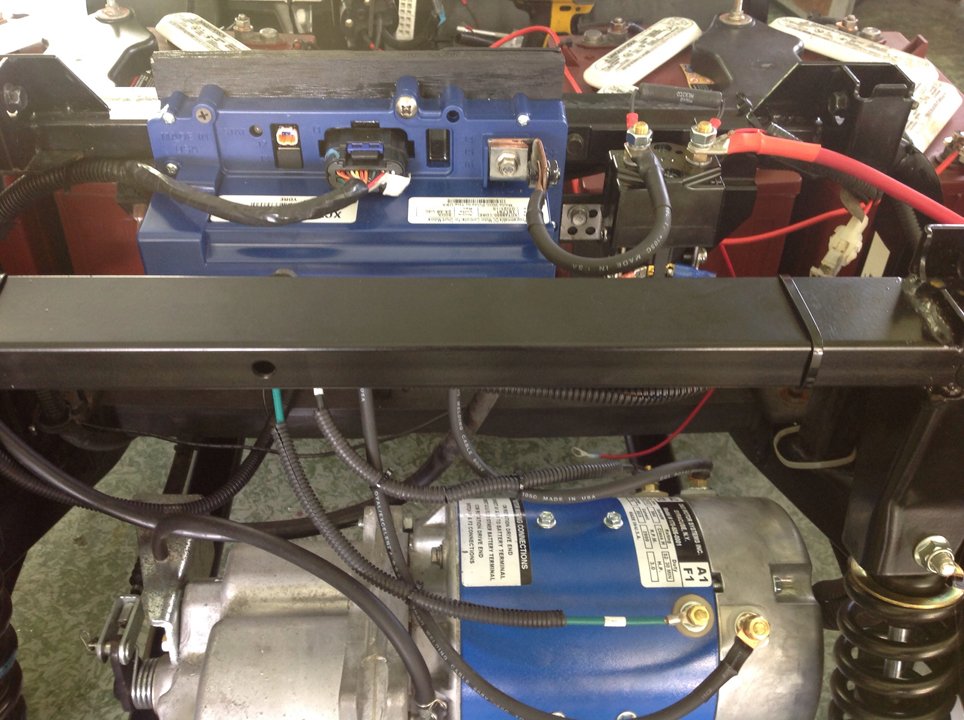
Certain platforms overheat for reasons unique to their design. The E-Z-GO DCS and PDS series from the late 1990s through the mid 2000s use a series-wound GE motor that runs hot when the controller current limit is cranked up for more speed, so a lifted, big-tire PDS cart is a classic overheating case. Club Car IQ and Precedent DC motors from 2004 to 2013 tolerate abuse well but suffer badly from worn brushes once past the 15-year mark. Yamaha G14 and G16 electric carts have a reputation for bearing failure at the commutator end because grease dries out, and the first symptom is exactly the coffee-grinder growl described above. Knowing your platform narrows the search fast.
06 : When the Controller Is the Real Cause
A motor that overheats is sometimes just following orders from a controller that is dumping too much current. Aftermarket high-amp controllers, or a factory unit with its current limit raised, will push a stock motor beyond its thermal design. If the case climbs past 210°F on flat ground with a healthy pack, suspect over-programming before you tear the motor apart. Many controllers also enter thermal cutback around 185°F, so a cart that mysteriously loses power on long hot pulls and then recovers after a rest is telling you the controller is the part running out of headroom, not the motor windings.
07 : Reading Brush and Commutator Wear
On a DC motor, pull the two access bands and inspect the brushes directly. New brushes are usually about three-quarters of an inch long, and once they wear to roughly a quarter inch the spring pressure falls off and arcing begins. Look at the copper commutator too: a healthy one has an even chocolate-brown film, while burnt dark bars or visible grooving mean the motor has been arcing under heat for a while. A commutator that is grooved can sometimes be turned on a lathe, but heavily burnt bars usually mean a rebuild or replacement is the honest fix rather than just swapping brushes.
08 : Airflow, Mud, and Duty Cycle
An electric motor sheds heat through its case and, on many designs, a small internal fan. Caked mud acts like a blanket and can add 30 to 40 degrees to case temperature, which is why a pressure wash of the motor housing is a legitimate first step after off-road use. Duty cycle matters just as much: a cart hauling a loaded utility bed up the same grade over and over never gets a chance to cool between pulls. Giving the motor a few minutes of rest, or spacing out heavy tasks, keeps peak temperatures inside the safe band and dramatically extends winding life.
09 : Preventing Repeat Failures
Once you have fixed the immediate overheat, close the loop so it does not return. Confirm the battery pack holds voltage under load, because tired batteries are the most common hidden cause and will cook a brand-new motor within a season. Keep terminals clean and torqued to spec so no single high-resistance connection creates a hot spot. If you run oversized tires or a lift, accept that the motor works harder and monitor case temperature with the IR gun for the first few outings. A little logging up front prevents an expensive rebuild later.
10 : Published motor limits and temperature context
Motor temperature is not one universal number. Safe limits depend on insulation class, sensor location, duty cycle, airflow, and controller programming. A controller heat warning is not automatically a motor winding limit.
| Check | Published value | Scope |
|---|---|---|
| Brush minimum, Club Car EJ4-4001 DC motor | 0.62 in / 16 mm | Motor-specific figure, not universal. |
| Brush minimum, Club Car starter/generator | 0.79 in / 20 mm | Different motor family, showing why generic limits are unsafe. |
| Commutator | Light polishing with 400-grit or finer permitted by service text | Measure runout only to the exact motor manual’s published limit. |
| Controller heatsink | DS diagnostics flag above 85C / 185F | Controller warning, not a winding limit. |
An infrared reading on the housing is a trend tool, not winding temperature. Stop for odor, smoke, sparking, a controller warning, or rapidly climbing housing temperature. Then test pack and cable voltage drop, brake drag, gearing, tire size, cooling, bearings, brushes, and commutator.
FAQ
What is a safe motor temperature?
There is no safe universal number because housing and winding temperatures differ. Follow the exact motor and controller documentation and stop for odor, smoke, sparking, or faults.
Bearing, brush, or voltage problem?
Bearings often growl mechanically with shaft speed. Brushes can arc or leave carbon dust. Voltage or cable trouble shows as supply sag under load. Test all three paths.
When should brushes be replaced?
Use the exact motor limit. One Club Car DC motor is 0.62 inch, while a different motor family is 0.79 inch.
Can overheating damage the controller?
Yes. Drag, overload, low pack voltage, or cable loss can heat motor and controller together. A controller fault does not prove the controller caused the original heat.