
Sulfation Reversal: Can You Actually “Bring Back” a Dead 8V Battery?
Equalization can rescue a stratified or undercharged 8V battery, but it cannot rebuild a shed plate or reconnect a broken strap. Here are the real manufacturer equalization voltages, what genuine recovery looks like on a hydrometer, and the point where a battery is simply done.
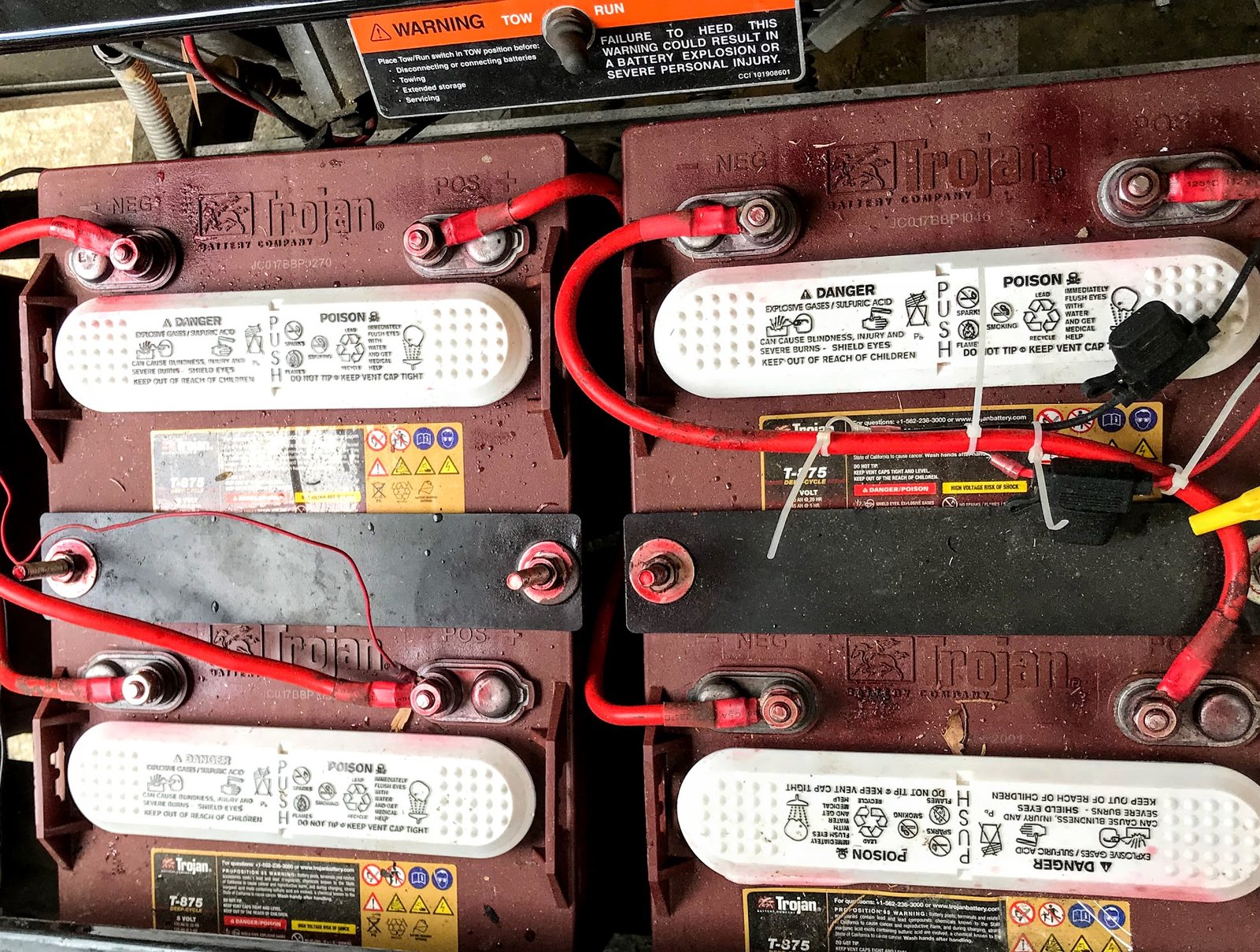
- Equalization is a controlled overcharge for flooded lead-acid only. It can correct stratification and undercharge imbalance, but it cannot rebuild shed plate material, reconnect a broken strap, or cure a shorted cell. Never equalize AGM, gel, or lithium.
- The manufacturers disagree on voltage, so do not average them. Trojan specifies 2.70V per cell (10.8V on an 8V battery, 64.8V on a 48V pack); U.S. Battery specifies 2.55V per cell plus or minus 0.05 (about 10.0 to 10.4V on an 8V).
- Real recovery is not bubbling. It is rising specific gravity in the low cells and a narrowing cell spread. Check temperature-corrected SG hourly and stop when SG no longer rises.
- A cell that stays more than 0.050 SG below the others after a correct charge, or an 8V battery about 2V low under load, points to a bad cell. That battery is done regardless of how long you equalize.
The internet is full of promises that any dead golf-cart battery can be revived with the right trick. The honest answer for an 8V flooded battery is narrower and more useful: equalization, a controlled overcharge, can correct stratification and some undercharge imbalance, but it cannot rebuild shed plate material, reconnect a broken internal strap, or cure a shorted cell. Knowing which failure you are looking at is the whole game, because it decides whether you are recovering a battery or wasting time on a dead one.
What Equalization Can and Cannot Do
Sulfation is soft at first, where lead sulfate forms on the plates and can still be driven back into the electrolyte, and hard later, where the crystals harden and permanently occupy plate area. A controlled equalization charge breaks down soft sulfation and evens out cells that have drifted apart. It does nothing for a plate that has physically shed its active material, a strap that has cracked from vibration, or a cell that has shorted internally. Never equalize AGM, gel, lithium, or any battery whose manufacturer prohibits it. Isolate the vehicle loads, provide ventilation, wear eye protection, and monitor temperature and electrolyte behavior throughout.
Manufacturer Equalization Limits
This is where most guides go wrong: they quote one universal voltage. The two major flooded golf-cart makers publish different targets, and you must use the one printed on the battery in your cart.
| Manufacturer reference | Equalization voltage | Current / control | Duration & completion |
|---|---|---|---|
| Trojan flooded deep-cycle | 2.70V per cell. An 8V battery has four cells, so the target is 10.8V per battery; a six-battery 48V pack is 64.8V. | Use the approved charger equalize mode after a normal full charge. Trojan lists 13% of C20 maximum current for Signature and Solar Premium flooded lines. | Check SG hourly, complete when SG no longer rises during gassing. Trojan describes 2 to 4 hours as typical, at least monthly. |
| U.S. Battery flooded lead-acid | 2.55V per cell plus or minus 0.05. For four cells the 8V range is 10.0 to 10.4V, centered at 10.2V. | Begin after the normal bulk and absorption cycle. U.S. Battery lists roughly 10% of C20 bulk and 3% of C20 absorption end. | Equalize 1 to 3 hours after the normal charge, every 30 cycles or monthly. |
The two makers publish different voltage targets, so do not average them. Use the label and charging data for the battery installed. The 8V figures above are calculations from each maker’s volts-per-cell spec, not a new universal setting. A charger that cannot hold the approved profile while monitoring temperature is not an equalizer.
What Recovery Should Look Like
Record temperature-corrected SG in every cell before equalization and once per hour during it. Trojan treats a spread over 0.030 SG as a reason to equalize and retest, with 1.277 plus or minus 0.007 at 80F as the full-charge reference; U.S. Battery treats a spread over 0.050 SG as grounds to assume a bad cell. The useful sign is not bubbling alone, it is rising SG in the low cells and a narrowing spread.
| Observed result | Interpretation | Decision |
|---|---|---|
| Low cells rise and the spread narrows until SG plateaus | Correctable imbalance or stratification responded | Stop at the maker’s completion point, cool and rest the pack, retest. |
| All cells were already close, little SG change | There was little imbalance to correct | Do not extend the session just to force a higher number. |
| One cell stays more than 0.050 SG away after a correct charge | U.S. Battery bad-cell rule is met | Confirm technique and temperature correction, then replace per pack age. |
| One 8V battery is about one 2V cell lower under the same load | A shorted or non-contributing cell is likely | Remove that battery from service and confirm with per-cell SG. |
| Voltage rises fast, current tapers, but SG and runtime do not improve | High resistance or lost active material limits capacity | Further overcharge only adds heat and water loss. |
| Case heats fast, vents violently, swells, leaks, or smells abnormal | Unsafe reaction or internal damage | Stop charging, disconnect safely, ventilate, follow handling guidance. |
The 2V deficit is a cell-count clue, not a standalone warranty threshold, since a flooded lead-acid cell is nominally 2V. Confirm the fault by comparing all six 8V batteries at the same current and reading each accessible cell’s corrected SG. The Battery Council deep-discharge endpoint of 1.75V per cell (7.0V for an 8V battery) is a controlled discharge endpoint, not a safe resting-voltage target.
Controlled Procedure
- Identify maker, model, age, terminal condition, and electrolyte level. Use distilled water and the maker’s fill timing. Never add acid.
- Repair loose or resistive cables first, because equalization cannot correct voltage lost at a hot connection.
- Complete the normal approved charge, then measure every battery and cell including electrolyte temperature.
- Disconnect vehicle loads and run only the maker’s equalization mode. Maintain ventilation and keep sparks, smoking, and flames away.
- Record pack voltage, per-battery voltage, current, temperature, and corrected SG hourly. Trojan’s correction is plus 0.004 SG per 10F above 80F and minus 0.004 per 10F below.
- Stop at the documented duration or when SG no longer rises, and stop earlier for excessive temperature or violent venting.
- After cooling and rest, repeat open-circuit voltage, SG spread, and a controlled discharge or load comparison. Capacity improvement, not charger-terminal voltage, is the result that matters.
Desulfator Claims
Pulse desulfators are marketed as breaking down sulfate crystals, and they may help with soft, early sulfation on a battery that is otherwise sound. Unless a product publishes a repeatable capacity improvement under a defined test, treat the marketing as manufacturer-claimed rather than proven. An electronic desulfator can take two to four weeks of continuous use to show a measurable specific-gravity change, and it will not restore a plate that has already shed or a cell that has shorted. Epsom salt is a popular myth that introduces impurities and accelerates plate destruction, so it is not a fix.
You can genuinely bring back an 8V battery that is stratified or mildly undercharged by equalizing it at the correct manufacturer voltage and watching the low cells recover on a hydrometer. You cannot bring back a battery that has lost active material, cracked a strap, or shorted a cell, and no voltage or additive changes that. Judge the outcome by rising specific gravity and restored runtime, never by the number on the charger, and when one cell refuses to come up, replace that battery before it cooks the good ones around it.
Frequently Asked Questions
Can I use Epsom salt to fix a dead golf cart battery?
No. Epsom salt (magnesium sulfate) is a popular internet fix that can briefly raise conductivity, but it introduces impurities that accelerate destruction of the lead plates and often make the battery fail more violently later. Use the manufacturer’s equalization charge on a flooded battery instead, and never add anything but distilled water to the cells.
How long does it take to desulfate a battery?
A proper equalization charge usually runs 1 to 4 hours of controlled overcharge, depending on the manufacturer’s spec, and you stop when specific gravity no longer rises. An electronic pulse desulfator works far more slowly and can take two to four weeks of continuous use to show a measurable specific-gravity improvement, and only on soft sulfation, not on a shed or shorted cell.
How often should I perform an equalization charge?
For carts used daily, about once every 30 days is a good interval, and U.S. Battery cites every 30 cycles. For occasionally used carts, roughly every 90 days prevents hard sulfation from forming. Always equalize when the cell specific-gravity spread grows past the manufacturer threshold (over 0.030 for Trojan), and only on flooded batteries the maker allows.
What voltage should I equalize an 8V golf cart battery at?
Use the manufacturer’s per-cell figure, not a universal number. Trojan specifies 2.70V per cell, which is 10.8V on a four-cell 8V battery and 64.8V across a 48V pack. U.S. Battery specifies 2.55V per cell plus or minus 0.05, about 10.0 to 10.4V on an 8V battery. Do not average the two; use the value for the brand printed on your battery and monitor temperature throughout.
