Will a 36V Solenoid Work on 48V?
When upgrading a golf cart from 36V to 48V, one of the most common questions is whether the existing 36V solenoid can handle the higher voltage. The short answer is no, but the reasoning is more nuanced than most people realize. It is not just about the main contacts, the activation coil is the critical component that determines voltage compatibility. Using the wrong voltage solenoid creates a ticking time bomb in your electrical system.
01 : Why the Coil Voltage Rating Matters
A solenoid has two electrically independent circuits inside the same housing. The main contacts (large posts) are just heavy copper pads that slam together, they do not care about voltage. The activation coil (small posts) is a precision-wound electromagnetic component designed for a specific voltage.
The coil’s wire gauge, number of turns, and insulation rating are all calculated for its rated voltage. When you apply 48V to a coil designed for 36V, Ohm’s law takes over:
- At 36V (rated): If the coil resistance is 60Ω, current = 36V / 60Ω = 0.6A. Power = 36V × 0.6A = 21.6W. The coil is designed to dissipate this amount of heat safely.
- At 48V (overvoltage): Current = 48V / 60Ω = 0.8A. Power = 48V × 0.8A = 38.4W. That is a 78% increase in heat dissipation that the coil was never designed to handle.
The opposite mismatch can fail too. Feeding a 48V coil only 36V cuts current to 75% and power to about 56% of rated values for the same resistance. That may be below the pull-in threshold, so the contactor can chatter, close slowly, or fail to seat; slow closure increases arcing at the main contacts. Actual pull-in and hold limits come from the contactor maker, not the pack label alone.
Typical labels: conventional 36V carts generally use a coil marked 36V, and conventional 48V carts generally use 48V. Exceptions exist: some controllers drive a lower-voltage coil with pulse-width modulation, and gas-cart starter solenoids are often 12V. Read the stamping on the solenoid body or coil, such as 12VDC, 36VDC, or 48VDC, then verify the exact part number, continuous/intermittent duty, contact-current rating, and suppression polarity in the parts manual.
This extra heat rapidly degrades the thin enamel insulation on the coil windings. Once the insulation breaks down, adjacent turns short together, reducing the coil’s inductance and further increasing current draw, a thermal runaway loop that ends with a burnt coil and a dead solenoid.
02 : What Actually Happens When You Try It
A 36V coil may pull in on 48V, but that first click does not prove compatibility. With the same coil resistance, increasing supply from 36V to 48V raises current by one-third and electrical heating by about 78%. How fast damage appears depends on duty cycle, ambient temperature, ventilation, and coil construction, so a fixed “weeks to failure” timeline is not credible.
- At first: the plunger may close normally, but the coil runs above its designed power.
- With repeated or continuous use: excess temperature ages winding insulation, connectors, and the plastic housing. A hot smell, discolored small terminals, or a coil that will not remain engaged is a stop-use warning.
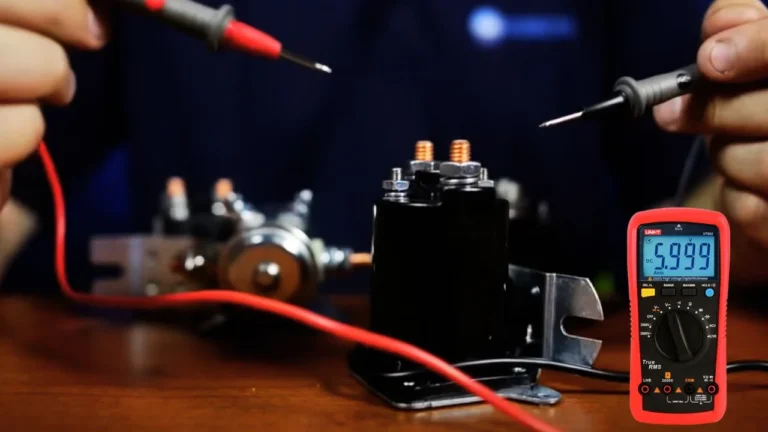
- As damage progresses: shorted turns can lower resistance and increase current further; an open winding produces OL on the meter and no click.
- At the contacts: the wrong pull force or slow seating can cause chatter and arcing even when the main-post voltage rating appears adequate.
Replace the mismatch with a contactor approved for the controller and application. Do not add a series resistor or improvise a voltage drop unless the controller or contactor manufacturer specifies that circuit.
03 : Contact and Coil Ratings Are Separate
It is important to understand that the coil and the main contacts are rated separately. When someone says a solenoid is “36V rated,” they almost always mean the coil voltage. The contacts have their own limits: a current rating, and a maximum voltage they can safely break, because a DC arc is harder to put out as the voltage rises. White Rodgers publishes contact ratings for its 586 stock-style solenoid on 6V to 36V circuits. Albright rates its standard SW180 contacts to 48V DC, and the SW180B and SW200, which add magnetic blowouts, to 96V DC. That is why a 72V build needs contacts rated for 72V, not just a 72V coil. On a sealed stock solenoid the coil cannot be swapped, so a 36V to 48V upgrade means a new solenoid. For guidance on choosing the right high-amperage solenoid for a conversion build, see our 400-amp solenoid upgrade guide.
04 : The Complete 36V to 48V Solenoid Checklist
If you are converting your golf cart from 36V to 48V, the solenoid is just one of several components that need to change. Here is the solenoid-related checklist:
- Purchase a 48V-rated solenoid with an amperage rating that matches or exceeds your controller’s peak output. For stock controllers, a 200A solenoid is sufficient. For aftermarket controllers like Alltrax or Navitas, upgrade to a 400A unit.
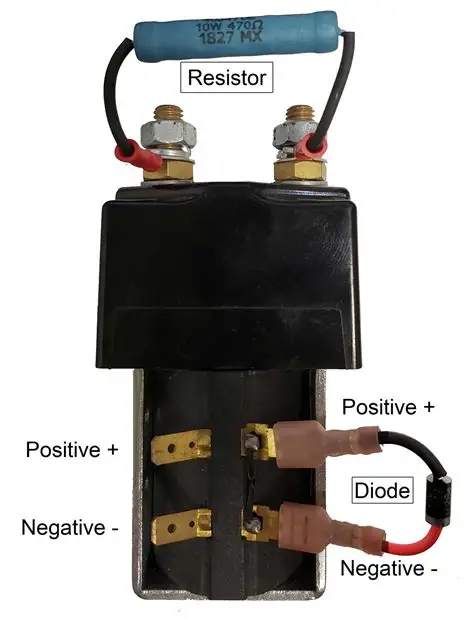
- Install a precharge resistor rated for 48V (250Ω, 10W). If you were using a precharge resistor on the 36V system, you may need to verify that its wattage rating is sufficient for the higher voltage. Our precharge resistor sizing guide covers the exact math.
- Install a flyback diode (1N5408, 3A 1000V). The higher voltage produces a stronger inductive kickback when the coil de-energizes, making the diode even more critical on 48V systems.
- Verify cable gauge. Higher voltage systems produce different current profiles. Ensure your main cables are adequate for the new amperage. See our cable voltage drop analysis.
- Update the voltage reducer if you have 12V accessories. A 36V-to-12V reducer will not work on 48V. You need a unit rated for 48V input. See our universal voltage reducer guide.
05 : Can a 48V Solenoid Work on 36V?
The reverse scenario is less dangerous but still problematic. A 48V coil on a 36V system will under-perform because the coil does not receive enough voltage to generate full magnetic pull force. The plunger may not fully engage, causing the contacts to make weak, partial contact. This results in high resistance at the contact junction, excessive heat, and accelerated contact pitting. While a 48V solenoid on 36V will not burn out the coil, it will prematurely destroy the contacts. Always match the solenoid voltage to the system voltage.
06 : Are There Universal Solenoids?
Not really. Albright builds its heavy-duty contactors (SW180B, SW200 and SU280 families) with a coil wound for one voltage, offered from 6V to 240V and including a 72/80V coil, so you still order the coil that matches the voltage feeding it. What does carry across voltages is the contact rating: the blowout versions are rated to 96V DC, so one contactor family covers 36V, 48V and 72V packs once the coil is right. If you plan a later voltage upgrade, choosing contacts rated for the higher pack now means only the coil voltage has to change when you order the replacement. For help choosing the right one, browse our OEM vs. aftermarket parts guide.
Frequently Asked Questions
Will a 36V solenoid work on 48V?
No. The main contacts can handle the current, but the activation coil is rated for 36V. Feeding it 48V overdrives the coil, causing overheating and early failure. Use a solenoid with a coil rated for the voltage that feeds it, which on most carts is the pack voltage.
What happens if you run a 36V coil on 48V?
The coil draws more current than designed, runs hot, and can burn out or stick. It may work briefly, which is why the failure is easy to misdiagnose later.
Can a 48V solenoid work on 36V?
It often will engage because the higher-rated coil is under-driven, but pull-in can be marginal, so matching the coil to the pack voltage is still the reliable choice.
How do I check a solenoid’s voltage rating?
Read the rating stamped on the coil housing near the small terminals, or match the manufacturer part number. Do not assume by size; contacts look identical across coil voltages.