
The Best Golf Push Cart Brand
If you walk the course instead of riding, the trolley you push for four-plus miles matters more than almost any club in your bag. Picking the best golf push cart brand comes down to how heavy your bag is, how much you care about a compact fold, and how much you want to spend. This guide breaks down the brands that actually hold up season after season.
01 : Clicgear, Best Overall
Clicgear is the brand most serious walkers land on, and for good reason. The Model 4.0 is famous for being almost indestructible, and the frame is covered in accessory tabs so you can bolt on an umbrella holder, cooler bag, GPS mount, or extra storage. That modularity is why so many golfers consider it the gold standard.
The trade-off is price, Clicgear sits at the higher end of the manual-cart market. But these carts hold their value remarkably well on the used market, so the real cost of ownership is lower than the sticker suggests. If you want one cart that lasts a decade, this is the safe bet.
A detail worth knowing about Clicgear is how the lineup has evolved: the older 3.5+ folds into a slightly taller, chunkier package, while the current 4.0 (and the wider-tire 8.0 Rovic-badged variant) tightened the fold and moved to storage-friendlier proportions. Owners of 2016-2024 models consistently praise how cheap and available the spare parts are, replacement wheels, brake cables, and the console cup holder all sell individually, which is a big reason resale values stay high years down the road. The one recurring quirk to plan around is width: a fully-loaded Clicgear with the umbrella holder and cooler attached can be a tight squeeze in a compact car trunk, so measure your cargo space before piling on accessories.
Numbers to know: the three-wheel Clicgear Model 4.0 is about 21 lb, folds to roughly 13 by 15 by 24 inches, and usually sells around $300 to $350. Its dense, cube-like fold favors durability over minimum carry weight.
02 : Bag Boy, Best Value
Bag Boy nails the thing most golfers actually care about day to day: setup and teardown. The Bag Boy Nitron uses a one-motion mechanism, a single pull and a small gas strut springs the whole cart open. No fiddling in the parking lot while the group behind you waits.
You also get thoughtful extras like an integrated beverage holder, a handle-mounted parking brake, and a phone holder, usually at a friendlier price than the premium brands. For a golfer who wants convenience without overspending, Bag Boy is hard to beat.
Numbers to know: the three-wheel Nitron is about 16.7 lb, folds to roughly 19 by 13.5 by 22 inches, and sells around $300 to $360. Four-wheel models such as the roughly 16 lb Quad Pro trade tighter turning for a more planted stance at a similar price.
03 : Sun Mountain, Best for Fast Walkers
Sun Mountain builds light, quick carts aimed at golfers who move briskly. Their Speed Cart line is designed for power walkers and works with both cart bags and carry bags, while the Ridgeline 3 was the first push cart with a fully adjustable bag bracket, a genuine fix for the compatibility headaches that plague some trolleys. If your bag is on the lighter side and you like a nimble, low-effort push, Sun Mountain should be on your shortlist.
Sun Mountain carts also lean on aluminum framing to keep weight down, so a Speed Cart typically tips the scale a couple of pounds lighter than a comparable steel-framed trolley, which you feel by the eighteenth hole. The adjustable bag bracket that debuted on the Ridgeline 3 is the standout feature for anyone who has fought a cart that would not grip their bag properly; it accommodates everything from a slim carry bag to a full 14-way cart bag without the straps sliding. Because Sun Mountain also builds stand bags and carry bags, their push carts are tuned to play nicely with lighter bags rather than the heaviest tour staff bags, so match the cart to a bag under roughly seven pounds for the best walking feel.
Numbers to know: Sun Mountain three-wheel carts generally weigh about 17 to 19 lb and sell around $250 to $350. The Ridgeline 3 folds to roughly 26 by 15 by 16.5 inches; the Speed Cart V1R is longer and flatter at about 37 by 16 by 13 inches.
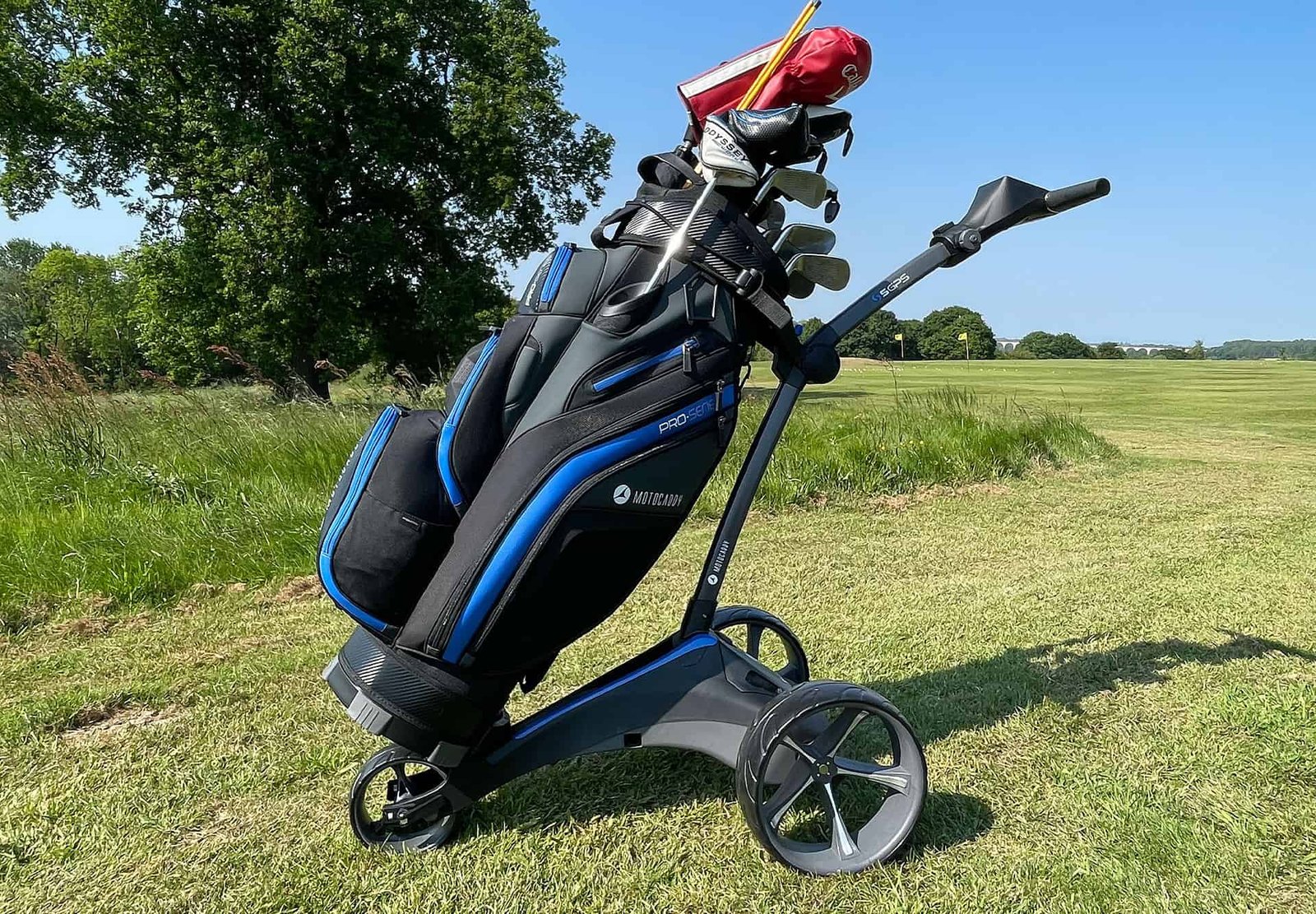
04 : Motocaddy & Stewart, Premium & Electric
If you want to stop pushing entirely, Motocaddy and Stewart Golf lead the electric-trolley category. These carts drive themselves with a remote or follow-mode, which is a game changer on hilly courses or for golfers managing back issues. They cost several times more than a manual cart, but for frequent walkers the comfort payoff is real. Think of these as the equivalent of stepping up from a manual cart to a powered ride, the same logic many owners apply when they weigh a full ride-on golf cart for getting around the property.
Numbers to know: Motocaddy’s S1 is about 20.7 lb before its removable battery, folds to roughly 33 by 19 by 15 inches, and powered models commonly span about $800 to $1,700. Stewart’s Q Follow is about 31 lb plus a 6.6 lb battery, folds to roughly 21.3 by 23.6 by 12.6 inches, and typically costs from the low $2,000s into the low $3,000s. These powered, stabilizer-equipped platforms are not direct manual three-versus-four-wheel substitutes.
05 : 3-Wheel vs. 4-Wheel: Which to Buy
Almost every brand above sells both layouts. Here is how to choose:
- 3-wheel: More maneuverable, turns on a dime, and the most popular choice. Ideal for average cart bags and flatter courses.
- 4-wheel: More stable on slopes and better at carrying heavy staff bags without tipping. Slightly bulkier folded.
- The deciding factor: Bag weight and terrain. Light bag on a flat course → 3-wheel. Heavy bag or hilly course → 4-wheel.
06 : How to Pick the Right Brand for You
Rather than chasing a single “best,” match the brand to your priority:
- Want it to last forever? Buy Clicgear.
- Want the easiest fold and best value? Buy Bag Boy.
- Want the lightest, fastest cart? Buy Sun Mountain.
- Want to stop pushing altogether? Buy Motocaddy or Stewart electric.
Whichever you choose, buy from a brand with available replacement parts, wheels, brackets, and brake cables wear out, and a brand that sells spares will keep your cart rolling for years. The same maintenance mindset applies whether you own a hand trolley or a full electric cart; browse our repair guides library for upkeep tips that protect any rolling investment.
Frequently Asked Questions
What is the best golf push cart brand?
Clicgear is the most popular all-rounder for durability and accessories, Bag Boy is the value pick, and Sun Mountain suits fast walkers. Motocaddy and Stewart lead the premium and electric end.
Is a 3-wheel or 4-wheel push cart better?
3-wheel carts are lighter and more maneuverable for turning; 4-wheel carts are more stable on slopes and sit level when parked. Choose by course terrain and how heavy your bag is.
How much should a good push cart cost?
Solid entry models start modestly, mid-range carts from Clicgear and Bag Boy cost more for better folds and accessories, and premium electric trolleys from Motocaddy or Stewart cost the most.
Are electric push carts worth it?
If you walk often and carry a heavy bag, an electric trolley saves real effort over a full round. They cost more and add weight to transport, so weigh convenience against price.
