Are Golf Carts Street Legal? LSV Rules Explained
How the federal 20 to 25 mph LSV rule decides street-legal status, the exact equipment a road-legal cart needs, and why the rules still change from state to state and town to town.
- Federal law defines a Low-Speed Vehicle as capable of more than 20 but not more than 25 mph, with GVWR under 3,000 lb.
- LSVs need lights, turn signals, mirrors, an FMVSS 205 (AS-1 or AS-4) windshield, seat belts, a parking brake, and a 17-character VIN.
- Modifying a titled LSV past 25 mph can drop it out of the federal category and void its registration and insurance.
- States and towns add their own rules; Florida, for example, caps LSVs to roads posted 35 mph or less.
Golf cart versus Low-Speed Vehicle, the legal line
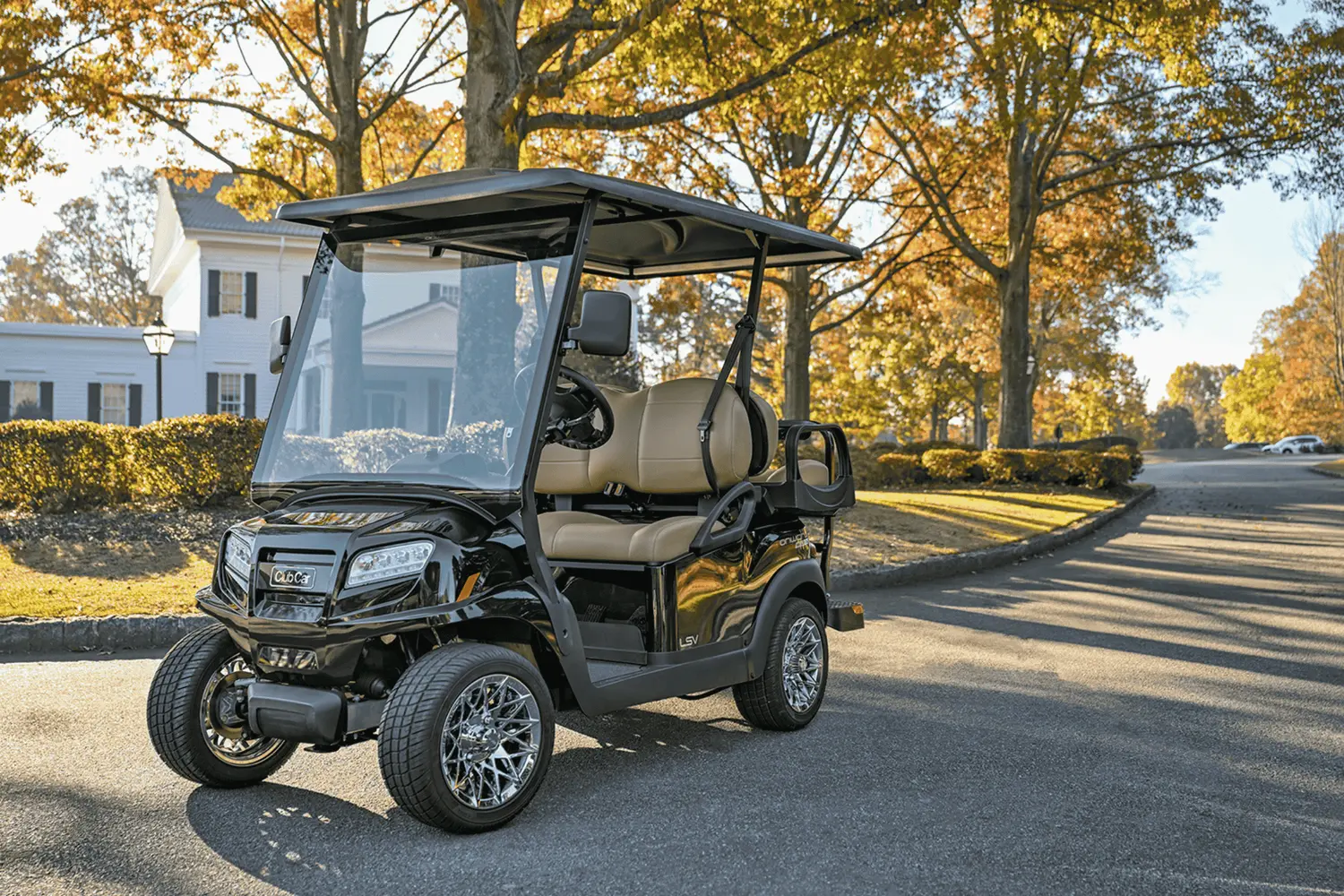
The easiest way to land on the right side of this line is to buy a cart that already ships as an LSV. Manufacturers now sell factory street-legal trims that come with the lights, signals, seat belts, windshield and a genuine 17-character VIN built in. The Club Car Onward LSV and the older Villager LSV, the EZGO Liberty and Express L6 in their LSV configurations, and many neighborhood EV models leave the factory titled as Low-Speed Vehicles. These come with a factory speed limiter set at 25 mph precisely so they stay inside the federal LSV window, and defeating that limiter to go faster is exactly what pushes a cart out of LSV status and into full motor-vehicle territory.
The precise federal definition is narrower than “street legal golf cart.” Under 49 CFR 571.3, a Low-Speed Vehicle is a four-wheeled motor vehicle with a speed attainable over 1 mile that is more than 20 mph but not more than 25 mph on a paved level surface, and with GVWR under 3,000 lb. Federal Standard No. 500 then caps the tested maximum speed at 25 mph and lists the required equipment. A cart capped at 20 mph or less is usually treated as a golf cart, with narrower and very local permissions, while a registrable LSV can usually travel on roads posted up to 35 mph in many states. To see exactly which category and equipment apply to your cart, run it through the street-legal checklist tool.
The equipment a street-legal cart has to carry
If your cart qualifies as an LSV, the federal standard requires the safety equipment below, and your state typically adds registration, a title, insurance, and a licensed driver on top.
| Requirement | Why it matters |
|---|---|
| Headlights, tail lights, brake lights | Visibility and signaling day and night |
| Turn signals | Required for LSVs federally |
| Mirrors | Driver-side exterior mirror plus either a passenger-side exterior mirror or an interior mirror |
| Windshield | Must conform to FMVSS 205 glazing; NHTSA guidance says LSV windshields must meet ANSI/SAE Z26.1-1996 AS-1 or AS-4 glazing |
| Seat belts | Type 1 or Type 2 belt assembly at each designated seating position |
| VIN | 17-character VIN that conforms to 49 CFR part 565 |
| Parking brake | Standard safety requirement |
| Rear visibility and alert sound | Current 49 CFR 571.500 also references FMVSS 111 rear visibility and the pedestrian alert sound rule in 49 CFR 571.141 |
You can read the federal rule itself at the eCFR 49 CFR 571.500 page. The registration and insurance steps that go with it live on your state DMV website.
Why the rules change state to state and town to town
A concrete Florida example shows the split. Florida FLHSMV says an LSV must be registered, titled, insured with PIP and PDL, operated by a licensed driver, and used only on streets where the posted speed limit is 35 mph or less. The same FLHSMV page defines golf carts as vehicles not capable of exceeding 20 mph and says they may be operated on roadways designated for golf carts with a posted speed limit of 30 mph or less. Florida Statute 316.2126 adds more specific municipal and state-road language, including a 30 mph cap for municipal golf-cart and utility-vehicle use on state roads and a 35 mph cap for low-speed vehicles and utility vehicles in certain residential delivery use.
That does not make Florida’s rule universal. Beyond the federal LSV baseline, every state and often every city or county sets its own rules about where carts can drive, what permits they need, the minimum driver age, and which roads or crossings are allowed. Some communities are very cart-friendly with marked routes; others restrict carts to private property. Because of this patchwork, treat any general guide, including this one, as a starting point and confirm the specifics with your state DMV and local authorities before driving on public roads. An accurate, maintained 50-state legal dataset is a project in its own right, so always verify locally.
Top speed is what really decides the category
One detail worth respecting on the speed side is that a factory LSV limiter is not just a suggestion. The federal LSV window starts above 20 mph and ends at 25 mph. The moment a titled LSV is modified so its speed attainable over the federal test distance exceeds 25 mph, it no longer fits the 49 CFR 571.3 definition and can fall out of the 49 CFR 571.500 equipment category. That can create registration and insurance problems even if the cart still has lights, belts, and mirrors.
Because the LSV category is defined by speed, knowing your real top speed matters before you start adding equipment. If you are unsure how fast your cart can go, estimate it with the top speed calculator, and remember that bigger tires raise top speed, which the tire size calculator can show. A cart modified past 25 mph generally loses LSV eligibility and faces full motor-vehicle requirements, so chasing speed can quietly change your legal status.
The bottom line on making a cart road legal
Start by pinning down your top speed, since that decides whether you are dealing with golf-cart rules or LSV rules. If you want to drive on public roads, plan to add lights, signals, mirrors, a windshield, seat belts, and a VIN, then register, title, and insure the cart through your state. Above all, confirm the local rules first, because two towns a few miles apart can treat the same cart very differently. The checklist tool gives you a clear federal baseline to work from, and your DMV fills in the state-specific steps.
Frequently Asked Questions
Are golf carts street legal?
It depends mostly on top speed and local rules. A cart limited to 20 mph or less is usually treated as a golf cart with limited road rights, while one that reaches 21 to 25 mph can qualify as a federal Low-Speed Vehicle if it carries the required lights, signals, mirrors, seat belts, windshield, and a VIN. Above 25 mph it is no longer an LSV.
What is the federal definition of a Low-Speed Vehicle?
Under 49 CFR 571.3, an LSV is a four-wheeled motor vehicle with a top speed attainable over one mile that is more than 20 mph but not more than 25 mph on a paved level surface, with a GVWR under 3,000 lb. Standard No. 500 then caps the tested maximum at 25 mph and lists the required equipment.
What equipment makes a golf cart street legal?
A qualifying LSV needs headlights, tail and brake lights, turn signals, mirrors, an FMVSS 205 glazing windshield (ANSI/SAE Z26.1 AS-1 or AS-4), seat belts at each seating position, a parking brake, and a 17-character VIN. Your state then adds registration, a title, insurance, and a licensed driver.
Can I drive my golf cart on the road?
Sometimes. Many states allow golf carts on low-speed local roads or to cross certain highways, and allow registered LSVs on roads posted up to 35 mph. The exact rules, equipment, and permits vary by state and locality, so confirm with your DMV before driving.