
Diagnosing the Death Wobble: Kingpins, Bushings, or Wheel Alignment?
Violent steering-wheel shake at speed is rarely one loose nut. Separate kingpin play, control-arm bushing wear, and toe error with a proper shakedown test, then align using the platform-specific spec, not a universal number.
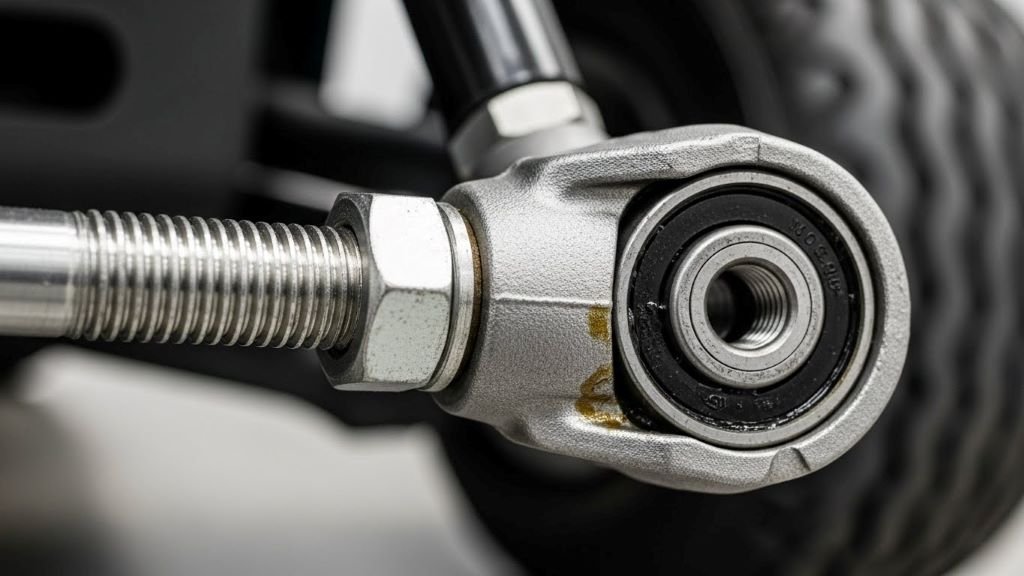
- Death wobble is usually a compound failure: kingpin/spindle play, control-arm bushing wear, and toe error, not one loose part.
- The 12-and-6 test finds kingpin and bearing play; the 3-and-9 test finds worn tie-rod ends.
- Alignment specs are platform-specific; use your model’s own service manual number, not a universal figure.
- Lug nut torque is documented per platform, from 50 ft-lb up to 85 ft-lb depending on brand and model year.
- A steering stabilizer can calm a lifted cart’s feedback, but it should never be used to mask loose kingpins or worn tie rods.
In the Golf Cart Lab diagnostic center, this shows up most often in lifted carts or older models. Unlike cars, golf carts have simplified steering systems that are highly sensitive to play. When your steering wheel begins to oscillate rapidly back and forth, it creates a terrifying driving experience that can lead to catastrophic accidents. Many owners assume they simply need to balance their tires, but tire imbalance usually presents as a mild vibration, not a violent shake. A true fix requires addressing the fundamental geometry and worn hardware of your front suspension.
The “Big Three” Culprits
The wobble is rarely caused by one loose nut. A real fix starts by separating three failure groups: spindle and kingpin play, control-arm or leaf-spring movement, and toe error. Any one of them can shake. Two together can make the steering wheel snap side to side at neighborhood speeds.
- Kingpins and knuckles: lift the front end on jack stands and rock the tire at 12 and 6 o’clock. Any clunk between spindle and axle needs bushing or kingpin work before alignment.
- Control arm, spring, or strut bushings: on independent front ends, worn inner bushings let the wheel move backward under load and change caster dynamically. On older beam-axle layouts, worn spring eye or shackle bushings can do the same thing.
- Toe-in: toe stabilizes straight-line tracking, but only after the mechanical play is fixed. Aligning loose parts only hides the problem for a few miles.
The old “over 15 MPH” rule is a rough symptom cue, not a specification. A cart with loose front hardware can shake below that speed, while a tight cart with badly cupped tires may only show vibration at higher speed.
Inspecting the Steering Rack
Sometimes the fix requires looking beyond the wheels and examining the steering rack itself. Inside the rack and pinion housing, metal gears interlock to translate your steering wheel movement to the tie rods. On older EZGO and Yamaha models, the internal gearing can strip out entirely.
If you can turn your steering wheel two or three inches in either direction before the tires actually begin to move, your steering rack is internally compromised. The correct fix in this scenario is replacing the entire steering box assembly, since rebuilding internal rack gears is rarely cost-effective or safe.
The Shakedown Test
You do not need to blindly order parts. You can isolate the exact failure point by performing this safety check on a flat, concrete surface. Always use heavy-duty jack stands before placing your hands near the suspension.
The 12-and-6 Test
Grab the tire at the top and bottom. Rock it back and forth. Zero play is allowed. Clunking means kingpin failure.
The 3-and-9 Test
Grab the tire sides. Wiggle horizontally. Play without the steering wheel moving means worn tie-rod ends.
Alignment Specs and Adjustment
Alignment specs are platform-specific. The most defensible measurement is the one in your model’s service manual, measured at tire center height after rolling the cart forward to settle the suspension. When a public manual does not publish a toe number, use the measurement method below and confirm the final number with the model manual.
| Platform | Toe / alignment reference | Lug nut torque verified here | Use note |
|---|---|---|---|
| Club Car Precedent | Service manual procedure adjusts front toe and equalizes front camber. Use the manual’s measurement method for your year. | 2016 Precedent service manual lists 55 ft-lb, plus or minus 5 ft-lb. | Do not apply lift-kit specs to stock Precedent steering. |
| E-Z-GO TXT gas / EX1 owner manual | Owner manual calls for front wheel alignment inspection, service manual needed for adjustment spec. | 65 to 85 ft-lb in the TXT EX1 gas owner manual. | Use the TXT service manual for tie-rod and steering hardware torque. |
| E-Z-GO RXV Elite | Owner manual calls for alignment inspection, service manual needed for toe number. | 50 to 85 ft-lb in the RXV Elite lithium owner manual. | RXV front geometry differs from TXT. |
| Yamaha G29 / YDRA | Owner manuals give wheel service torque, service manual needed for toe setting. | G29A owner manual lists 58 ft-lb. 2013 YDR-A manual lists 65 ft-lb. | Use the manual for your exact year because Yamaha torque changed by model family. |
| Yamaha DR2 / newer PTV | Owner manual wheel service data only, service manual needed for alignment spec. | 2021 DR2 PTV owner manual lists 74 ft-lb. | Do not reuse older G29 torque on newer PTV without checking the manual. |
Toe measurement method when the exact number is not published
- Set tire pressure equally side to side and inspect wheel bearings, kingpins, bushings, and tie-rod ends first.
- Roll the cart forward at least one tire rotation and stop without backing up.
- Mark a line on the tread center of both front tires at spindle height.
- Measure between the marks at the front of the tires, then at the rear of the tires at the same height.
- Toe-in means the front measurement is slightly smaller than the rear measurement. Adjust both tie rods evenly so the steering wheel remains centered.
- Tighten jam nuts, roll the cart forward again, and remeasure.
Do not use one universal tie-rod torque here. Public owner manuals commonly publish wheel torque, but tie-rod, spindle, and kingpin hardware torque comes from the service manual for the exact chassis. If that manual is not available, do not guess on steering fasteners.
The “Lift Kit” Factor
Installing a 6 inch lift kit and 23 inch all-terrain tires changes more than ride height. Larger tires increase leverage on kingpins, tie-rod ends, and steering racks. Many spindle lifts also change caster and scrub radius. That is why a cart that felt acceptable on stock tires can wobble after a lift even though no single part “broke” during the install.
- Caster change: reduced or uneven caster makes the wheel less willing to self-center.
- Scrub radius change: wider wheels and offset rims move the tire contact patch away from the steering axis, amplifying feedback.
- Hardware load: stock tie rods and bushings may be marginal with heavy tires.
- Tire balance: a balance vibration feels like speed-related shaking. Death wobble feels like the steering linkage is oscillating. Check both.
A proper fix for a lifted cart is to return the front end to tight mechanical condition first, then align it, then consider a steering stabilizer. A stabilizer can calm feedback, but it should not be used to hide loose kingpins, worn tie rods, or unsafe wheel hardware.
1. Torque wheel nuts to the manual for your exact platform. 2. Perform the 12-and-6 kingpin and bearing test. 3. Perform the 3-and-9 tie-rod test. 4. Inspect control-arm, spring, or strut bushings for movement. 5. Measure toe only after all play is fixed. 6. For lifted carts, verify caster, wheel offset, and tire balance before adding a stabilizer.
Frequently Asked Questions
What causes the death wobble in golf carts at high speed?
The violent shaking known as death wobble is usually caused by a combination of worn kingpin bushings, degraded control arm or A-arm bushings, and improper wheel alignment, specifically a toe-out condition instead of the correct toe-in. Any one of these can shake the steering; two together often make it violent at normal driving speeds.
How do I test for worn golf cart kingpins?
Jack up the front of the cart on jack stands so the tires are off the ground, then perform the 12-and-6 test: grab the tire at the top and bottom and rock it vertically. Any play or clunking means the kingpin bushings are worn and need replacement. Use the 3-and-9 test on the sides of the tire to check for worn tie-rod ends.
What are the correct alignment specs for a golf cart?
Alignment specs are platform-specific, not universal. The most defensible number is the one published in your model’s own service manual. When a manual does not publish a toe number, use the string/mark measurement method to set toe-in and confirm against the model’s manual rather than assuming one figure fits every brand.
Does a lift kit cause golf cart death wobble?
A lift kit does not create the wobble by itself, but it amplifies existing steering looseness. Larger, heavier tires change scrub radius and caster and put more leverage on kingpins, tie rods, and the steering rack, so a cart that felt acceptable on stock tires can wobble after a lift even though no single part failed during the install.
