What Wire to Use for Golf Cart Batteries? Gauge & Cable Guide
Stock carts use 6 AWG; performance and high-amp builds step up to 4 or 2 AWG. Here is how to pick the right gauge, why it matters for heat and voltage drop, and how to terminate it correctly.
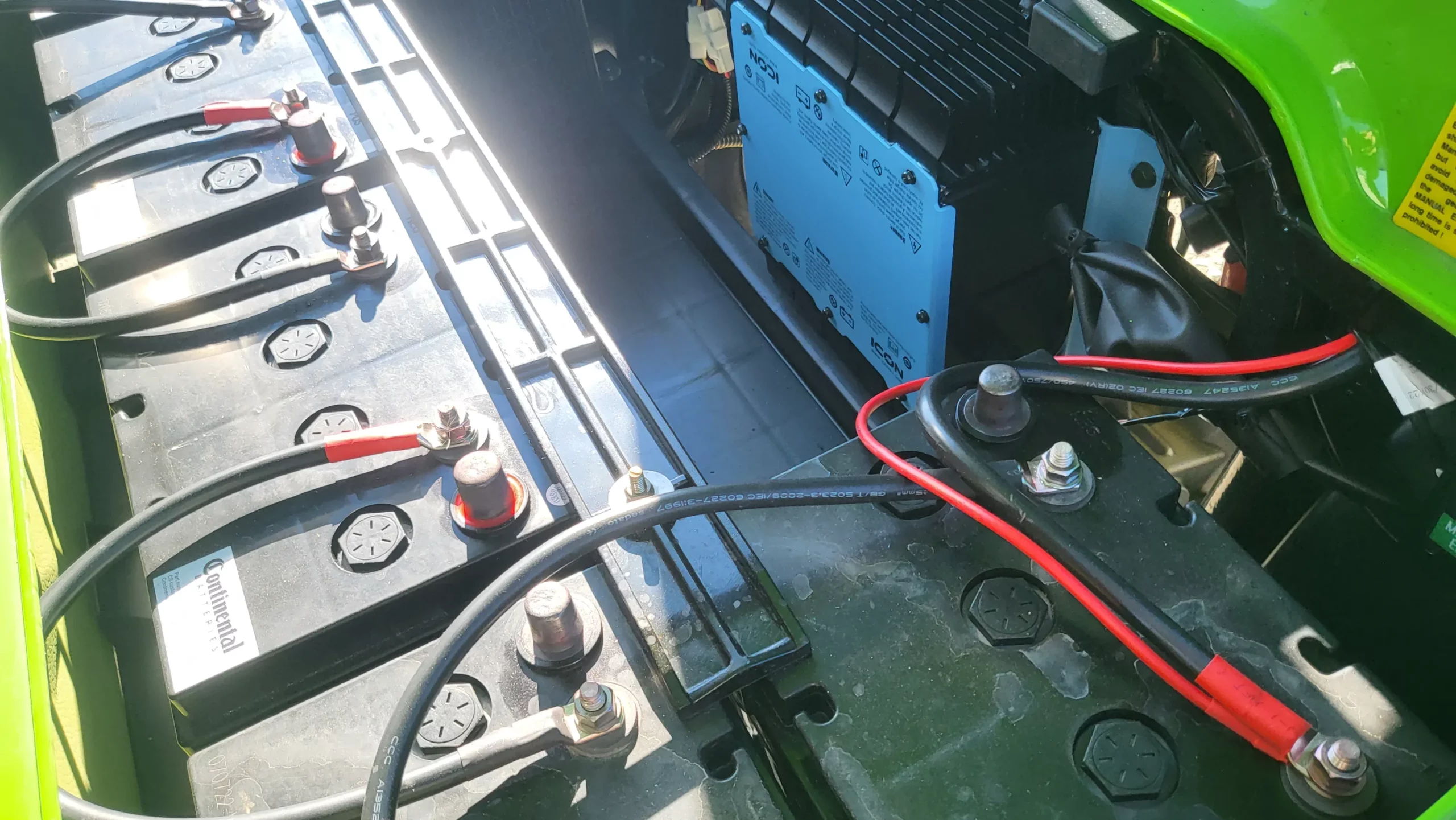
- 6 AWG copper battery/welding cable is the common baseline for stock 36V and 48V carts, confirmed by Red Hawk’s fitment catalog across multiple platforms.
- Upgraded controllers, high-torque motors, and lifted/heavy carts should step up to 4 AWG or 2 AWG.
- Moving from 6 AWG to 4 AWG cuts conductor resistance about 37%; moving to 2 AWG cuts it about 61%.
- A proper hydraulic crimp plus adhesive-lined heat shrink outperforms solder alone, which is brittle under vibration.
The cable between your batteries is doing serious work, carrying hundreds of amps to the motor, so gauge is not a detail to guess at. Choosing the right wire to use for golf cart batteries means matching the conductor size to your current draw so the cables run cool and lose minimal voltage.
01. What Gauge Wire to Use for Golf Cart Batteries
For most stock carts, 6 AWG is the common short-jumper baseline. Red Hawk’s golf-cart battery cable catalog, for example, lists 6 gauge sets for Club Car DS 48V, E-Z-GO Medalist/TXT, E-Z-GO RXV, Yamaha G19, and Club Car Tempo/Onward/Precedent applications, with 4 gauge versions listed as heavier upgrade options on several of the same fitments. If you have upgraded the controller, added a high-torque motor, or run a lifted/heavy cart that pulls more amps, move to 4 AWG or 2 AWG. Lower gauge numbers mean thicker copper, which carries more current with less heat and voltage drop. Our 6AWG vs 2AWG analysis quantifies the difference.
02. Choosing the Right Cable Material
Use fine-stranded copper battery or welding cable, it is flexible, handles vibration, and conducts better than aluminum. Direct Wire describes welding cable as fine copper stranding under a flexible EPDM or neoprene jacket, and notes that SAE J1127 is one of the standards buyers should look for on welding and battery cable. Avoid solid-core wire and cheap copper-clad aluminum, which are poor choices for a vibrating, high-current battery bay. Quality insulation rated for abrasion, heat, oil, and battery-compartment exposure is worth the small extra cost.
03. Why Gauge Affects Voltage Drop
Undersized cable acts like a resistor, dropping voltage and generating heat under load, robbing performance and risking melted terminals. Blue Sea Systems’ voltage-drop method starts with current multiplied by circuit length, measured from power source to load and back. Golf-cart battery jumpers are short, but current is high enough that small resistance differences matter.
| Copper Cable | Resistance at 77F | Drop, 1ft at 200A | Drop, 1ft at 400A |
|---|---|---|---|
| 6 AWG | 0.403 ohm / 1000 ft | 0.081V | 0.161V |
| 4 AWG | 0.253 ohm / 1000 ft | 0.051V | 0.101V |
| 2 AWG | 0.159 ohm / 1000 ft | 0.032V | 0.064V |
Those figures use Engineering Toolbox’s copper resistance table and simple Ohm’s law. Multiply by every jumper in the current path, then add lug and terminal resistance. That is why a clean voltage drop test under load tells you more than a visual inspection.
04. Building Reliable Lug Connections
- Use copper lugs sized to the cable gauge and stud.
- Crimp (and ideally solder) lugs for a gas-tight connection.
- Use heat-shrink over the lug barrel to seal out moisture.
- Keep runs short and torque connections properly.
A proper hydraulic crimp with a hex die creates a gas-tight, cold-welded joint that handles high current and vibration extremely well, which is why it is the professional standard. Soldering can add a belt-and-suspenders seal against moisture wicking up the strands, but solder alone is brittle under vibration and can crack, so it should supplement a good crimp rather than replace it. Pair good cable with correct series wiring, see how golf cart batteries are wired.
05. Matching Gauge to Real Current Draw
A practical rule of thumb: a stock cart can pull roughly 150 to 250 amps on a hard launch or hill, while a performance build with a 400A to 500A controller can spike well past what the original short jumpers were chosen for. Treat those as diagnostic ranges, not factory-published limits for every brand. Direct Wire’s welding-cable chart illustrates why length matters: at a 50 ft welding lead length, its reference table moves from 4 AWG at 100A to 2 AWG at 150A and 200A, then up to 2/0 at 400A. A golf-cart jumper is much shorter, so ampacity is not the same chart row, but the engineering direction is the same: more current and more length demand more copper.
Undersized or tired cable announces itself in a few ways. After a hard run, carefully feel the cables and terminals: any spot that is noticeably hotter than the rest is a high-resistance point burning energy as heat. Discolored or brittle insulation near a lug is a classic sign a cable has been cooking. A voltage drop test under load is the definitive check; more than about a half volt lost across a single short cable is not a published universal limit, but it is a strong practical warning that the cable is undersized, corroded internally, or has a bad crimp.
06. Keeping Cables Healthy
Good cable only stays good if the connections are clean. Corrosion at the lugs is the number one enemy on lead-acid carts because acid fumes attack copper and steel alike. A yearly clean-and-protect routine, wire brush the terminals, apply a thin coat of dielectric or terminal protectant, and re-torque every stud, prevents the slow creep of resistance that eventually shows up as sluggish acceleration. Keep battery-to-battery jumpers as short as the layout allows, and where cables pass over metal edges or the frame, use grommets or loom so vibration does not chafe through the insulation. Cables that are properly sized, cleanly terminated, and kept corrosion-free will outlast several sets of batteries.
The wire to use for golf cart batteries is 6 AWG for stock carts and 4 or 2 AWG for high-amp builds. Use fine-stranded copper battery/welding cable, properly sized copper lugs, and short runs to minimize heat and voltage drop.
Frequently Asked Questions
What wire should I use for golf cart batteries?
Use 6 AWG copper battery or welding cable for stock 36V and 48V carts. For high-performance or high-amp builds, step up to 4 AWG or 2 AWG to reduce heat and voltage drop. Always use fine-stranded copper, not aluminum or solid wire.
Is thicker battery cable better for a golf cart?
Thicker (lower-gauge) cable carries more current with less heat and voltage drop, which helps high-amp or lifted carts. For a stock cart, 6 AWG is sufficient; oversizing slightly never hurts but adds cost and stiffness.