Is a Golf Cart Controller Upgrade Worth It?
A bigger controller adds real torque, but only if your batteries, cables, solenoid and motor can take the extra amps. Here is the honest verdict.
- Stock controllers run about 250-300A (EZGO TXT/T48 Curtis 1206 at 250A, Club Car Precedent IQ Curtis 1510A-5251 at 250A, Yamaha G29 kit at 300A).
- Alltrax SR48400/500/600 deliver 400A, 500A, and 600A for 2 minutes, roughly doubling a stock Series-motor controller’s ceiling.
- A controller upgrade is rarely standalone: solenoid, F/R switch, and cable gauge must scale with the amps or they become the new weak link.
- Worth it for torque and hills when paired with a capable battery; skip it if you only want top speed or your motor/batteries are already tired.
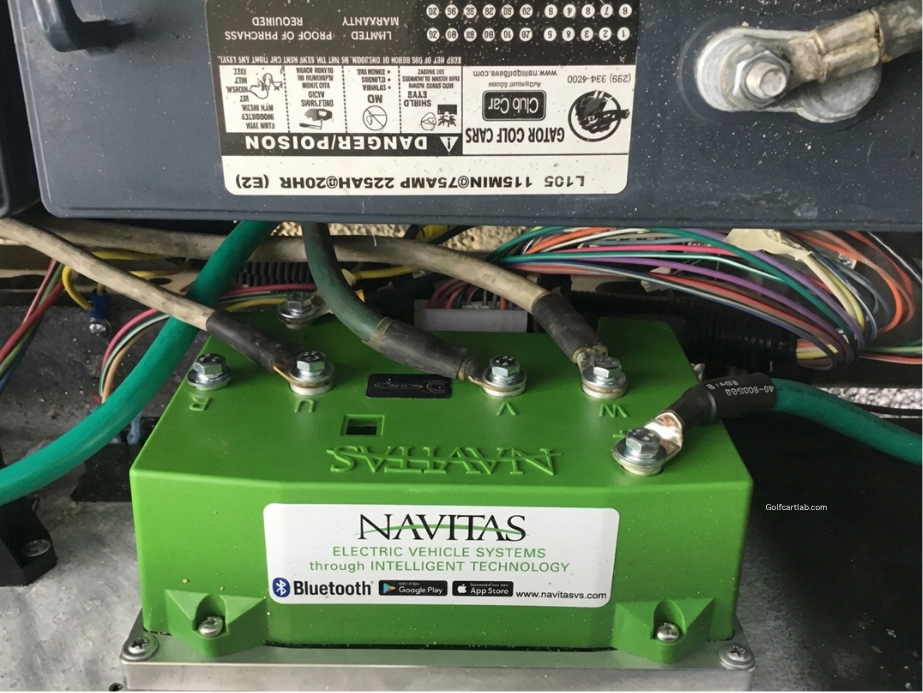
Upgrading the controller is the classic golf cart performance mod. Done right, it transforms low-end torque and hill climbing. Done in isolation, it just exposes the next weakest part, so whether it is worth it depends on the whole system. A golf cart controller upgrade is worth it if your stock controller is the bottleneck and the rest of your drivetrain can handle more amps. Going from a stock 250-300A unit to a quality 400-600A Alltrax or Navitas controller delivers a genuine, immediately noticeable jump in torque and hill-climbing, but only pays off when paired with adequate batteries, cables, solenoid and motor.
What a Controller Upgrade Does (and Costs)
The controller is the brain between your throttle and motor: it decides how many amps reach the motor. Stock replacements are usually conservative. Nivel lists the 2010-up EZGO TXT/T48 Curtis 1206 at 250A, FSIP lists the Club Car Precedent IQ Curtis 1510A-5251 at 250A, and FSIP’s Yamaha G29/Drive stock-motor kit is 300A. That is the baseline a real upgrade has to beat.
For the older Series-motor 48V carts, the clean spec-sheet jump is Alltrax SR. Alltrax’s SR manual lists the SR48400, SR48500, and SR48600 at 400A, 500A, and 600A for 2 minutes, with higher peak-amp-mode numbers. Navitas TSX3.0 is also a 600A family, but it is for separately excited DC applications, so motor type and harness matter before anyone treats it as a bolt-in Series swap.
| Controller | Motor Type | Published Amp Rating |
|---|---|---|
| Alltrax SR48400 | Series motor DC | 400A peak, 460A peak mode, 400A for 2 min |
| Alltrax SR48500 | Series motor DC | 500A peak, 575A peak mode, 500A for 2 min |
| Alltrax SR48600 | Series motor DC | 600A peak, 690A peak mode, 600A for 2 min |
| Navitas TSX3.0 | Separately excited DC, not every Series cart | Up to 600A motor current, 50A peak field current |
| Stock Platform | Documented Controller | Published Rating |
|---|---|---|
| EZGO TXT / T48 2010-up | Curtis 1206 stock replacement | 250A, 48V (Nivel item 8320) |
| Club Car Precedent IQ | Curtis 1510A-5251 reman to OEM spec | 250A max, 48V (FSIP RP77-1510A-5251) |
| Yamaha G29 / Drive | GE SX replacement kit | 300A, 48V (FSIP 51-FX302G027K) |
That before-and-after is the point: a Series cart moving from a 250A stock replacement to an SR48500 is not getting a vague “high amp” box, it is roughly doubling the controller ceiling. The rest of the system has to come with it, because Alltrax also calls out heavier F/R switching, solenoids, fusing, and cable gauge as controller amperage rises.
What Owners Actually Say
The recurring lesson from owners who have done this swap is that the controller is rarely a standalone upgrade. The most common forum advice is to upgrade the controller, solenoid, and cables together: a 600A controller pulling through a stock solenoid and undersized cables overheats the weakest part first. Owners who upgraded everything report the cart “feels like a different machine” off the line; owners who swapped only the controller often report a melted solenoid or a tripped controller within weeks.
On lead-acid carts, owners also warn that a big controller can sag voltage hard under load, which is part of why a lithium pack and a high-amp controller are so often recommended together, lithium delivers the sustained current the controller is rated for. Threads on the Cartaholics forum repeatedly stress matching the controller to the motor and battery rather than chasing the highest amp number.
A specific weak point owners name again and again is the factory Forward/Reverse switch on Series carts. The DS and TXT F/R switch was sized for stock amperage, and running 500 to 600 amps through it can pit or weld its contacts, so many owners either upgrade to a heavy-duty F/R switch or accept babying the reverse under load. On the DS in particular, the stock 4-gauge main cables are on the thin side for a big controller, and swapping them for 2-gauge is a cheap way to keep voltage from dropping on a hill.
The Honest Trade-offs
- Torque & hills: The clearest, most reliable benefit, stronger acceleration and load-carrying.
- Tunability (Navitas): Adjust acceleration, top speed and regen on the fly.
- System stress: More amps strain the solenoid, F/R switch, cables and motor brushes. Plan to upgrade those too.
- Heat & lifespan: Pushing a stock motor harder shortens its life; consistent high-amp use eventually calls for a motor upgrade.
Is a Controller Upgrade Worth It For You?
Worth it if: your cart feels gutless on hills or under load, you have (or will add) a lithium pack, and you are willing to upgrade the supporting parts. The payoff in drivability is large and immediate.
Skip it if: you just want a few more MPH on flat ground (a gear or tire change is cheaper), or your motor and batteries are already worn, fix those first, or you will simply break the next weakest part.
Before buying, see the real dyno differences in our Navitas vs Alltrax dyno comparison, and follow the wiring and supporting-parts steps in the controller upgrade guide. To make sure your wiring can carry the new amps, check the battery cable size chart. Ready to choose? Find the controller kit made for your cart.
Parts note: The controller kits we stock are listed by cart and by the stock controller they replace. See controller kits
The Bottom Line on Upgrading Your Controller
A controller upgrade is one of the most satisfying performance mods on an electric cart, when it is done as part of a balanced system. Treat it as a package (controller + solenoid + cables + capable batteries) and you get a transformed, torquey cart that climbs hills without complaint. Treat it as a single bolt-on and you are likely to spend the savings on a melted solenoid. For owners chasing real-world drivability rather than a spec-sheet amp number, the upgrade is well worth it.
Worth it for torque and hills when upgraded as a system with a capable battery. Skip if you only want top speed or your motor/batteries are already tired. Never run a big controller through stock cables and solenoid. To see which controller kit or AC conversion fits your cart, use the AC conversion kit finder.
Frequently Asked Questions
Is a golf cart controller upgrade worth it?
Yes, if your cart lacks torque on hills and you upgrade the solenoid, cables and use a capable battery alongside it. It is not worth it just for top speed, or if your motor and batteries are already worn.
Do I need to upgrade anything else with the controller?
Usually yes, a higher-amp controller should be paired with a heavy-duty solenoid, larger gauge cables, and ideally a lithium or strong battery pack so the weakest part does not fail first.