Golf Cart Battery Cable Size: AWG Chart & Voltage Drop
How to size golf cart battery and motor cables: a copper AWG chart, the 3 percent voltage-drop rule with a worked 48V example, and why pure copper and clean lugs matter.
- Keep voltage drop at or below about 3 percent; size by drop on long runs, not ampacity alone.
- Most 48V carts use 6, 4, or 2 AWG pure copper for main and motor cables; high-amp builds step up to 1/0 or larger.
- A worked example: 200A over a 16 ft circuit on 2 AWG drops only 1.04 percent of a 48V pack.
- Pure copper beats copper-clad aluminum, and clean hydraulic-crimped lugs matter as much as gauge.
Why golf cart cable size matters
Every length of wire has resistance, and resistance turns current into heat instead of motion. On a golf cart the motor can pull hundreds of amps under load, so even a small resistance produces a real voltage drop. That drop makes the cart feel weak off the line, heats cables and terminals, and wastes battery energy that should be moving you down the path. Undersized or corroded main cables are one of the most common reasons an otherwise healthy cart feels sluggish.
The fix is choosing a cable gauge that keeps voltage drop low for your specific current and run length. The golf cart wire gauge calculator does this for you: enter the system voltage, current, one-way length, and gauge, and it returns the voltage drop, percentage, a pass or fail against the 3 percent target, and the smallest copper size that passes.
Golf cart battery cable size chart
The table lists copper resistance per foot and a rough chassis ampacity for short DC runs, plus where each gauge typically belongs on a cart. Always size by voltage drop on longer runs, not ampacity alone. ABYC E-11 is a marine standard, not a golf-cart rulebook, but its DC practice is a useful benchmark: it limits critical circuits to 3 percent voltage drop, uses the full out-and-back circuit length, and says the larger conductor wins when ampacity and voltage-drop tables disagree.
| Gauge (AWG) | Ohms/ft | Approx. ampacity | Typical use |
|---|---|---|---|
| 8 | 0.000628 | ~50 A | Accessories, small lights |
| 6 | 0.000395 | ~75 A | Light controllers, short runs |
| 4 | 0.000249 | ~95 A | Common battery/motor cable |
| 2 | 0.000156 | ~130 A | Upgraded motor cable |
| 1/0 | 0.0000983 | ~170 A | High-amp builds |
| 2/0 | 0.0000779 | ~195 A | High-performance / long runs |
These are standard copper values consistent with references such as the PowerStream wire gauge chart. Ampacity depends heavily on insulation, bundling, temperature, and duty cycle, so treat it as a guide and prioritize voltage drop on the actual cart.
Worked voltage-drop example on a 48V cart
Suppose a 48V cart has a controller that can draw 200A on a hill, and the positive path from pack to solenoid to controller plus the return path adds up to an 8 ft one-way run. Voltage drop uses the complete circuit length, so the math uses 16 ft. With 2 AWG copper from the table, the arithmetic is: 200A x 16 ft x 0.000156 ohm/ft = 0.499V lost. As a percentage of a 48V pack, 0.499 / 48 x 100 = 1.04 percent, which is comfortably under a 3 percent target. If the same cable sees a 400A launch surge, the short peak drop doubles to about 0.998V, or 2.08 percent. That is why a gauge that looks oversized by ampacity can still make sense on a cart with high burst current and short acceleration events.
Welding-cable charts support the same current-plus-length idea, but they must be read in context. Direct Wire publishes suggested in-line ampacity by total cable length, and the Carolprene welding-cable table at Farnell says its total circuit length includes both welding and ground leads and is based on 60 percent duty cycle. Those charts are useful for comparing fine-strand copper cable sizes, but a permanently installed battery cable still needs correct lugs, insulation rating, abrasion protection, and conservative routing.
Copper vs copper-clad aluminum
Not all cable labeled with a gauge is equal. Pure copper carries the resistance values above. Copper-clad aluminum, often sold cheaply, has noticeably higher resistance at the same gauge, runs hotter, and corrodes differently at the lugs. For battery and motor cables that carry serious current, pure copper is worth the extra cost. Pair good cable with clean, properly crimped lugs, because a loose or corroded terminal adds resistance that no wire upgrade can overcome.
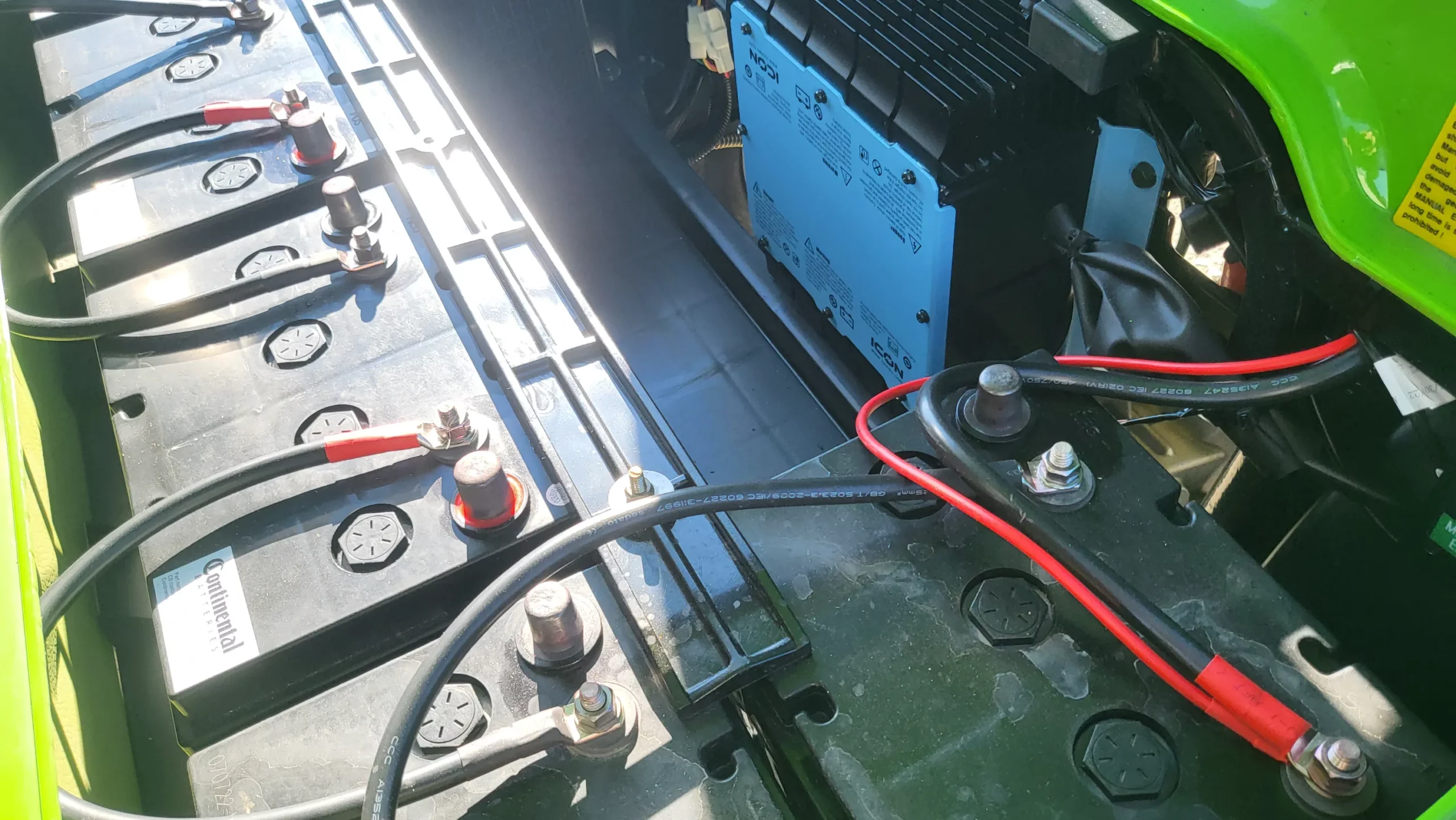
There is also a jumper-cable question that many carts get wrong. On a 48V lead-acid setup, the six or eight short jumpers that link batteries in series carry the same full motor current as the main leads, so they need to be the same heavy gauge. A set of thin, tired factory jumpers is a hidden source of voltage drop even when the two big main cables look fine. When you upgrade to 4 or 2 AWG mains, replace the inter-battery jumpers to match rather than leaving the old ones in place. A useful field check is to feel each cable and lug by hand after a hard drive; any connection that is noticeably warmer than the others is shedding energy as heat and is your weak link.
Wiring tips for golf carts
Keep runs as short as practical, since voltage drop scales directly with length, so mount controllers and solenoids close to the pack. Upgrade the whole current path together rather than one cable, because the weakest link sets the limit. And when you size a controller, match the cable to it; the controller amp calculator suggests a matching cable gauge for your target current. If your cart already lost power and you suspect a cable, a voltage drop test under load will find the bad section, as our battery cable voltage drop test guide explains.
Termination technique matters as much as gauge on these high-current DC runs. A proper hydraulic crimp on a tinned copper lug gives a gas-tight, low-resistance joint; a loose mechanical clamp or a poorly soldered lug will heat, oxidize, and slowly increase resistance over months until the cart mysteriously loses pep again. Slide adhesive-lined heat shrink over each finished lug to seal out moisture, since corrosion creeping under the insulation is the usual reason a cable that tested fine last year now fails a voltage-drop test. Torque the terminal hardware to spec and re-check it after the first few weeks, because copper relaxes slightly and a connection that was snug can loosen just enough to matter.
Bottom line on cable size
For most 48V carts, 6, 4, or 2 AWG pure copper handles the main battery and motor cables well, and high-amp performance builds step up to 1/0 or larger. The right number for your cart depends on how much current you draw and how long the run is, so let the calculator confirm it rather than guessing. Spend the money on pure copper and proper terminals, keep the runs short, and you will get more of your battery energy to the wheels, run cooler, and avoid the slow, hot, mysterious power loss that undersized cabling causes.
Frequently Asked Questions
What gauge battery cable for a 48V golf cart?
Most 48V carts use 6, 4, or 2 AWG copper for the main battery and motor cables, and high-amp builds move to 1/0 or larger. The correct size depends on the current and the cable length, so use the wire gauge calculator to keep voltage drop at or under 3 percent.
Can I use welding cable for golf cart battery cables?
Yes, and many builders prefer it. Welding cable is pure copper made of very fine strands, so it is flexible and easy to route, and at the same AWG it carries current identically to standard battery cable. Confirm it is genuine copper rather than copper-clad aluminum, and use crimp lugs sized for the fine-strand count so the crimp stays gas-tight.
Does thicker battery cable make a golf cart faster?
It will not raise top speed on its own, but if your existing cable is undersized or corroded, upgrading it removes voltage drop and recovers lost torque and responsiveness. The cart feels stronger because more battery voltage actually reaches the controller and motor.
How do I know if a golf cart cable is undersized?
Feel each cable and lug by hand right after a hard drive. Any connection noticeably warmer than the others is shedding energy as heat and is your weak link. For a precise answer, run a voltage-drop test under load, or compare your gauge and run length against the chart and the wire gauge calculator.