Alltrax vs Navitas vs Curtis: Best Controller (2026)
Three controllers, three priorities: Navitas for app-tunable performance, Alltrax for rugged set-and-forget value, Curtis for OEM-level AC replacement. Verified model numbers and specs, not marketing copy.
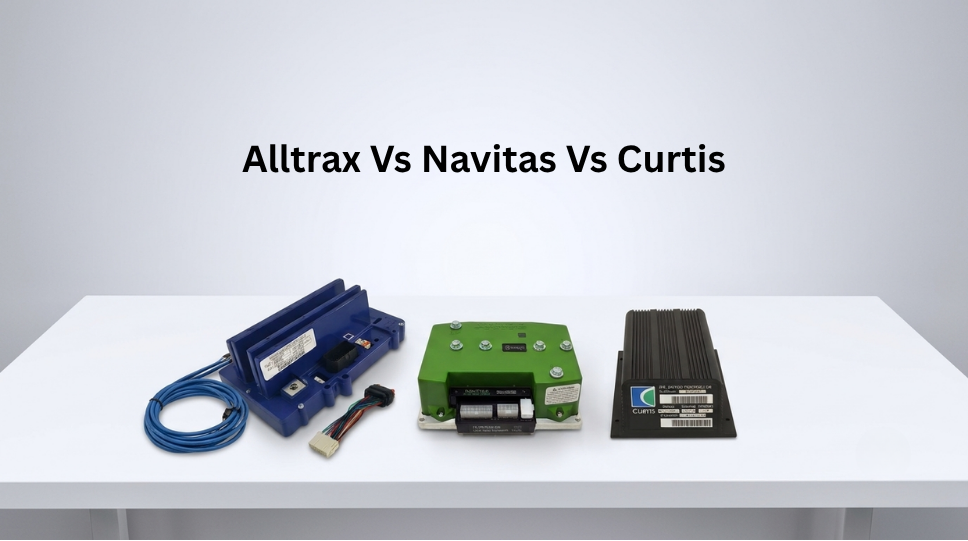
- Navitas TSX3.0 is verified up to 600A with Bluetooth app tuning and OTF programmer support, the feature leader for tuners.
- Alltrax XCT spans three verified models (XCT48300, XCT48400, XCT48500) at 300 to 570A peak, USB-programmed, the rugged value pick.
- Curtis 1236/1238 is OEM-level AC hardware spanning 24 to 80V systems, built to restore factory performance, not exceed it.
- Whichever controller you choose, budget another $100 to $250 for a matching solenoid and heavier cables, the supporting parts decide whether the upgrade lasts.
Alltrax, Navitas, and Curtis are the three controllers every golf cart owner weighs when upgrading drive performance. This guide compares verified model numbers, voltage ranges, current ratings, and programming interfaces, not just marketing claims, so you can pick the right one for how you actually use your cart.
01. The Three Controllers at a Glance
These are the three names every cart owner weighs, but they aren’t one universal plug-in choice. Navitas TSX3.0 is a fully programmable separately-excited DC controller line with Bluetooth app support, optional OTF programmer support, 36 to 48V and 48 to 72V variants, and up to 600A motor current. Alltrax XCT is a shunt or regen controller line for carts such as E-Z-GO DCS/PDS/TXT-48, Club Car IQ/Precedent/i2, and Yamaha G19/G22/YDRE, with XCT48300, XCT48400, and XCT48500 models. Curtis 1236/1238 is an AC induction controller family used more like OEM/dealer-level AC drive hardware, with 24 to 80V model ranges and 2-minute RMS current ratings from 300A to 650A depending on exact model.
The choice is less “which brand is strongest” and more “which controller family matches my motor, harness, battery voltage, and tuning goal.” A series-wound cart may need an Alltrax SR or another series controller instead of XCT. A late AC cart such as an RXV often needs an AC-specific Curtis, a Navitas TAC-style kit, or a vehicle-specific conversion rather than a DC shunt controller.
Compatibility is where the choice narrows fast. Match the cart model, motor type, throttle input, connector harness, solenoid rating, cable gauge, and battery chemistry before comparing amp numbers. The controller only performs as well as the contactor, wiring, motor, and battery pack feeding it.
02. Alltrax vs Navitas vs Curtis: How They Compare
| Controller Line | Verified Voltage & Current | Programming Interface | Best Fit |
|---|---|---|---|
| Navitas TSX3.0 | 36-48V and 48-72V variants. Part 10-000685 = 600A 36-48V Bluetooth controller. Up to 600A motor current, up to 50A peak field current. | Bluetooth app, Dashboard app, optional PC Probit II, optional OTF programmer | Owners who want app tuning, variable regen, speed limits, and diagnostics |
| Alltrax XCT | XCT48300: 300A peak/125A cont. XCT48400: 400A peak (460A peak mode)/175A cont. XCT48500: 500A peak (570A peak mode)/250A cont. 24-48V nominal, 62V max. | USB A-to-B with Alltrax Toolkit; optional FN programming box | Strong, simple shunt or regen upgrades on compatible DC carts |
| Curtis 1236/1238 AC | 24-80V battery systems. 1236: 300-500A 2-min RMS. 1238: 450/550/600/650A 2-min RMS depending on voltage suffix. | Curtis 1311 handheld programmer or 1314 PC Programming Station, VCL support | OEM-style AC drive systems, dealer service, custom AC builds |
The performance gap between a quality Alltrax and a Navitas can be smaller than the feature gap when both are matched correctly. What you’re really choosing between is Navitas app control and richer tuning, Alltrax USB simplicity and published current tables, or Curtis OEM-style AC control and service tooling. Don’t compare a 600A TSX, a 500A XCT, and a 650A Curtis 1238 as if the amp number alone decides the winner, motor type, voltage range, continuous rating, thermal behavior, and the tuning tool matter just as much.
03. What Owners Actually Say
Owner consensus tracks the verdict: tuners and performance seekers gravitate to Navitas and enjoy dialing it in, accepting occasional setup quirks; owners who want a strong, trouble-free upgrade pick Alltrax and rarely think about it again; and owners simply fixing a factory cart replace their Curtis like-for-like. The one universal piece of advice on the Cartaholics forum is to pair any high-amp controller with an upgraded solenoid, cables, and a capable battery, the controller choice matters less than building a balanced system.
A few model-specific notes come up repeatedly in owner threads. Navitas owners on lithium carts praise the on-the-fly Bluetooth tuning for letting them soften throttle response for a new driver and then unlock full power later, but they also warn that initial pairing and programming can be finicky the first time. Alltrax owners on 48V EZGO TXT and Club Car DS carts most often report simply installing the XCT, setting the current limit, and never touching it again, which is exactly the appeal. Curtis buyers, meanwhile, tend to be owners restoring an OEM PDS or Regen cart who want the factory throttle feel back rather than a performance jump, and for that narrow goal the like-for-like Curtis is the least fuss.
04. Which Controller Should You Buy?
Buy Navitas if you want the most performance and tunability and will run lithium. Buy Alltrax if you want reliable value and simplicity. Buy Curtis if you just need a dependable OEM replacement. For most upgraders, it comes down to Navitas vs Alltrax, features vs simplicity. Whichever brand you lean toward, see which of them fits your cart before you choose.
Read the full individual takes in our Navitas review, Alltrax review, and Curtis review, and see the measured numbers in the dyno comparison.
Parts note: We stock Navitas and the Alltrax AC1 line. AC1 is an AC system and is not the XCT DC controller compared in the verdict. See the Alltrax AC1 TXT kit
05. Budget for the Whole System, Not Just the Controller
Whichever controller you choose, the smartest money decision is to treat it as one part of a package. A 500 to 600A controller pulling through a stock solenoid and thin factory cables will simply overheat the weakest component first, owners who skip this step often melt a solenoid or burn a connector within weeks. Plan to add a heavy-duty solenoid (a 400A-class contactor such as the Albright SW180B is the common pick), upgrade your main cables to 4-gauge or larger, and, where possible, feed it all with a lithium pack that can deliver sustained current without sagging.
In practical terms, that means budgeting another $100 to $250 on top of the controller for the solenoid and cables, and ideally pairing the build with the battery upgrade many owners do at the same time. Spend that way and any of the three controllers will reward you with a transformed, durable cart; cut that corner and even the best controller becomes the thing that exposes, and breaks, your weakest link.
Navitas = max performance and app tuning. Alltrax = reliable value, set-and-forget. Curtis = dependable OEM replacement. Most upgraders choose between Navitas and Alltrax, and should build a balanced system around whichever they pick.
Frequently Asked Questions
Which is better, Alltrax or Navitas?
Navitas wins on tunability and features (Bluetooth app, regen, variable settings) while Alltrax wins on simplicity and reliable value. Most performance-minded owners choose based on whether they want to tune (Navitas) or set-and-forget (Alltrax).
Is a Curtis controller a real upgrade?
Not typically. Curtis 1236/1238 AC controllers are OEM-level, dealer-service hardware built to restore factory performance rather than exceed it. Choose Curtis when you want a dependable factory-spec replacement, not a performance jump.
Do I need more than just a controller upgrade?
Yes. A 500 to 600 amp controller pulling through a stock solenoid and thin factory cables will overheat the weakest component first. Budget for a heavy-duty solenoid and heavier gauge cables alongside any controller upgrade.